


Israel's international image has deteriorated significantly and confidence in Prime Minister Benjamin Netanyahu has fallen across much of the world, including in several of Israel's closest allies, a sweeping new global survey by the Pew Research Center released Thursday suggests.
The survey polled 44,657 respondents in 36 countries and is one of the largest international studies conducted since the war with Iran. It found that 67% of adults surveyed hold an unfavorable view of Israel, compared with 25% who view the country favorably.
Gallery

Prime Minister Benjamin Netanyahu, US President Donald Trump
(Photo: ATTA KENARE / AFP, JOE RAEDLE / AFP, Anna Moneymaker AFP)
The findings come amid growing international scrutiny of Israel's military campaigns and diplomatic standing. They also lend statistical weight to concerns voiced privately and publicly by U.S. President Donald Trump, whose tense relationship with Netanyahu has increasingly spilled into public view.
According to Pew, negative views of Israel increased in 13 of the 24 countries where the organization has tracked opinion trends over time.
Some of the sharpest deteriorations were recorded in countries not traditionally considered hostile to Israel. Negative views rose by 10 percentage points in South Korea, 9 points in Germany, Argentina and Nigeria, and between 5 and 8 points in countries including Poland, Australia and Canada.
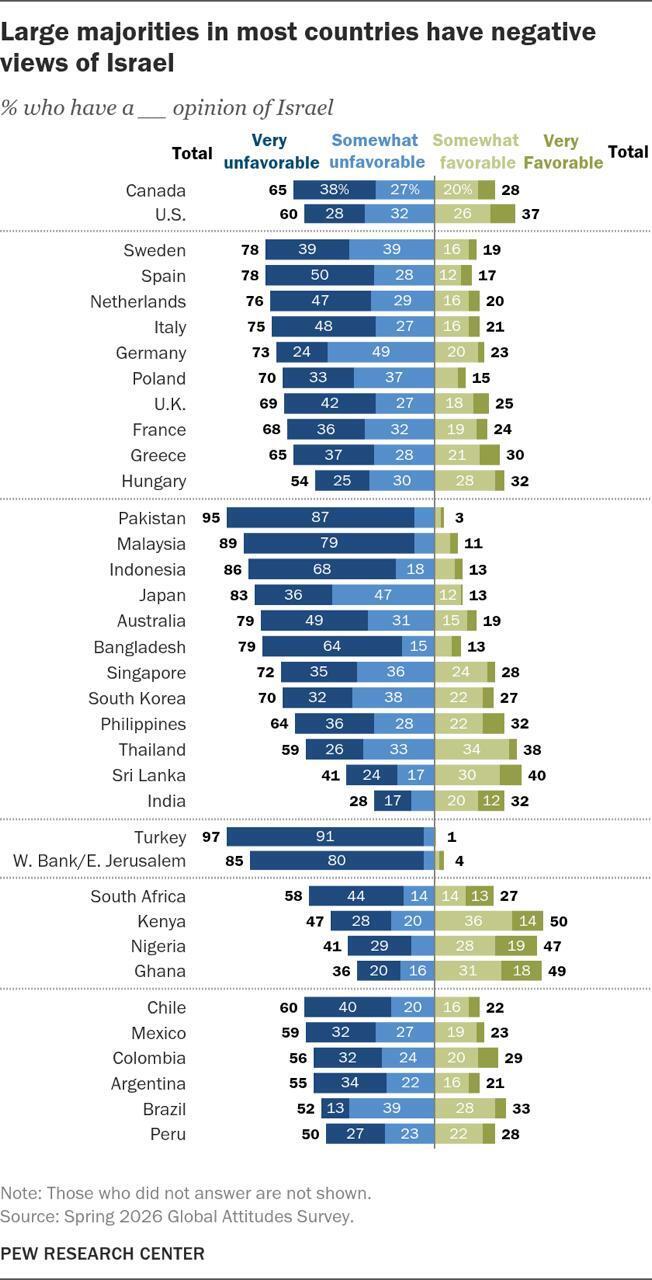
Across Europe, attitudes toward Israel were overwhelmingly negative. Italy, the Netherlands and Spain stood out, with roughly half or more of respondents expressing a "very unfavorable" opinion of Israel.
The survey also found growing skepticism in countries that have long been among Israel's closest partners.
In the United States, unfavorable views of Israel rose by 7 percentage points compared with last year. In Britain, negative views increased by 8 points.

Viktor Orbán and Netanyahu
(Photo: Attila KISBENEDEK / AFP)
Even in Hungary, where former prime minister Viktor Orbán has been one of Netanyahu's strongest political allies in Europe, public opinion was markedly less favorable. Fifty-four percent of Hungarians surveyed held a negative view of Israel, compared with 32% who viewed it positively.
The generational divide was especially pronounced. Among Hungarians ages 18 to 34, 72% held unfavorable views of Israel, compared with 45% among those 50 and older.
The survey found similar age gaps across many Western countries, particularly in North America and Europe.
In the United States, 74% of adults ages 18 to 34 expressed unfavorable views of Israel, compared with 49% among respondents aged 50 and older.
Pew also found sharp ideological divides, especially in Western democracies.
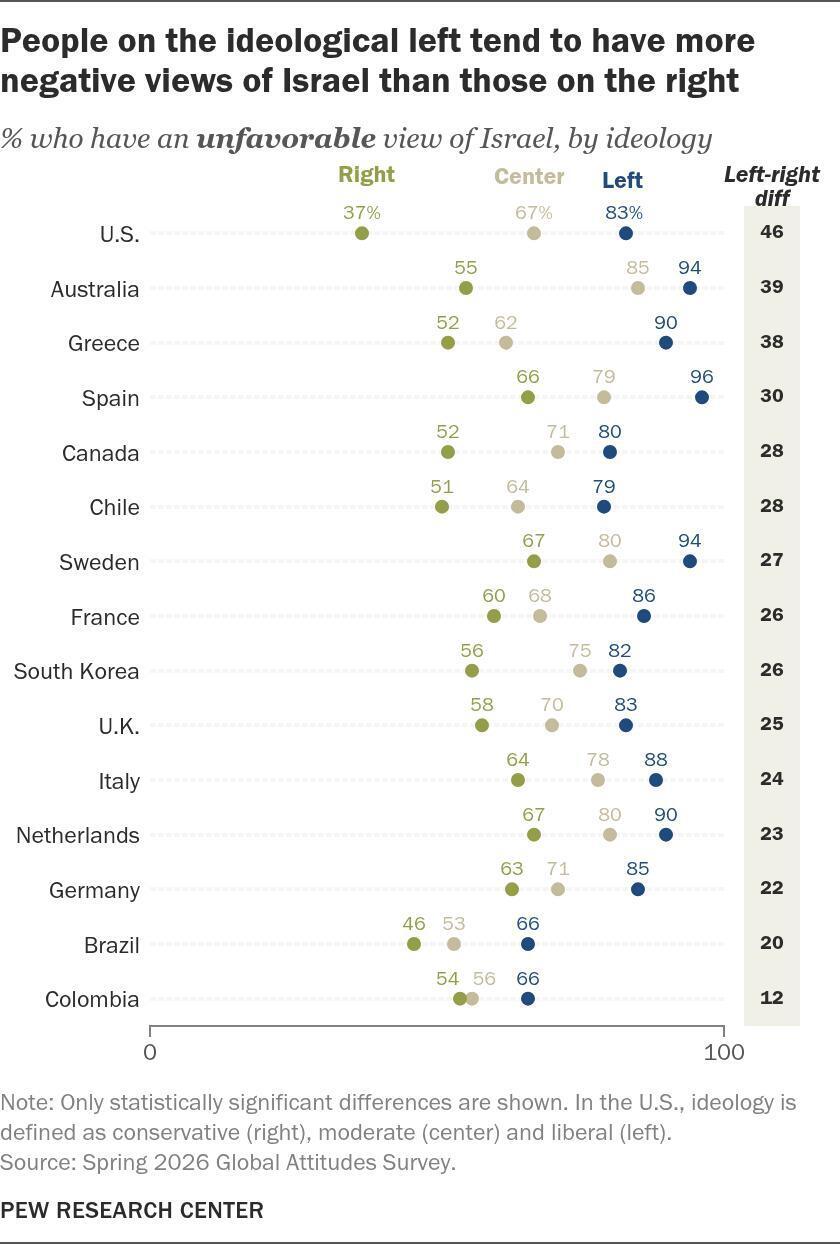
In the United States, 83% of self-described liberals held unfavorable views of Israel, compared with 37% of conservatives. Similar patterns emerged in Australia, Greece, Italy, the Netherlands, Spain and Sweden, where roughly nine in 10 respondents identifying with the political left expressed negative views of Israel.
In several of those countries, the gap between left- and right-leaning respondents exceeded 23 percentage points.
Among all 36 countries surveyed, none recorded a majority with a favorable view of Israel.
The strongest support came from parts of Africa. In Kenya, 50% of respondents viewed Israel positively, while in Ghana the figure was 49%. Nigeria remained one of the few countries where positive views still outnumbered negative ones, despite a decline in support.
Greece was the only country in Pew's long-term tracking data where Israel's favorability rating improved slightly over the past year, though only 30% of Greeks surveyed viewed Israel positively.
The findings on Netanyahu were even more troubling for the Israeli leader.
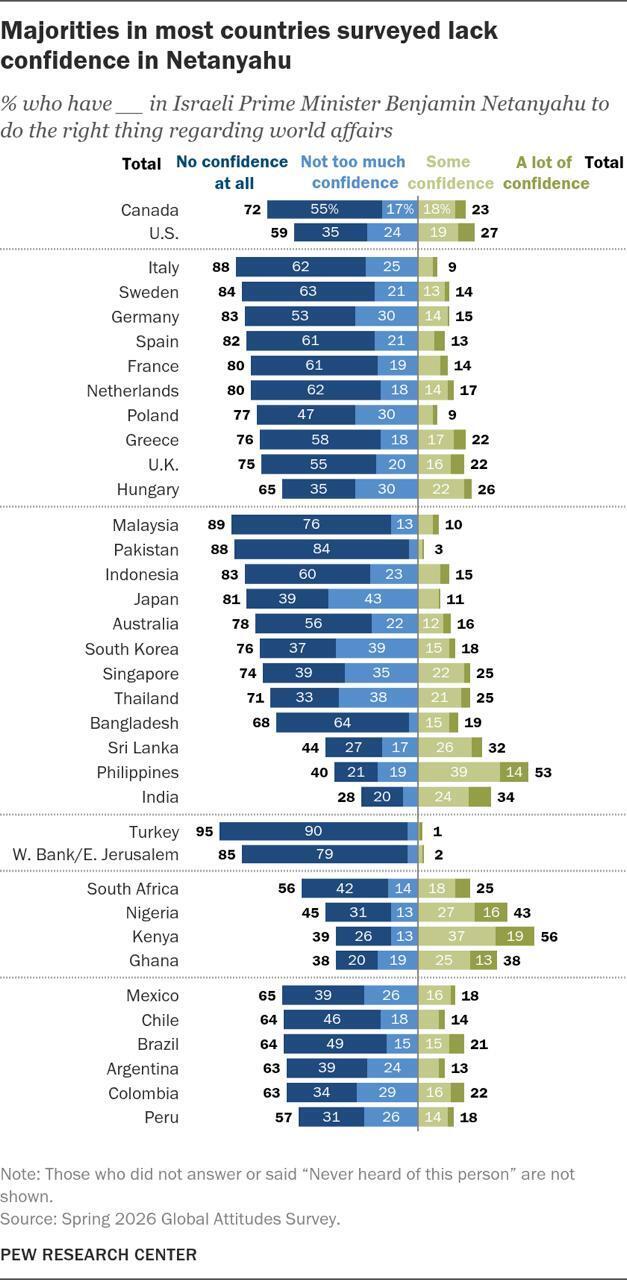
Asked whether they had confidence in Netanyahu "to do the right thing regarding world affairs," majorities in most countries said they had little or no confidence in him.
In the United States, 59% said they did not trust Netanyahu, compared with 27% who expressed confidence in him.
Among American Jews, the survey revealed a distinction between attitudes toward Israel and attitudes toward its prime minister. While 64% held favorable views of Israel, 56% said they had little or no confidence in Netanyahu.
Across Europe, distrust of Netanyahu was widespread.
More than half of respondents in countries including France, Germany, Britain, Sweden, Spain and the Netherlands said they had no confidence in the Israeli prime minister.
Italy recorded the highest level of distrust, with 88% saying they lacked confidence in Netanyahu.
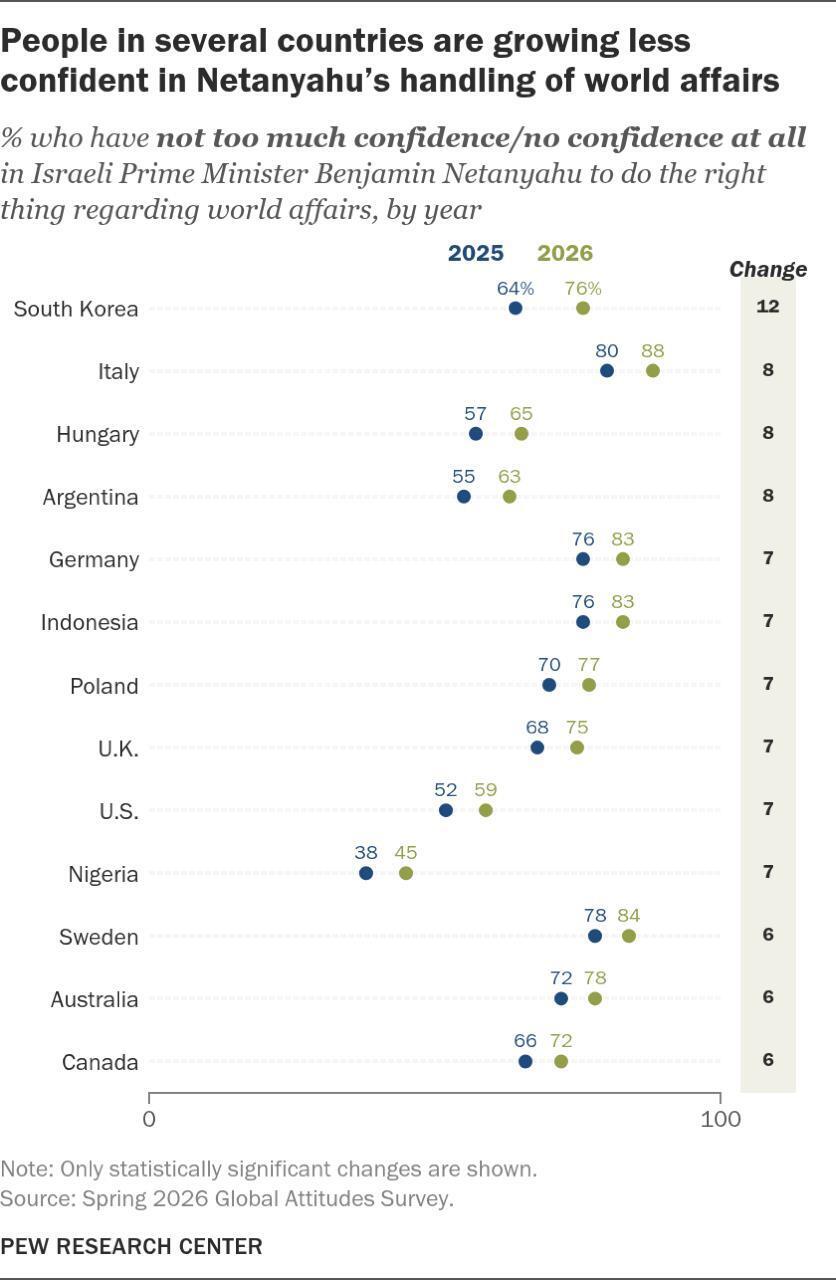
South Korea saw the sharpest deterioration, with the share expressing little or no confidence in Netanyahu rising from 64% last year to 76% this year.
Netanyahu continued to enjoy majority confidence in only two countries surveyed: Kenya, where 56% expressed confidence in him, and the Philippines, where 53% did.
The Philippines presented a notable exception in the data. Although a majority of Filipinos held unfavorable views of Israel, a majority still expressed confidence in Netanyahu personally.
Pew researchers said ideological differences remain one of the strongest predictors of attitudes toward Israel in wealthier countries, where left-leaning respondents consistently express more negative views than conservatives. In lower- and middle-income countries, the pattern was less consistent.