

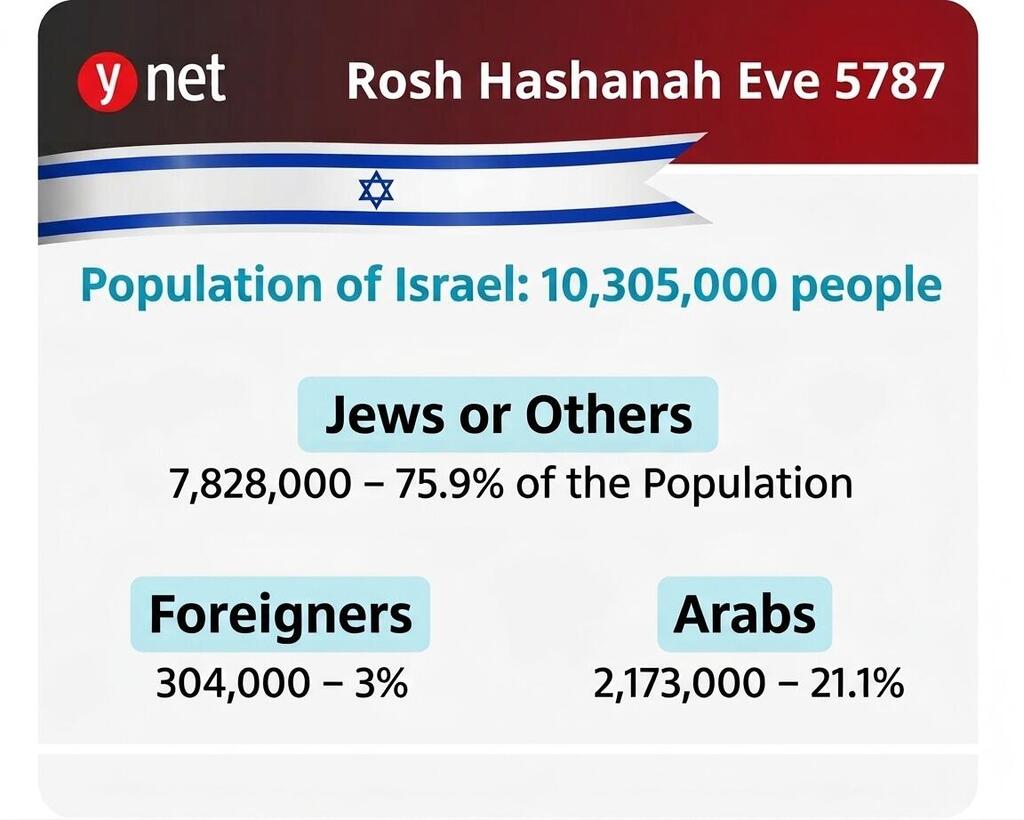
On the eve of Rosh Hashanah 5787, Israel's population is estimated at some 10.305 million people, according to figures released Wednesday by the Central Bureau of Statistics (CBS).
Data show that some 7.828 million residents are Jewish or classified as "other" — including non-Arab Christians, members of other religions and people without a religious classification in the Population Registry. They account for 78.3% of the population. Some 2.173 million residents are Arab, accounting for 21.7% of the population. In addition, some 304,000 foreign nationals live in Israel and are included in the overall population count. In other words, for the first time, the number of Israeli citizens has surpassed 10 million.

The CBS data also show that since last Rosh Hashanah, Israel's population has grown by about 124,000 people, an increase of 1.2%. Over the past year, some 182,000 babies were born in Israel and about 50,000 people died.
At the same time, the international migration balance was negative, reducing the Israeli population by about 8,000 people. A breakdown of the migration balance for 5786 shows that over the past year, some 24,000 new immigrants arrived in Israel and another 4,000 people came through family reunification. In addition, about 21,000 Israelis who had previously emigrated abroad returned to Israel, while some 57,000 Israelis left the country to emigrate abroad during the year.
However, when looking at the Gregorian calendar year, the data show that 69,500 Israelis left the country to emigrate abroad in 2025, compared with 82,800 in 2024. The number of returning Israelis also declined. Last year, 18,800 Israelis returned to Israel from abroad, compared with 24,200 in 2024. As noted, the CBS published data for both the Hebrew year 5786 and the Gregorian year 2025.
How do Jews define themselves? Some 39.6% say they are not religious — secular, 21.8% identify as traditional or not very religious, 14% as traditional-religious, 12.4% as religious and 11.5% as Haredi.
The data also show that last year, 75.2% of the population lived within municipal boundaries. Another 13.7% lived within local council jurisdictions, 10.4% lived in regional councils and 0.8% lived in communities without municipal status.
Life expectancy — and satisfaction with life
Life expectancy in Israel is 81.4 years for men and 85.9 years for women. In an international comparison for 2024, life expectancy for men in Israel was higher than the OECD average of 78.7 years. Israel ranked seventh, with men's life expectancy matching that of men in Australia, Iceland and Japan. The highest life expectancy for men was recorded in Switzerland, at 82.4 years, while the lowest was in Latvia, at 71.4 years.
Life expectancy for women in Israel was also higher than the OECD average of 83.8 years. Israel ranked eighth, with women's life expectancy similar to that of women in Luxembourg and Sweden. The highest life expectancy for women was recorded in Japan, at 87.1 years, while the lowest was in Mexico, at 78.9 years.
What is the education level of Israelis? The data show that 0.9% of Israelis ages 25 to 66 hold a doctoral degree, 12.6% hold a master's degree and 21.9% hold a bachelor's degree. Another 7.6% hold a nonacademic postsecondary certificate, 14.2% completed high school with a matriculation certificate but did not pursue postsecondary education, 4.5% completed high school — 12 years of schooling — but it is not known whether they hold a matriculation certificate, 22% hold a high school completion certificate without a matriculation certificate, 12.8% hold a certificate for completing middle school or elementary school and 0.9% of Israelis have less than an elementary school education.
The CBS also examined satisfaction with life and financial circumstances, as well as expectations for the future. The data show that 92.2% of Israelis are satisfied with their lives — including 92.6% of Jews and 90.6% of Arabs. Some 70.2% are satisfied with their financial situation — 71.6% of Jews and 64.6% of Arabs — while 29.4% are dissatisfied with their financial situation.
Some 53.8% believe their financial situation will improve in the coming years, 29.2% believe it will remain unchanged and 9.9% expect it to worsen.
Regarding satisfaction with housing and the area where they live, 89.2% are satisfied with their home, 85% are generally satisfied with their neighborhood or area of residence, 58.8% are satisfied with cleanliness in their area and only 39.3% are satisfied with public transportation in their area.
The CBS also examined feelings of poverty and the sacrifices people make because of financial difficulties. Some 5.7% said they felt poor over the past year — 3.9% of Jews and 12.8% of Arabs. Some 23.4%, or about 1.5 million people, have difficulty covering all of their household's monthly expenses, while 4.8% cannot cover all of their monthly expenses at all.
Some 6.8% said they had gone without food over the past year because of financial difficulties — including 11% of Arabs and 9.5% of Haredim. Another 4.8% had gone without a hot meal at least once every two days, including 10.1% of Arabs. Of those who needed medical treatment, 10.1% went without it. Some 6.7% of those who needed prescription medication went without it, while 24% of those who needed dental care went without it.
The CBS also collected data on feelings of stress, loneliness and discrimination. Some 26.3% said they always or frequently feel stressed, 20.7% said they frequently or occasionally feel lonely and 23% said they had experienced some form of discrimination over the past year.