


Jordan has become increasingly central to U.S. military operations against Iran, leaving the kingdom exposed to a growing wave of Iranian attacks and fueling anger toward Tehran.
“There are feelings of anger and hostility toward the Iranians because sensitive sites in Jordan are being attacked,” a Jordanian source told ynet on Sunday after Iran fired four missiles toward Aqaba, across from Eilat.
Interceptions over Aqaba seen from Eilat


“The airport and seaport are operating normally. Life in Jordan is continuing completely as usual,” the source added.
Jordan’s Foreign Ministry said it summoned a representative of the Iranian Embassy to protest the continued attacks on the kingdom and statements issued by Iranian officials about Jordan.
In recent days, Iran’s Revolutionary Guard Corps has also sought to turn the Jordanian public against the government and U.S. forces stationed in the country.
“The American military, whose blood may be shed and which is responsible for the deaths of hundreds of thousands of Muslims in Afghanistan and Iraq, as well as thousands in Iran, Yemen, Lebanon, Libya, Sudan, the Philippines and Palestine, is now within your reach,” an Iranian message addressed to Jordanians said Saturday.
“It is your religious and humanitarian duty to eliminate it by every means and cleanse Jordanian soil of the killers of Muslims.”
Iran has stepped up its attacks on Jordan as the kingdom takes on a larger role in U.S. military operations, experts told The New York Times.
Jordan hosts several American bases and has cooperated with Washington for years in military affairs, intelligence and counterterrorism.
Iranian missiles launched toward Jordan
U.S. officials told the newspaper that Washington increasingly relied on Jordan before the war with Iran and during its opening days, as the Pentagon moved forces from Gulf states including Bahrain, the United Arab Emirates and Qatar to locations considered safer, among them Jordan and Israel.
After countries across the region came under attack, some limited Washington’s ability to station forces and aircraft on their territory, prompting an expansion of U.S. activity in Jordan.
Unlike the wealthy Gulf states, Jordan depends more heavily on American assistance and is not in a position to easily reject Washington’s requests.
An Iran expert at a Washington research institute told The Times that Gulf countries, including Saudi Arabia, had become even more reluctant to allow the United States to make extensive use of their bases for attacks on Iran.
“But Jordan, because of its security agreement with the United States and the relationship between the two, in which Washington holds the dominant position, is not in a position where it can say no,” the expert said.
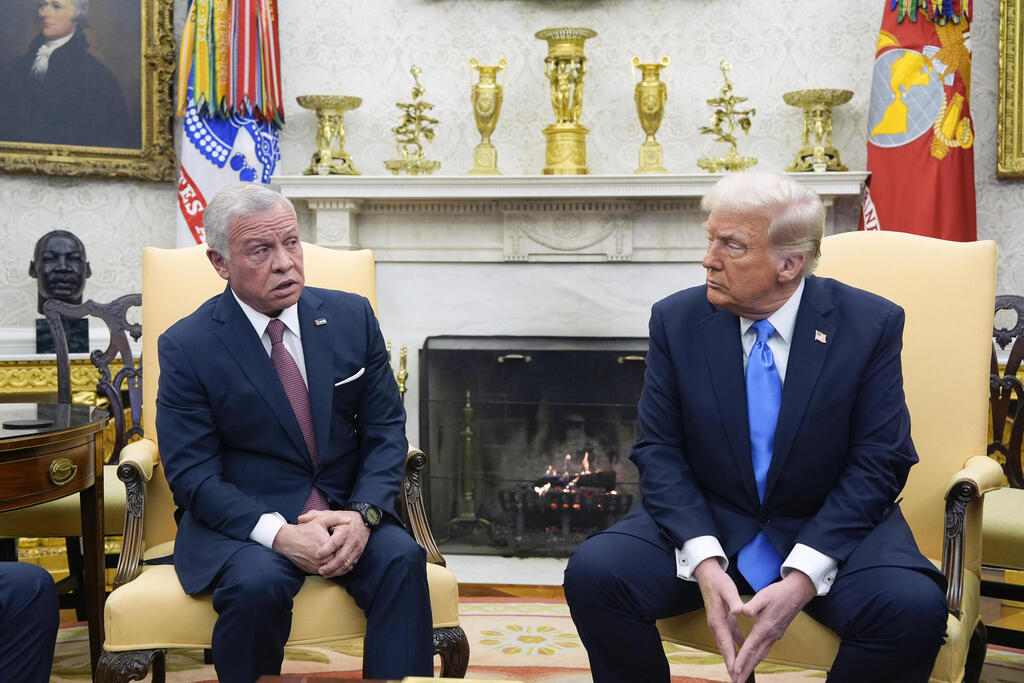
Jordan’s King Abdullah II meets with US President Donald Trump in the White House
(Photo: AP/Alex Brandon)
Two U.S. service members were killed Friday in an Iranian attack on Jordan, while another was listed as missing. It was the fourth attack in a week against American forces in the kingdom, leaving dozens wounded and damaging several helicopters.
The first strike hit a residential compound at King Faisal Air Base and wounded up to five U.S. troops. A second attack struck a base in eastern Jordan used by American Black Hawk helicopters and damaged a significant number of them.
Iranian missiles later struck Muwaffaq Salti Air Base near Zarqa. About 20 U.S. troops were injured while rushing to shelters in that attack, though no one was killed.
Iran struck the same base again Friday, killing two U.S. service members and wounding four others. Additional personnel were examined for minor injuries and later returned to duty.
The U.S. military has operated from Jordanian air bases for years. A recent congressional report said nearly 4,000 American troops are stationed in the country.
According to The New York Times, U.S. economic and military assistance to Jordan, which began in the 1950s, has tripled over the past 15 years. In 2025, the United States provided Jordan with approximately $33.8 billion.