


Religious Zionist Party leader and Finance Minister Bezalel Smotrich takes pride in a term in which he says he transformed the reality in the West Bank and stabilized Israel’s economy despite a costly, prolonged war. But polls suggest the public has been less impressed by those achievements, with his party hovering around the electoral threshold until it joined forces with Moshe Feiglin. Meanwhile, his partner and rival, Itamar Ben-Gvir, has cemented his position as a leading figure among party leaders to the right of Prime Minister Benjamin Netanyahu’s Likud.
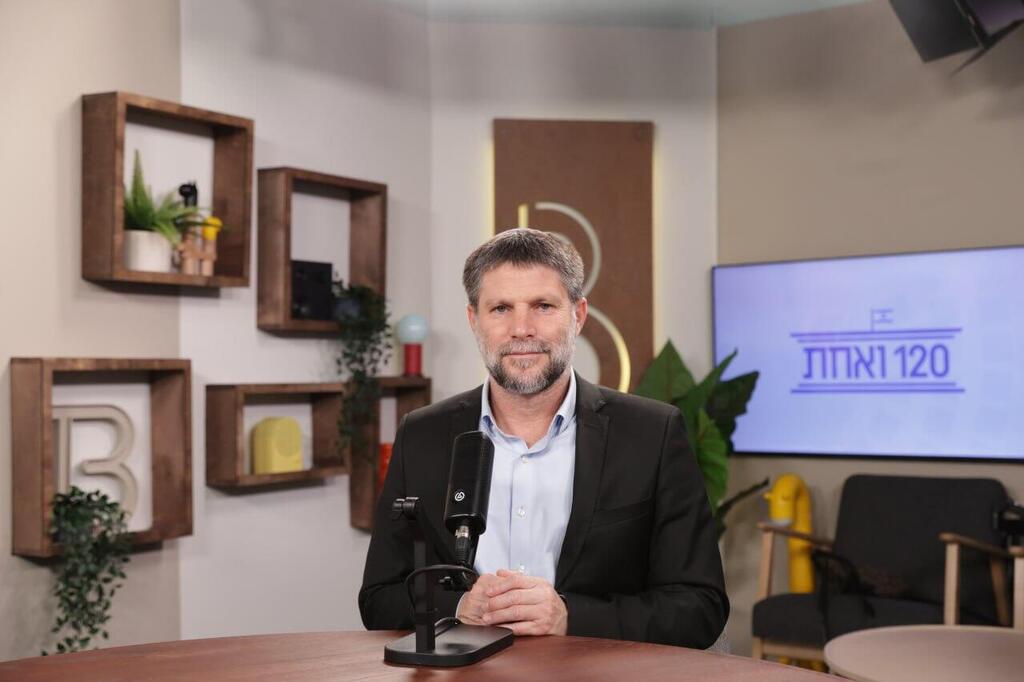
Smotrich appeared on ynet's Hebrew-language political podcast “120 and One” to discuss Ofer Winter, a former senior military officer and new entrant to right-wing politics, as well as the drastic steps Smotrich believes Israel should take in the West Bank.
With about a month remaining until the election, polls point to a political configuration in which neither bloc is able to assemble a coalition of more than 60 seats in the 120-member Knesset. Even in that scenario, Smotrich said he would not be interested in a government bringing the two camps together.
“I don’t turn my back on my partners,” he said. “I will not be a fig leaf in a government that engineers public consciousness and calls it unity. I am part of the national camp, which shares a broad common denominator of Jewish identity, Zionism, love of the land, settlement and a particular security outlook. Anyone who identifies with that set of values is, of course, welcome to join.”
Smotrich also explained his longstanding opposition to including Ra’am, an Arab Islamist party led by Mansour Abbas, in a governing coalition, despite Abbas’ repeated public opposition to violence and his acknowledgment of Israel as a Jewish state.
“I did a doctorate on the Islamic Movement,” Smotrich said. “This is the method of ‘taqiyya,’ concealment, in which you hide your real objective and accumulate power through legitimate civilian activities — education, welfare, culture, health. And once you accumulate that power, you use it to achieve the objective, which is the destruction of the State of Israel.”
After the 2021 election, when Netanyahu called you and tried to persuade you to form a government with Abbas, what did you tell him?
“That he was wasting his time. If you remember, I posted that it simply wasn’t going to happen.”
But what did you make of Netanyahu wanting Abbas as part of the coalition?
“I tried to understand it. We are a people that seeks peace, and when an Arab leader comes along and says these things, we are tempted. It is a dream for all of us. We would all like the wolf to dwell with the lamb. But unfortunately, that is not the situation.”
There is a new player in the political system, Ofer Winter, and there is a debate over whether his party will cross the electoral threshold. What worries you more: that he will waste votes by failing to cross the threshold, or that he will make it into the Knesset and join a coalition with the other bloc?
“Winter is a highly accomplished officer, a good and worthy man. I very much wanted him to come with us. But in my view, he embarked on an irresponsible course. There is a 99.9% chance he will not cross the electoral threshold. Anyone who votes for him is throwing their vote in the trash, and that is what will bring the left to power, establish a Palestinian state and harm Israel’s Jewish identity. It endangers the country and would be a disaster for security. They will evacuate the communities and farms we established [in the West Bank]. They say so themselves.”
Are you calling on Winter to withdraw from the race?
“Unfortunately, I don’t think he is listening. So I am telling the people of Israel: Understand what is at stake. You don’t gamble with Israel’s security and our future. I worked very hard before the candidate lists closed to get all the parties to the right of Likud to run together. I wanted to run with Ben-Gvir and Winter not because we think alike — it would have been a technical bloc, and we would have gone our separate ways the next day.”
Throughout your political career, you have strongly opposed including Arab parties in a governing coalition. What do you think of the idea of Winter’s No. 2, Yoseph Haddad, serving as a Cabinet minister?
“I have no problem with that. We are not against Zionist Arabs. What, do we have a problem with the Druze? They are our brothers.”

Ofer Winter and Yoseph Haddad
(Photo: Shalev Shalom)
Let’s talk about the style of your campaign. The Religious Zionist Party recently released a video showing Attorney General Gali Baharav-Miara being dragged away during a demonstration. It is a video that encourages violence and is meant to hit viewers in the gut.
“Absolutely not. What is happening is that Israel’s judicial system, [Supreme Court Chief Justice] Yitzhak Amit and Gali Baharav-Miara, are constantly blocking the right. They block decisions, block policy, block appointments. Roads are blocked here every day. We didn’t clear her away with batons or a water cannon, the way they do here to the ultra-Orthodox every other day. The video was meant to be a punch in the gut because there is a punch in the gut here.”
'Like what you did in Gaza'
Smotrich warns of a security threat if the right-wing bloc does not win the election, although Israel suffered the worst security failure in its history under a fully right-wing government.
“That’s true. The greatest disaster happened on our watch,” he said. “But since then, we managed to recover and wage war on all fronts with tremendous achievements. Israel’s security situation is incomparably better now. The prime minister says, ‘We changed the Middle East,’ and I say: No. First and foremost, we changed ourselves, our approach to warfare.
“By the way, I would like us to annex at least as far as the yellow line in Gaza and as far as the Litani River in Lebanon, because a war that ends along the same lines where it began will not prevent the enemy from going to war again next time.”
Did the fact that some of the hostages returned without being alive keep you awake at night?
“During the war, we as leaders were required to make difficult, heartbreaking decisions. I will carry those decisions with me until my last day. I sit in the Cabinet and send my two sons to war. Both have fought on the ground in Gaza, Lebanon and Syria. One was seriously wounded. Ron Dermer’s son also fought, and of course there was Gadi Eisenkot’s son, who was killed. We understand the significance of the decisions we make. I faced vicious, toxic campaigns that tried to portray me as someone who didn’t care about the hostages.”
When you examine your own actions surrounding Oct. 7, do you tell yourself, “I also bear responsibility”?
“Of course I bear collective responsibility. I was a minister in the government on whose watch this happened. I will carry that responsibility with me to the grave. It weighs on my shoulders. And I have worked very hard over the past three years to live up to that responsibility.”
If I take you back several months before the massacre, is there anything you would have done differently?
“Maybe I would have turned the table over. The essence of the conception was, ‘We need quiet. We must not inflame the situation.’ After the brothers Hallel and Yagel Yaniv were murdered in Huwara, I told the prime minister that the minimum Zionist response was to allow the group to return to Evyatar.”
The Yaniv brothers were killed in a Palestinian terrorist attack in the West Bank town of Huwara in February 2023. Evyatar is a Jewish outpost in the northern West Bank that has been at the center of repeated disputes over Israeli settlement policy.
“A meeting was convened with the prime minister, defense minister, IDF chief of staff, Shin Bet chief, head of Military Intelligence, head of Central Command and coordinator of government activities,” Smotrich continued. “All the senior officials explained why under no circumstances could we return to Evyatar, because the Arab villages below would cause unrest, that would ignite Judea and Samaria, Judea and Samaria would ignite Gaza, Gaza would ignite Lebanon, and we needed quiet because we had to prepare for the Iranian threat,” he added, using the biblical name for the West Bank.
“So for 20 years, we had an illusion of quiet while enormous monsters were being built on our borders,” he said.
Ultimately, the disaster happened on the right’s watch, under a prime minister who has served longer than any other in Israel’s history.
“Netanyahu made many mistakes, and I always tried to minimize them. But I only have seven seats. If I have 30 seats, I’ll be prime minister and everything will look different.”
What grade would you give the current Israeli government on security?
“From the moment we recovered after Oct. 7 — a very, very high grade. I don’t know any leader who could have withstood the enormous pressures we faced — domestically, from the hostage campaign, which contains a valid point but went to very dangerous places, and externally from the Biden administration.”
Even now, a series of senior military officers and security officials are warning that the situation in Judea and Samaria is on the verge of exploding because of settler violence and other factors. What do you say to them?
“When they came to the Cabinet and said that, I said, ‘So what do you want? Tell us what to do. You’re the military.’ Let the chief of staff say what he proposes. I don’t understand these meaningless warnings. It’s a little like covering your ass. Your job isn’t to issue warnings. Intelligence needs to provide warnings, and you, as the military, need to bring solutions.
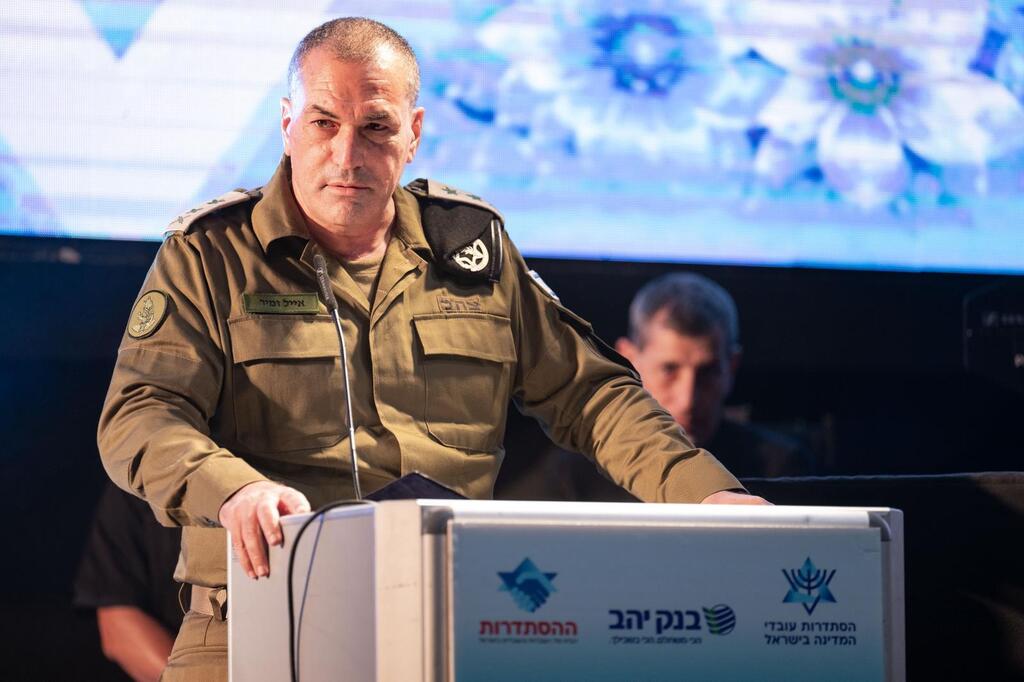
IDF Chief of Staff Lt. Gen. Eyal Zamir
(Photo: IDF)
“I certainly have solutions. I think we need to go to war in Judea and Samaria. Do there what we did in Gaza. Dismantle the Palestinian Authority, which is a terrorist authority.”
What does going to war mean?
“We’ve already done it. There are three refugee camps there that are empty. We evacuated the population for its protection and cleared out all the terrorism. I want to kill all the terrorists and collect all the weapons.
“That means I’m not playing make-believe. If there is a clear directive, the IDF needs to be told: Just as you dismantled Hamas in Gaza, there will be no terrorist infrastructure in Judea and Samaria — no terrorists, no weapons, no tunnels. And if vehicles are turned into weapons and used to run people over, as happened last week, then you will not drive cars on our roads.”
'Gentlemen, please become more efficient'
Smotrich may place the highest priority on security, but in his role as finance minister he has recently been clashing with the defense establishment over demands for additional defense spending.
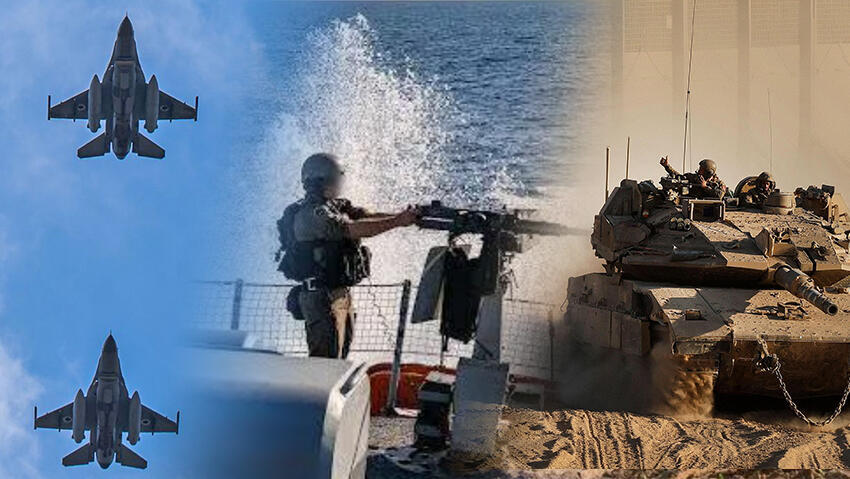
“The military is trying to portray the Finance Ministry as the one harming security,” he said. “They get the glory, and there is plenty for which they deserve credit, given the tremendous achievements in the war. But someone stood behind them and fueled those tanks, those planes, that enormous war machine.
“But there is a limit, and the defense establishment has to learn to operate within budgetary constraints because the people of Israel have other needs — health, education, welfare and culture. During the first two years of the war, we told the military: You do your job and we’ll pay. At some point, we said enough. Start becoming more efficient. Start imposing limits on yourselves. Work hard and change your operating methods.
“I want an even bigger arms buildup than the prime minister does, and I know how to finance it outside the defense budget through other investment models and economic partners. In the meantime, the military can become more efficient at the margins. And if the defense budget is 140 billion to 150 billion shekels a year, the margins amount to 5 billion. Do you know how many hospitals I can build with 5 billion shekels every year? I sat with the prime minister, and I think I managed to persuade him. I hope that in the next term, certainly if I remain at the Finance Ministry, we will change the entire approach.”
(Photo: IDF, Jack GUEZ / AFP)
You mentioned Israeli taxpayers’ money. What are the chances that surplus tax revenue will be returned to them?
“I’ve already cut income tax, and I want to cut it further. Corporate tax as well, and I think we’ll do it. How did I do it? We became more efficient, saved, made cuts, expanded efforts to combat the shadow economy and closed various loopholes, such as those involving closely held companies.”
But is there a chance that the money will actually go back to the public?
“I think we’ve already returned some of the surplus, and we need to return more.”
'Thousands of people will go to prison'
Last week, amid controversy surrounding a protest encampment near the Arab town of Majd al-Krum in northern Israel, Smotrich’s Religious Zionist Party held a faction meeting at the site and quickly publicized footage showing the extensive security presence required for the visit.
The episode has become part of an increasingly prominent election campaign debate over Israel’s Arab minority and the government’s ability to enforce the law in the Galilee and Negev regions.
“The footage illustrates the severity of the problem we face in the Galilee,” Smotrich said. “A minister or member of Knesset has to be protected like that inside the sovereign territory of the State of Israel. They don’t protect me like that in Gaza or Judea and Samaria.
“I went there because I am not prepared to accept a reality in which a foothold on land belonging to the Jewish National Fund is removed because of threats of nationalist violence. There is a nationalist incident here, and we are burying our heads in the sand like ostriches, just as we did on Oct. 6, seeking artificial quiet in the present.”
Smotrich said the Shin Bet domestic security agency had data showing more than 1 million illegal weapons in Israel’s Arab sector, including more than 1,000 machine guns, explosive charges and large numbers of fragmentation grenades.
“This is a threat to the national security of the State of Israel,” he said. “Today it is in the criminal sphere, and very quickly it crosses into nationalist violence. We are losing the Galilee and the Negev. Jewish settlement is being suffocated and shrinking as a result of decades of post-Zionist policies by the Israel Land Authority and the Planning Administration.”
Young families living in those areas have serious complaints against your government, saying it did not listen to them. Don’t you also have complaints against Shas chief Aryeh Deri and United Torah Judaism leader Yitzhak Goldknopf and the interior and housing ministries, which did nothing to fix the situation?
“I have plenty of complaints. They not only failed to help, they made things worse. I’m someone who comes to make changes. Just as I came into this term prepared to act in Judea and Samaria, I’m going to take all those capabilities to the Galilee and the Negev and Judaize them.
“I will demand responsibility for the Israel Land Authority as well. As for the Planning Administration, I will change the legislation. I am already writing those laws.”
You talk about crime and illegal weapons, but the National Security Ministry is controlled by your government. You criticized the Bennett government when the number of killings was half what it is now. Maybe it’s time to admit that you failed on this issue.
“I don’t know what you mean by ‘you failed.’ I’m the finance minister. I understand the headline you want, but I’m not going to fire inside the armored personnel carrier,” Smotrich said, using an Israeli expression meaning he would not attack his own political camp.
“The number of Israelis paying protection money is unacceptable. There are many people who don’t feel safe walking the streets — in Jaffa, Acre, Karmiel and Tiberias. People feel it on the roads, in shopping malls and throughout the cities. I was at a conference in Bat Yam last week, and people told me, ‘Our daughters can’t walk freely along the promenade and feel safe because Arabs harass them by whistling at them.’
“I am someone who takes responsibility, and I am declaring it here: This is my mission for the next term. I am now building the toolbox I need to Judaize the Negev and Galilee and eradicate crime and protection rackets.
“We will define it as terrorism and bring in the Shin Bet with all its tools and capabilities. We will create evidentiary presumptions: You touched a weapon? Minimum sentences of 10 or 20 years. We will put thousands of people in prison. You will see Arabs lining up to hand over their weapons.”