

On a quiet Russian summer night last August, an irritating buzz suddenly broke the silence over the Lukoil oil refinery in Ukhta, in Russia’s northern Komi Republic, about 1,750 kilometers from the Ukrainian border.
Technicians at the site were initially startled by the sound, which resembled the sputtering engine of a scooter. Within seconds, they understood what it meant. Large explosions shook the refinery, a major fire broke out and a thick mushroom of black smoke rose high into the sky.
With 'Moscow calling' written on the drone: Ukrainian frontline launch footage
(Video: Reuters)


It was not an American or British cruise missile costing millions of dollars. It was a Ukrainian-made suicide drone, developed domestically at a cost of no more than tens of thousands of dollars per unit. The drones penetrated Russian air defenses and caused significant damage to the facility. Ukrainian military intelligence later confirmed the strike, which signaled a dramatic improvement in Kyiv’s ability to hit targets deep inside Russia.
The same refinery was struck again in February, suffering heavy damage once more.
The year 2025 has become a record year for Ukrainian attacks on energy targets inside Russia. According to data from the Botak monitoring site, Ukraine carried out at least 88 such strikes this year, compared with just four in 2023 and 34 in 2024. Ukrainian drones have repeatedly hit Russian energy infrastructure far from the border, including in Perm, near the Ural Mountains, about 1,500 kilometers from Ukraine, and across southwestern Russia, hundreds of kilometers from the front.
The trend is intensifying, and Moscow is struggling to find effective answers.
What began in 2022 as an almost desperate effort by Ukrainian volunteers to attach explosives to commercial Chinese camera drones, alongside the difficult use of Turkish drones, has become the greatest military revolution of the 21st century. Ukraine, a country fighting for survival against one of the world’s largest military powers, has become a global drone superpower.
It is rewriting the doctrine of modern warfare. The vast military experience it has accumulated is also allowing Kyiv to strengthen its defense industry through major deals in Europe and the Gulf, with governments seeking cheap, fast and battle-tested solutions to the Iranian threat, as seen in the recent war involving Iran, Israel and the United States.
Ukraine’s drone capabilities are also sending shock waves that could undermine the political standing of Russian President Vladimir Putin and his regime.
The king of the modern battlefield
But the real story of Ukraine’s drones is not only 1,000 kilometers inside Russia. It is in the mud, trenches and long front line facing Russian forces in Donbas, in eastern Ukraine, and in the southern regions of Zaporizhzhia and Kherson, which Russia formally annexed but only partially occupies.
Along those points of contact, small tactical drones play a critical, almost existential role in Ukrainian doctrine. They are Kyiv’s main answer to Russia’s built-in manpower advantage.
Russia relies on a vast pool of soldiers and a willingness to sacrifice them in brutal “meat grinder” tactics, sending wave after wave of troops toward Ukrainian trenches. Ukraine does not have that luxury and is trying to preserve soldiers’ lives as much as possible, even as losses remain heavy.
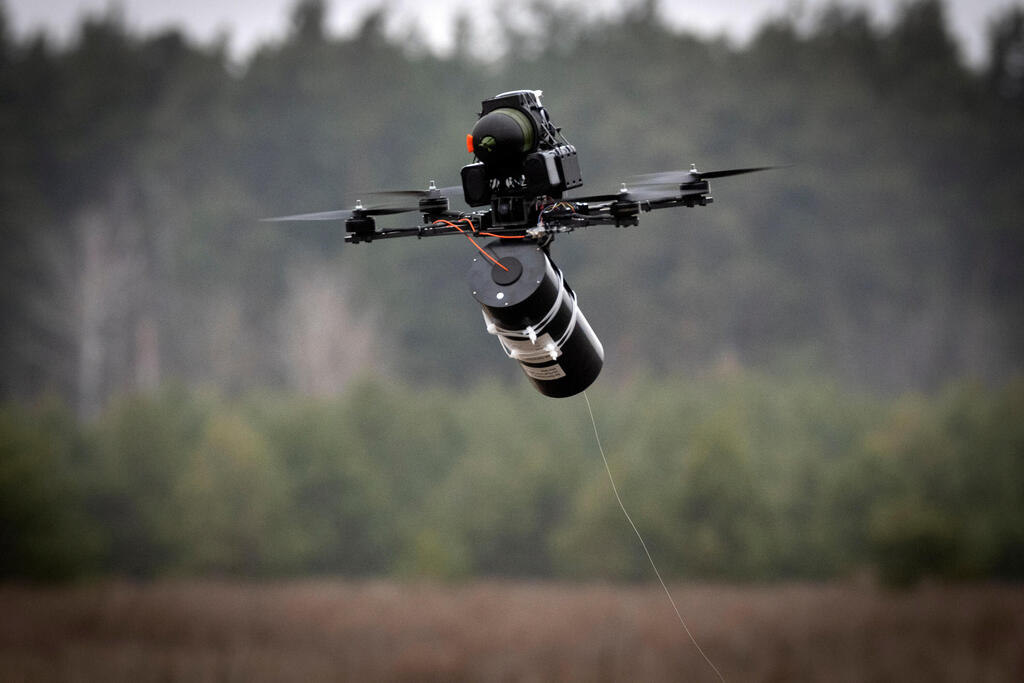
That is where small tactical drones, FPV drones and bomb-dropping quadcopters come in. Small Ukrainian drone teams, sometimes numbering only a few dozen fighters hiding in underground bunkers, can now stop, wear down and destroy Russian forces that once would have required an entire infantry brigade to confront.
The technological shift is difficult to overstate. Operational efficiency is extremely high, the cost is minimal, with some drones costing only a few hundred dollars, and most importantly, Ukrainian casualties are reduced dramatically.
The intense professionalization of both Ukrainian and Russian drone operators, combined with rapidly improving technology, has completely changed the geography of the battlefield. Along the front, it has created what soldiers call a “kill zone” or “destruction zone,” terrifying terms that describe the new reality.
The skies over the front are filled around the clock with thousands of electronic eyes from both sides. The moment a Russian armored vehicle, tank or even a lone soldier on a dirt bike enters open terrain or tries to advance toward Ukrainian lines, it is detected within seconds. Small explosive drones are then launched almost immediately.
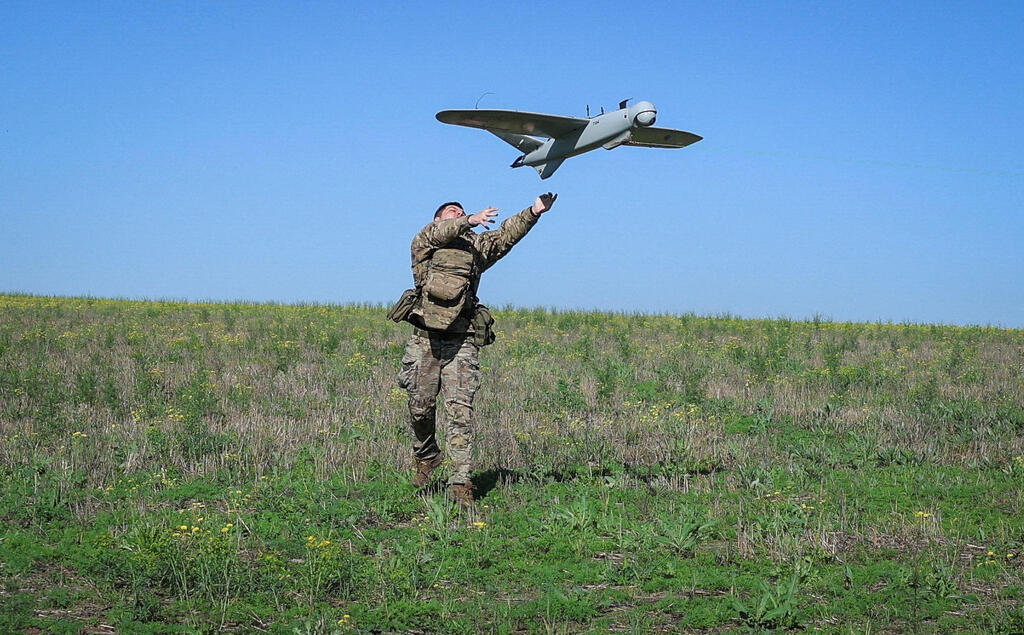
Ukrainian soldier carries a suicide drone with 3.5 kilograms of explosives and a 100-kilometer range in the Kharkiv region, May 22
(Photo: REUTERS/Anatolii Stepanov)
These drones, which can cost about $500 each, chase soldiers through trenches, dive into the open turrets of tanks worth millions of dollars, enter rooms where Russian troops are hiding and eliminate almost any attempt at maneuver.
The “kill zone” has made classic military maneuver almost impossible. The tactical drone has become the undisputed king of the modern battlefield, replacing traditional artillery in many cases because of its surgical precision and negligible cost.
These areas are littered with burned-out vehicles and, at times, the bodies of Russian soldiers left in the field because trying to retrieve them can mean instant death. Ukraine, for its part, has begun using ground robots to evacuate wounded soldiers or bodies, including robots carrying first-aid equipment that allow troops to treat wounded comrades when rapid evacuation is impossible.
High-tech speed behind the revolution
To sustain such exhausting activity along the entire front, Ukraine had to move to fast, efficient mass production.
In 2022, Ukraine was almost entirely dependent on imports and foreign suppliers. That has changed dramatically. By 2025, domestic production had crossed 3.7 million units a year for tactical drones alone, excluding long-range UAVs. More than 200 local companies, most of them civilian startups that rapidly converted to defense production, now manufacture unmanned systems of various ranges while protecting the production and supply chain.
The key to Ukraine’s success is decentralization and flexibility.
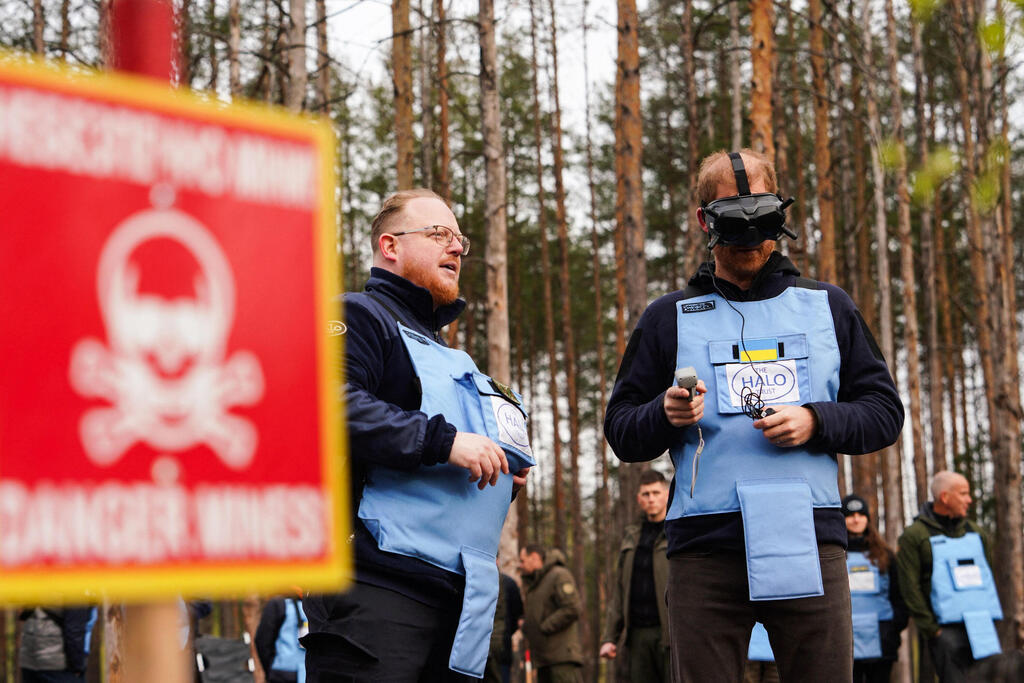
Prince Harry examines drone use for mine clearance during visit to Kyiv, April 24
(Photo: Valentyn KUZAN / THE HALO TRUST UKRAINE / AFP)
Unlike conservative Western defense industries, and certainly unlike Russia’s more cumbersome system, Ukraine works at the pace of the tech world. A drone model leaves the production line, is tested at the front against Russian electronic warfare systems, is upgraded within two weeks based on feedback from soldiers and then returns to combat in an improved version.
One of the most important developments now in widespread use is artificial intelligence for navigation and target guidance. As Russia improved its electronic jamming systems, Ukraine developed drones with autonomous homing. Once the drone identifies a target, the human operator can disconnect, and the drone locks on and hits even if the communication link is fully jammed.
Ukraine, like Russia, also uses many drones connected to their operators by fiber-optic cables, preventing electronic warfare systems from disrupting or downing them.
Moscow also makes extensive use of drones, both in massive attacks on Ukrainian cities and on the front. Ukrainian commanders do not dismiss Russian capabilities.
“You must not underestimate the enemy,” a Ukrainian unit commander who launches medium-range drones at Russian targets in occupied eastern Ukraine told Reuters. “They have enormous experience in developing air defense systems, radars and technology. Their specialists are also working on this. It must not be ignored.”
In Reuters footage, one Ukrainian drone known as Drakusha, or “little dragon,” was seen before launch with the words “Moscow calling” written on it.
Cracks in the Kremlin wall
While small drones are holding the front, their bigger brothers, medium- and long-range attack drones, are changing the strategic balance.
Putin’s original strategy was based on keeping the war far from Russian civilians, especially in major cities such as Moscow and St. Petersburg, but also deep inside Russia. Ukrainian long-range drones have shattered that illusion.
Over the past two years, Ukraine has launched a systematic aerial campaign against Russian energy and aviation infrastructure. Drone attacks have hit dozens of major Russian refineries, at times causing significant disruptions to the country’s oil refining capacity, an economic lifeline for the Kremlin and a crucial source of funding for the war.
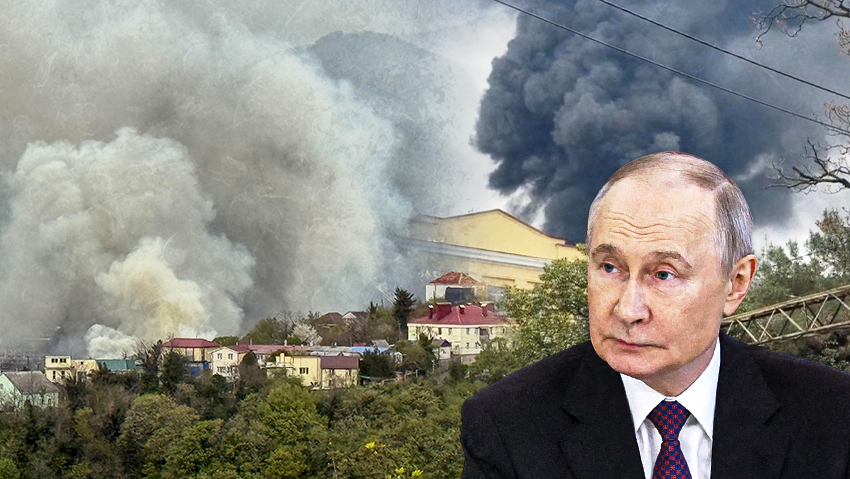
Putin and smoke rising after a Ukrainian strike on an oil facility in Tuapse in early May
(Photo: STRINGER / AFP, Social Media/via REUTER)
The damage is not only economic. It is also political.
When Ukrainian drones explode over Russian air bases deep inside the country, destroy strategic bombers or repeatedly force Moscow airports to close, the Russian public begins asking questions. Putin’s core promise to his people, stability and security in exchange for freedom, is beginning to crack. The Kremlin is increasingly seen as unable to protect its own skies.
Even the traditional Victory Day parade in Red Square on May 9, long used by Putin as an international display of power, was unusually scaled back and shortened. The message is filtering into Russian society, where patience is beginning to wear thin.
The “personal protest potential” index of Russia’s state-run Vtsiom polling institute, which measures respondents’ willingness to take part in demonstrations, rose in April to 25%, its highest level since the war began.
“Everyone is furious. People in the Russian elite are completely unanimous that this is a catastrophe. This has to be solved somehow,” a senior Russian businessman told the Financial Times anonymously. He said Putin was suffering from “overwhelming unpopularity” and described him as “old and stubborn.”
CNN also reported this month, citing a European intelligence assessment, that the Kremlin had dramatically increased security around Putin, including because of fears of a coup.
No longer begging
Ukraine’s remarkable, even phenomenal, operational success, in defending the front, intercepting Russian drones over cities and developing strategic attack capabilities, has dramatically changed its geopolitical standing.
Once viewed as a country almost begging the West for military aid, Ukraine is now far less dependent on Western weapons than it was, even though it still needs help in areas such as air defense.
Kyiv continues to press its allies for Patriot interceptors and batteries. But amid shortages, Ukraine is using not only older systems such as machine guns, but also small interceptor drones that chase Russian UAVs.
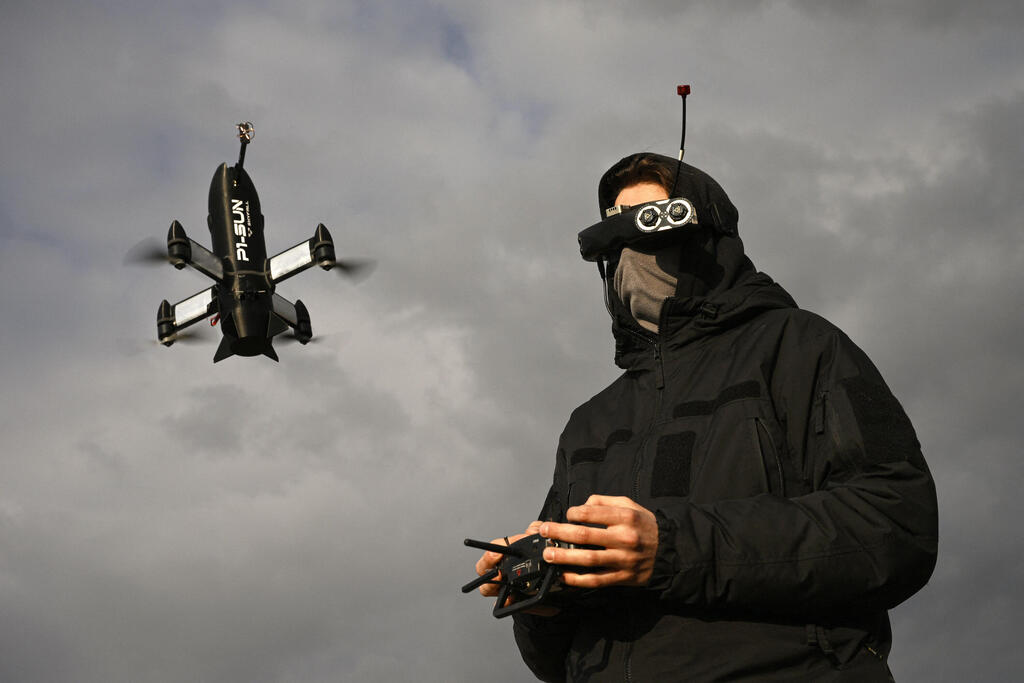
Small P1-SUN interceptor drone: 3D-printed, costs $1,000 per unit and chases Shahed UAVs
(Photo: Genya SAVILOV / AFP)
One such drone, the P1-SUN, can reportedly reach speeds of up to 300 kilometers per hour and fly more than 30 kilometers, according to the BBC. It is built using 3D printers and costs about $1,000 per unit, far less than the estimated $50,000 cost of a Russian Shahed drone based on the Iranian model.
“This is a very serious weapon,” a Ukrainian drone unit commander identified only as Volkous told the BBC. “It shows how quickly we can adapt, how we can hold the defense line and how much we can develop.”
The war with Iran accelerated a process that had already begun. Countries are now coming to Kyiv to learn and buy technology.
In Europe, a drone coalition led by Britain and Latvia now includes more than 10 NATO countries. Its goal is to invest directly in Ukrainian factories and integrate Ukrainian technology into European armies, based on the understanding that NATO’s next defensive line will be shaped by these lessons.
The most surprising shift may be taking place in the wealthy Gulf states. The United Arab Emirates, as well as Qatar, Bahrain and Saudi Arabia, which suffered from Iran’s power during the recent war and sustained real losses and damage, are showing major interest in Ukrainian expertise.
Representatives of government-linked Gulf defense companies have signed memorandums of understanding and cooperation agreements with Ukrainian firms to purchase combat-proven systems tested against some of Russia’s most advanced electronic warfare capabilities, and to move production lines into their own countries.
The lesson for Israel
Ukrainian President Volodymyr Zelensky has recently visited Gulf states, including Saudi Arabia twice, to promote those deals and partnerships. That is a dramatic development in itself.
There is also, of course, an Israeli angle. It relates to the complex challenge posed by Hezbollah explosive drones against IDF forces in southern Lebanon and along the northern border, and to the fact that Israel and Ukraine are not cooperating as closely as might have been expected.
The fighting against Hezbollah shows a chilling resemblance to the trenches and tunnels of Donbas in eastern Ukraine. Hezbollah, with close Iranian guidance and support, has fully absorbed the lessons of the war in Ukraine.
The challenge facing the IDF against fast, low-flying tactical drones guided by fiber-optic cables and exploiting mountainous terrain is, to some extent, similar to what is happening on the Ukrainian front, though there are obvious differences between the arenas.
Ukrainian footage: drone captured with net-firing gun
Israel, long considered a global drone power because of large, expensive strategic UAVs such as the Hermes 450, has found itself conceptually disadvantaged by cheap micro-robotics. A Chinese drone costing $3,000, carrying explosives and guided by a camera, can repeatedly penetrate Israel’s multilayered air defense network, hit military sites along the northern border and inside southern Lebanon, and tragically kill soldiers and civilians.
The lesson Ukraine offers Israel is clear: it is not viable to intercept every cheap drone with an Iron Dome Tamir missile costing tens of thousands of dollars.
The IDF must adapt to the rapidly changing reality, moving from a doctrine based on a small number of expensive aircraft to the mass production and procurement of small tactical drones for every infantry platoon, alongside cheap kinetic defenses and decentralized electronic warfare systems.
Beyond that, Israel would be wise at the diplomatic level to improve ties with Kyiv in a way that serves Israeli security interests against common enemies operating in both arenas.
Ukraine’s ambassador to Israel, Yevgen Korniychuk, expressed surprise this month that Israel was not making greater use of his country’s experience.
“We are fighting from another angle against the same axis of evil,” he told ynet. “Unfortunately, we do not see much interest or appetite from the Israeli leadership in this field. I do not want to speculate about the reasons.”
He said that in meetings with people from different parts of Israeli society, “I often hear frustration that Israel is missing an opportunity to save more soldiers’ lives. Most Israelis support Ukraine and do not understand why the Ukrainians can deal with drones and Israel cannot.”