

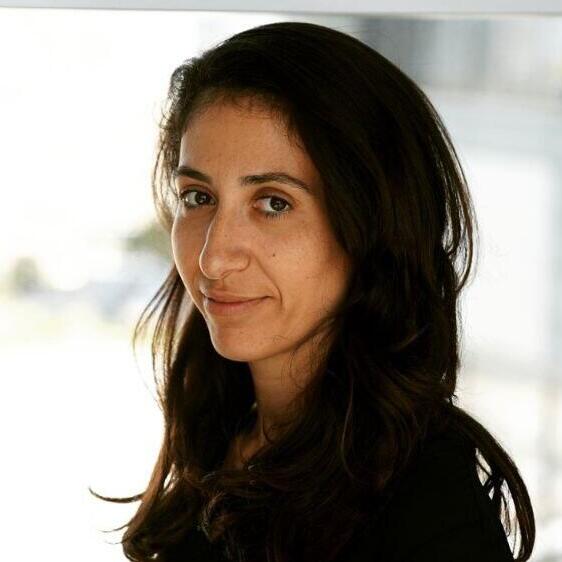
Asaad al-Shaibani, Syria’s foreign minister and one of President Ahmad al-Sharaa’s closest aides, has quickly become one of the most visible figures in the country’s post-Assad political order. With an Instagram account launched only in March and already drawing more than 900,000 followers, he has turned into a central messenger of Syria’s new leadership, showcasing behind-the-scenes moments with al-Sharaa and documenting the country’s efforts to reenter international diplomacy.
Al-Shaibani, 38, has accompanied al-Sharaa on a series of high-profile trips since the fall of Bashar Assad’s regime in December 2024. Last week he visited London for meetings with senior British officials and was later photographed raising Syria’s new flag over the Syrian Embassy there, reopening it after a 14-year closure. On X, where he has more than 380,000 followers, he wrote that Syria was “returning to the world with its free identity” after years of isolation imposed by Assad’s “chemical weapons regime.”
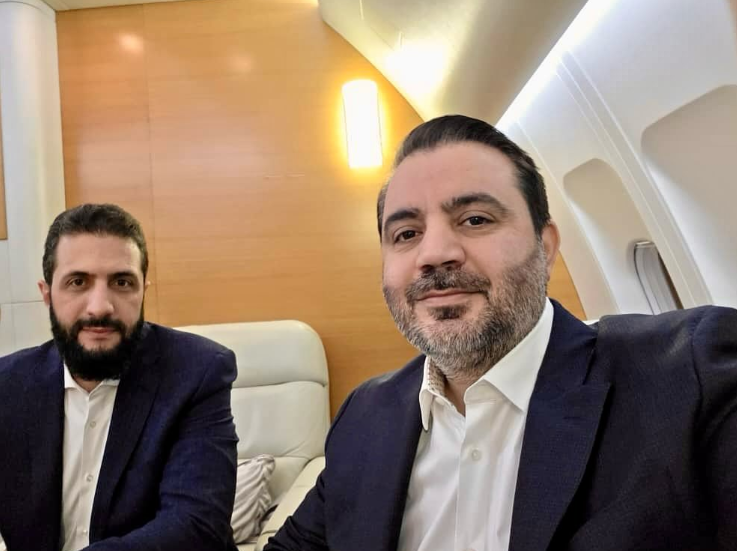
Ahmad al-Sharaa and Asaad al-Shaibani
During a discussion at Chatham House in London, al-Shaibani criticized Israel, accusing it of playing “a negative role in Syria” and trying to weaken the new government. He said unrest in Sweida, a predominantly Druze area in southern Syria, escalated due to what he called Israeli intervention, though he said Damascus sought to respond diplomatically.
He said Syria is exploring “every possible agreement” through the lens of national reconstruction and argued that Israel’s interest lies in avoiding involvement in Syria’s internal affairs. He claimed that several international actors support Damascus’ diplomatic stance on what he described as Israeli violations.
From London, al-Shaibani returned to Damascus for talks with an adviser to France’s president, then continued to China for his first official visit there.
Al-Shaibani’s social media presence focuses less on formal diplomacy and more on curated glimpses of the new leadership. His Instagram account includes selfies with al-Sharaa and widely circulated videos of the president playing basketball, including one game with U.S. Central Command chief Gen. Brad Cooper.
He also accompanied al-Sharaa on the president’s recent trip to the United States. After the visit he posted a selfie from the plane, calling the week a series of achievements “paving the way for Syria’s revival.” During the visit, U.S. President Donald Trump presented al-Sharaa with two bottles of his fragrance Victory 45-47 and sprayed some on al-Shaibani’s neck.
Al-Shaibani’s prominence marks a dramatic shift from his past. Profiles by regional media say he was born in Syria’s Hasakah province in 1987 and later moved with his family to Damascus, where he studied English language and literature at the University of Damascus. He earned a master’s degree and doctorate in political science and international relations at Sabah al-Din Zaim University in Turkey, completing his Ph.D. in 2024.
Al-Sharaa playing basketball with top US generals


Before entering politics, al-Shaibani operated for years within jihadist groups under several aliases, including Abu Aisha, Abu Ammar al-Shami, Hossam al-Shafei and Zayd al-Attar. His real identity became public only after Assad’s fall.
Under the name Abu Aisha, he was a senior figure in Jabhat al-Nusra, al-Qaida’s former affiliate in Syria that was commanded by al-Sharaa. He was involved in the group’s media and security operations. He later served as spokesperson for Jabhat Fath al-Sham after the group rebranded in an effort to distance itself from al-Qaida.
When Hayat Tahrir al-Sham was created in 2017 through a merger of several anti-Assad factions, al-Shaibani became known as Zayd al-Attar and headed the new group’s political affairs department under al-Sharaa, who was then known as al-Joulani. Reports say he handled foreign relations and external security issues, including cases involving foreign fighters, and built working ties with U.N. agencies. Within the opposition-run “Salvation Government,” established in areas held by Hayat Tahrir al-Sham, he oversaw political matters.
After Assad’s fall on Dec. 8, 2024, the transitional Syrian government appointed al-Shaibani foreign minister later that month. When al-Sharaa announced a new government lineup in March 2025, al-Shaibani kept his post, solidifying his role as one of the most influential figures in Syria’s emerging political order.