


Senior Israeli cabinet officials say prospects for normalizing relations with Saudi Arabia remain slim, contrary to recent media reports, citing a range of political and regional factors.
Officials, speaking on condition of anonymity, said that as long as the war in Gaza continues, Riyadh will not join the U.S.-brokered Abraham Accords. They added that Israel’s standing in Saudi Arabia has weakened in recent years and that the kingdom no longer views diplomatic ties with Israel as a strategic necessity.
Gallery
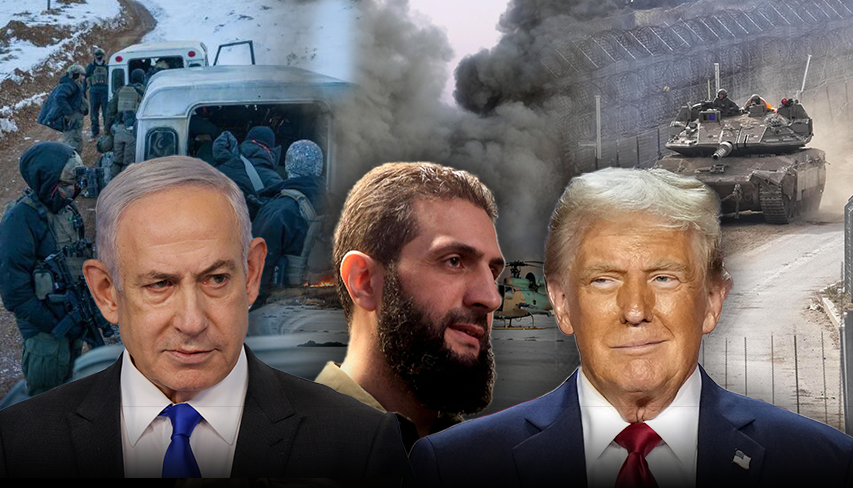
Benjamin Netanyahu, Ahmad al-Sharaa, Donald Trump
(Photo: Mark Israel Salem, Abdulaziz Ketaz / AFP, Alex Brandon / AP)
The officials cited Syria as an example where quiet talks between Israel and Arab nations had advanced, but not toward full peace — only limited security understandings.
During the Biden administration, Saudi Arabia had pursued a mutual defense pact with the United States, requiring backing from Israel to help secure two-thirds support in the U.S. Senate. That backing was considered necessary due to opposition from Democratic lawmakers over Saudi Arabia’s human rights record. However, officials said such a pact is even less likely under President Donald Trump, and Saudi Arabia no longer sees value in seeking Israeli support for it.
While Trump touts an expansion of the Abraham Accords and a possible role for the Saudis in the future administration of Gaza, Riyadh's involvement in the accords would require Israel to agree in principle to the future establishment of a Palestinian state.
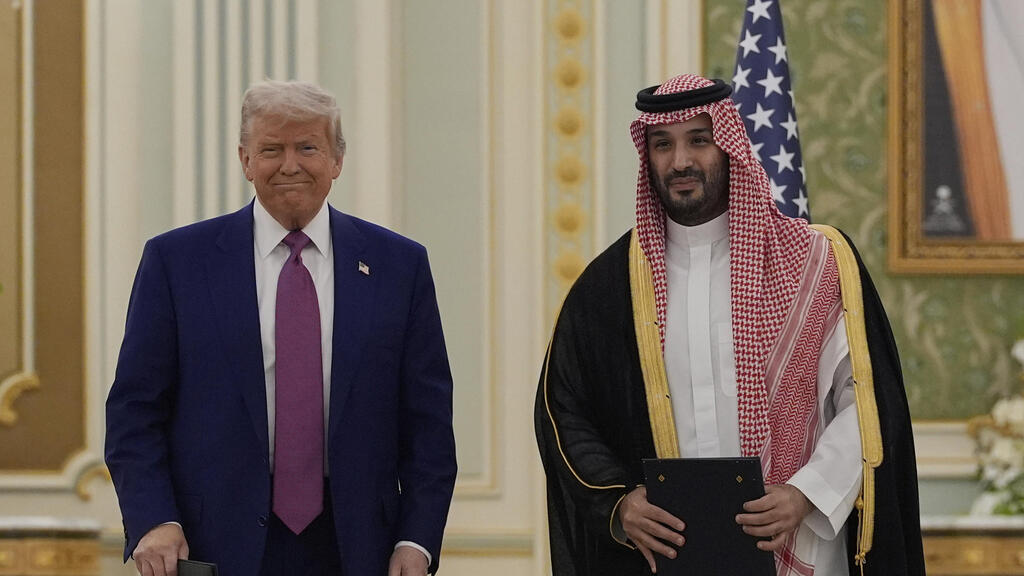
Trump and Saudi Crown Prince Mohammed Bin Salman
(Photo: Alex Brandon / AP)
"Prime Minister Benjamin Netanyahu is politically unable to bring such a proposal," Cabinet officials said.
Foreign Minister Gideon Sa'ar said on Monday that Israel would like to see the Abraham Accords expanded to more countries, including neighboring Lebanon and Syria, but rejected any possibility that Israel would withdraw from the Golan Heights.
The negotiations between Israel and the new Syrian regime are bolstered by a rare confluence of interests. Syrian leader Ahmad al-Sharaa needs foreign investments and sanction relief, while Israel seeks security on its northern border. But there will be no peace deal. "Those hoping to enjoy a plate of hummus in the Damascus market will have to dream on," one Cabinet official said.
US President Trump says countries asking to join Abraham Accords
(Video: Fox News)


A security agreement would prevent Iranian entrenchment in Syria, keep terror actors away from the border and ensure calm there. According to foreign media reports, Israel used Syrian airspace to attack Iran, indicating there are already unofficial bilateral understandings in place.
Any security agreement would be based on the 1974 disengagement agreement signed after the 1973 Yom Kippur War, outlining the deployment of forces along the border and a supervising mechanism in place to oversee compliance with the terms. That deal has held since it was signed and the officials in Israel believe it can be updated to address the current challenges, provided the new regime in Damascus indicates it is cutting itself off from any Iranian influence.
Get the Ynetnews app on your smartphone: Google Play: https://bit.ly/4eJ37pE | Apple App Store: https://bit.ly/3ZL7iNv
Officials point to Indonesia as the most likely to join the Abraham Accords, but that, too, would be possible only after the war in Gaza ends. Some African nations, including Mali and Djibouti, are also seen as possible additions to the accords, as is Azerbaijan, which already has strategic cooperation with Israel.
The officials played down expectations that a deal in Gaza was possible within a week and sources have said there is no real progress in negotiations. "Trump's statements are not always grounded in reality," senior cabinet officials said after the American president said a deal was likely to be announced. "He throws out a statement and then moves on and no one goes back to check."
US President Trump says Gaza deal within a week
(Video: White House)
After the Israel-Iran war, all regional actors were reassessing the situation, the officials said. The Iranians are considering whether to continue to invest in their nuclear program after the damage caused by the Israeli and American attacks. They are also dealing with the disappointment in their proxies, especially Hezbollah and must rethink their priorities.
The officials believe Iran will try to at least partially continue the nuclear program, but would also be seeking revenge. There is no expectation that its animosity toward Israel would change, unless there is a new regime. "Israel will not stop being Iran's enemy," one official said.
Trump said in a post on Truth Social on Monday that he is not talking to Iran and is not offering the Iranians anything, this, in contrast to his statement last week, that Iran was interested in renewing negotiations with the United States and that he was looking forward to talks.