

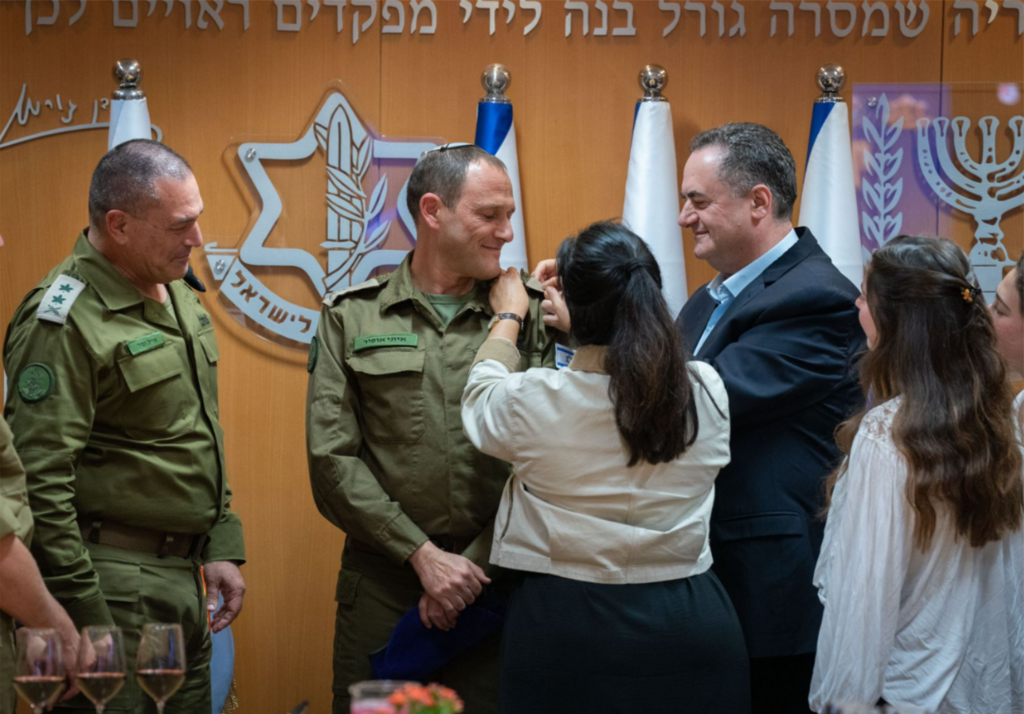
IDF Chief of Staff Lt. Gen. Eyal Zamir and Defense Minister Israel Katz on Thursday promoted attorney Itai Ofir to the rank of major general as he assumed the post of military advocate general. The ceremony at the Kirya military headquarters in Tel Aviv took place under the shadow of the leaked video showing abuse at the Sde Teiman detention facility and as the High Court met earlier in the day to review the appointment of an investigator examining the conduct of Ofir’s predecessor, Maj. Gen. Yifat Tomer-Yerushalmi.
The event also came amid an escalating public rift between Katz and Zamir following the release of personal accountability findings for senior officers, including conclusions from the Turjeman Committee report. Prime Minister Benjamin Netanyahu recently met with each of them separately and urged both to end their dispute through the media.
(Photo: IDF)
Katz said during the ceremony that the IDF is facing “significant operational challenges, but also moral and public ones.” He said public trust in the military has been in “deep crisis” since the Oct. 7 Hamas attack and worsened following the leak from Sde Teiman, which he described as “one of the gravest blood libels against IDF soldiers and one of the most serious affairs in the country’s history.”
“IDF soldiers must have the trust of the public, and therefore the Military Advocate General’s Office must have the public’s trust,” Katz said. “We will confront this crisis by correcting the serious mistakes, learning the lessons and applying them. Only then can we restore the trust the IDF needs more than anything else.”
Addressing Ofir, he added: “I am confident you will turn this major crisis into an opportunity to rebuild and reorganize the Military Advocate General’s Office.”
Katz said the core mission for Ofir and the legal corps is to defend IDF soldiers “who fight with courage in difficult and complex conditions for Israel’s security, and who are pursued internationally by those who wish us harm.” He said he believes Ofir will lead the corps “with humility and integrity.”
Zamir said the Military Advocate General’s Office is “an inseparable part of the IDF and a critical element of its strength.” He said a strong legal backbone ensures the legitimacy of operations and protects the military “with an unshakable ethical foundation.”
He urged Ofir to expand the corps to include more combat-experienced officers, strengthening ties with frontline units. “You will need to lead from the front at the critical junctions where commanders and fighters stand,” Zamir said.
“We do not have the privilege of demanding the public’s trust in advance,” he added. “We must rebuild it step by step — through professionalism, transparency where possible and consistency.”
Ofir, in his remarks, said he was assuming the role “because we have one state — the hope and prayer of generations — which we must protect.” He said the IDF operates under a “persistent, multi-front existential threat,” and that the military’s strength derives from the spirit of its soldiers and from its commitment to remain both effective and moral.
“In a Jewish and democratic state, especially a state engaged in the longest and most complex war it has known, the rule of law must be a source of strength,” he said. He pledged to examine and improve what needs fixing, and to lead the corps to new achievements.
“I promise to act with all my strength as a faithful public servant, to do what is right and just, and to carry with me always the soldiers, fighters and commanders of the IDF,” Ofir said.