


Armed local militias in the Gaza Strip are voicing growing opposition to the establishment of a new committee intended to manage the territory’s next civilian phase, casting doubt on its legitimacy and ability to operate as Gaza faces a prolonged power vacuum.
Leaders of the militias, which maintain armed strength, territorial control and significant influence over daily life across the enclave, have dismissed the proposed body as ineffective and disconnected from realities on the ground. “This is a committee of coupons and containers,” said Ghassan al-Dahini, described as one of the leaders of the strongest militias operating against Hamas in Gaza. Speaking to ynet, he called it “a foolish committee, a committee for distributing food and water.”
Gallery

Clockwise from top right: Aed Yaghi, Bashir al-Rais, Ali Shaath, Hana Tarzi, Omar Shamali, Abdul Karim Ashour, Jaber al-Daour and Ayed Abu R
Al-Dahini said discussions about civilian administration, committees and political arrangements miss what he described as the core issue. “Our status is much greater than these stories,” he said. “Our story is with Israel, with Witkoff and with the Emirates. What do we have to look for among these people?” He added that his militia is preparing to expand. “We have the names of about 10,000 young men ready to join immediately, once residents of Rafah return to their homes. They should not think we lack a plan or are acting improvisationally.”
Similar messages have emerged from Khan Younis, where Husam al-Astal, head of the local militia, questioned whether the proposed arrangements would ever be implemented. “In my view, all the talk and publications about committees, civilian management and arrangements in Gaza are mostly media noise and political marketing,” he told ynet. “It is not really going to happen.”
Al-Astal set out what he described as clear red lines. “There will be no possibility of an Israeli military withdrawal from the Yellow Line,” he said, referring to the security line established by Israel inside Gaza. “And no agreement will be signed without Hamas handing over its weapons, which from our perspective is impossible.”
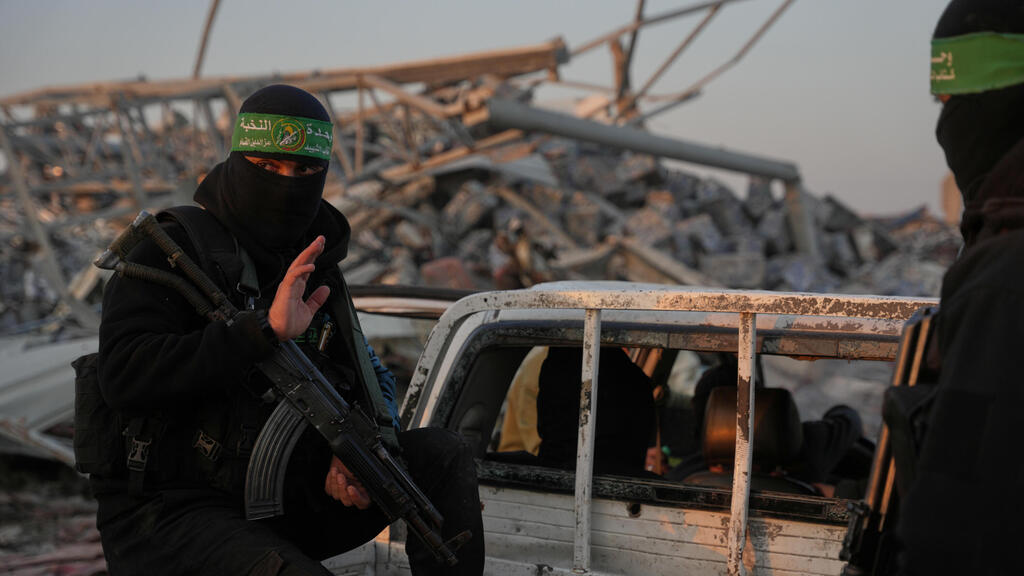
Hamas terrorists in Gaza
(Photo: AP Photo/Abdel Kareem Hana)
He also criticized the makeup of the committee, arguing it lacks public legitimacy. “They talk about a management of 14 or 15 people, but there are many figures there who are not accepted by the public on the ground,” he said. “In the end, those who are present on the ground are the ones who need to decide, not external actors.”
The committee, whose members have been disclosed in recent days, is made up of 15 figures with professional, institutional and security backgrounds. Many have past ties to institutions of the Palestinian Authority. It is headed by Ali Shaath, a former senior administrator and deputy minister in the Palestinian Authority, who is identified with the moderate wing of the Fatah movement. Other members include retired senior officers from the Palestinian Authority’s security services, as well as officials from the fields of law, land administration, health, education, welfare and economics. The panel also includes heads of Gaza-based civil society organizations, academics, engineers and business figures.
According to sources familiar with the details, the committee includes individuals residing both in the Gaza Strip and in Palestinian Authority–controlled areas of the West Bank and is expected to operate in coordination with officials in Ramallah and with international actors. That composition has already drawn criticism from local actors in Gaza, who question its public legitimacy.
Al-Astal’s remarks come amid a prolonged governance vacuum in the territory. Hamas has been weakened militarily and administratively, while the Palestinian Authority has struggled to reestablish control. International initiatives involving Egypt, Qatar, the United States and other countries have yet to produce a single effective governing mechanism. Into that vacuum have stepped local militias that are armed, clan-based and locally rooted, with partial legitimacy among residents, largely due to their ability to provide security, food and a minimal level of order.
While Israel and the international community are increasingly discussing a transition to a second phase of arrangements, including the possibility of an Israeli withdrawal from the Yellow Line and the transfer of civilian responsibilities, the militias’ message has been clear: Without Hamas being disarmed and without the involvement of local armed forces, any move risks being seen as irrelevant.
Security officials assess that the recent statements are deliberate, aimed at drawing red lines, demanding recognition of existing power structures and making clear that Gaza’s next phase will not be determined solely at negotiating tables, but also, and perhaps primarily, on the streets of Gaza.