

A senior Hamas official laid out the terrorist group’s conditions for the next phase of U.S. President Donald Trump’s Gaza ceasefire plan, insisting the Islamist movement will not disarm before the creation of a Palestinian state and rejecting any deployment of an international stabilization force inside the Gaza Strip.
Khalil al-Hayya, one of five members of Hamas’ top leadership in Gaza, said in a Saturday interview that the group is prepared to accept only a border-monitoring presence, not a force empowered to operate within Hamas-held areas or to dismantle its arsenal, a central requirement in the U.S. plan and in Israel’s demands.
US President Donald Trump on Gaza
(Video: from X)


Al-Hayya said he told U.S. envoys Steven Witkoff and Jared Kushner that Hamas views its weapons as tied to what he called “the existence of the occupation and the aggression.” According to an official Hamas account of his remarks, he said the movement would surrender its arms “if the occupation ends,” adding that discussions over the weapons issue were taking place with Palestinian factions and international mediators.
His office later clarified to Agence France-Presse that any reference to returning weapons “under the authority of the state” referred to a "sovereign and independent Palestinian state."
Israel has insisted that Hamas must be fully disarmed and says it will not move to the second phase of the ceasefire deal until the body of Sgt. First Class Ran Gvili — a police commando abducted on Oct. 7 — is recovered. Al-Hayya said Hamas operatives would enter “new areas” Sunday to search for Gvili, and Gaza sources reported that Hamas and the Red Cross plan to conduct sweeps in Gaza City’s Zeitoun neighborhood.
Israeli officials fear Hamas and Palestinian Islamic Jihad are not making serious efforts to locate the missing serviceman and warn that if Washington pushes ahead to the second stage without Gvili’s return, terrorists will have little incentive to do so. A senior Israeli official said mediators are pressuring Hamas but that Jerusalem is concerned Trump may announce a transition to the next phase regardless.
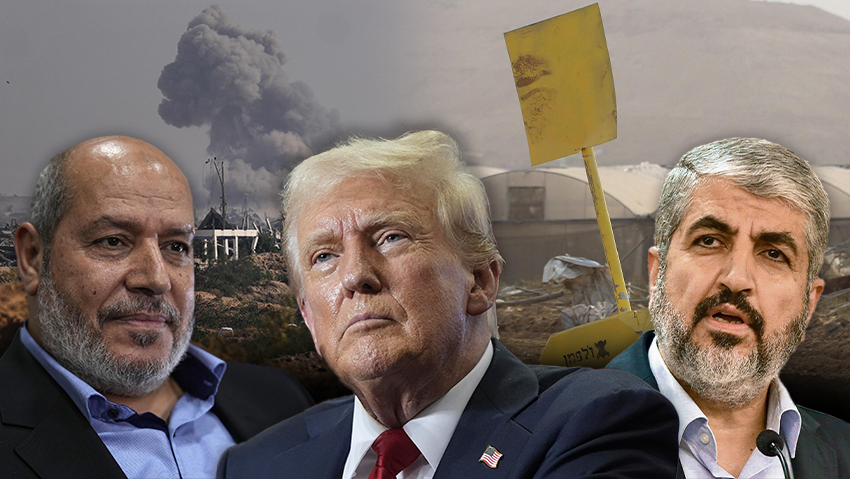
(Photo: Bashar Taleb / AFP, AP Photo/Jehad Alshrafi/Osama Faisal/Alex Brandon/Khalil Hamra)
Al-Hayya also rejected key elements of the proposed multinational stabilization force authorized by the UN Security Council. He said Hamas would accept UN forces only as a “separating force” positioned on Gaza’s borders to monitor the ceasefire, not operating inside the enclave. His remarks signaled the group’s opposition to the broader mandate envisioned by Washington, which includes authority to dismantle Hamas’ military infrastructure.
The United States has floated alternatives amid disputes over the force’s scope, including deploying it on what U.S. officials describe as the “green zone” — areas on the Israeli side of the Gaza perimeter where Hamas is considered weakest. Under that proposal, international personnel would manage early reconstruction, build “safe communities” with housing, schools and medical services, and gradually draw Palestinian civilians out of Hamas-ruled areas.
Al-Hayya’s comments were echoed by Khaled Mashaal, Hamas’ political leader abroad and also a member of the group’s executive council. Speaking in Istanbul, Mashaal said Hamas rejects “all forms of trusteeship or mandate,” insisting that Palestinians alone “decide their fate.” He said Hamas’ weapons constitute “the resistance project” and are “the right of our people to defend themselves.”