


Doubts are deepening over the ability of the National Committee for the Administration of Gaza—also known as the “Technocrats' Committee,” which was established as part of Phase II of the U.S. peace plan—to actually begin operating in the enclave. Nearly a month after its formation was announced, the committee’s members have yet to enter Gaza.
A source in the Palestinian Authority addressed the issue and told ynet: “There is one reason for the delay—Israel is preventing the committee from entering. Within the Israeli political system, an internal campaign is underway in which the Palestinian issue in Gaza and the West Bank has become a central tool in the struggle ahead of the upcoming elections.”
The Palestinian source added: “The occupation talks about Rafah, Jabalia, Yatta, Ramallah and Hebron—not about the cost of living or the lives of Israeli citizens. Try to find a single Israeli election platform that genuinely deals with the lives of Israelis—you won’t find one.”
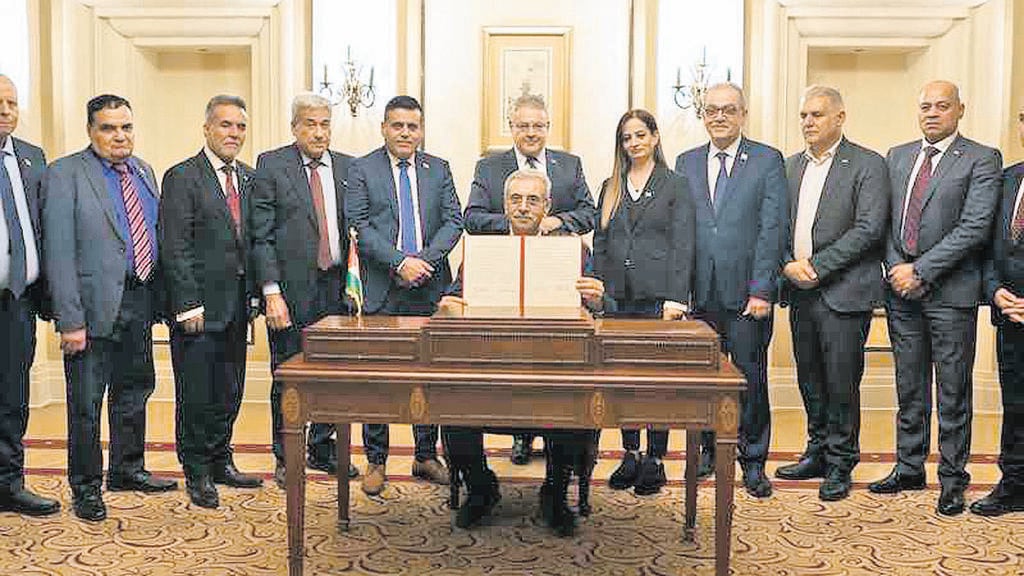
However, it appears that Israeli opposition is not the only factor preventing the Technocrats Committee from beginning its work in Gaza. Internal Palestinian disputes are also at play, along with steps being taken by Hamas that are seen as potentially complicating the committee’s future operations.
Regarding Israel’s position toward the stalled committee, Palestinian sources quoted by the London-based newspaper Asharq Al-Awsat said that Jerusalem is not only blocking the committee members’ entry into Gaza but is also presenting a series of demands and conditions. These include issues related to symbols, the committee’s identity and a fundamental demand that Hamas be disarmed as a condition for transferring control of the Strip to another body. This is despite U.S. pressure on Jerusalem to advance the start of the committee’s work, which operates under the full authority of the executive arm of the Board of Peace, headed by Bulgarian diplomat Nikolay Mladenov.
Still, according to those same sources, the obstacles are not coming solely from the Israeli side. Inside Gaza, Hamas continues to take administrative steps that raise questions about the terrorist organization’s true intentions. Since the committee’s establishment—and even in recent days—deputy ministers, directors-general and senior figures in Hamas’ security apparatuses have been appointed. This has led officials both inside and outside the committee to question whether there is genuine willingness to transfer governance of the Strip to other hands.
Hamas rejects these claims. Sources within the movement say the appointments are intended solely for “routine administration” until the committee arrives, and that clear instructions have been given to facilitate its work, including in the security sphere. However, sources close to the committee note that the establishment of a Palestinian body to accompany the transfer of authority—one that includes factional representatives and figures identified with Hamas—has raised concerns that this is effectively the creation of a future pressure mechanism on the committee itself.

Just waiting for the right moment to return to the forefront. Hamas terrorists in Nuseirat
(Photo: Eyad Baba / AFP)
It was also revealed that Hamas objected to certain individuals slated to oversee sensitive portfolios within the committee. Among the names raised again were Sami Nasman, a former senior officer in the Palestinian Authority’s General Intelligence Service, and Rami Hilles, identified with Fatah, who was designated to manage the Waqf portfolio. According to sources, in at least one case Hamas’ opposition led to the cancellation of a planned appointment to the committee.
Rafah crossing tour and waiting for budget approval
At the same time, committee members conducted a visit on Sunday to the Rafah Crossing on the Egyptian side and to aid transfer centers—their first such visit since the committee’s establishment. The crossing, which had been closed most of the time since the start of the war, reopened to pedestrian traffic last week. Committee chairman Ali Shaath said Egypt is making “enormous logistical efforts” to ease the movement of Palestinians and bring large-scale aid into the Strip. He said the committee is working to formulate a comprehensive assistance plan, including the entry of medical and educational equipment, and has held meetings with representatives of the European Union, the United Nations and Arab states. According to Shaath, commitments have been received to fund the committee’s activities, and a discussion has been scheduled at the Peace Council in Washington on February 19 for final approval of the aid.
Despite this, the committee itself is maintaining silence. Sources familiar with the details say clear instructions were given to avoid public statements—especially on controversial issues. For now, the National Committee for the Administration of Gaza exists largely on paper: without entry into Gaza, without an approved budget, and without the ability to exercise its authority, while Hamas remains a central player, waiting for an opportunity to return to the forefront.