


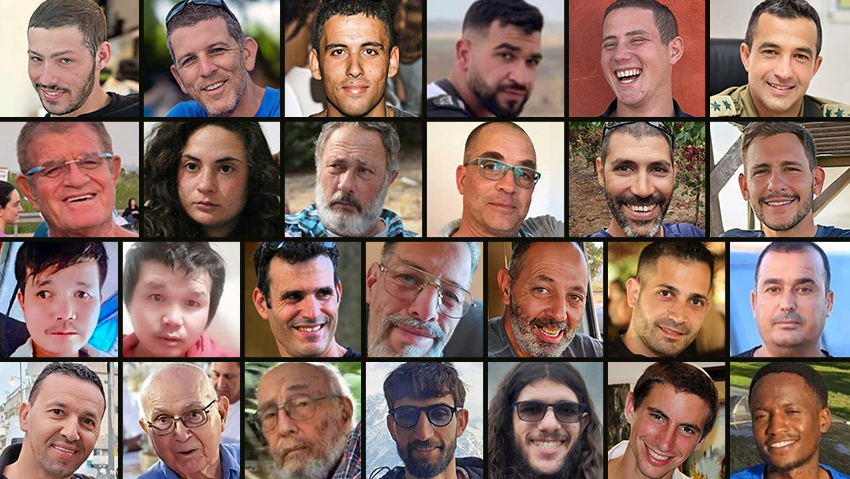
Preparations have been ongoing at the National Center for Forensic Medicine for the return of the dead hostages to Israel, the Health Ministry said in a press briefing on Sunday. The ministry noted that at this stage it is not known how many of the hostages who were killed will be returned on Monday.
“We know what was promised in the deal and we hope, for the families, that it will be as soon as possible,” said Dr. Hagar Mizrahi, head of the Health Ministry's medical division.
The preparations include dozens of experts from different fields, coordinated with the IDF, the Military Rabbinate, the police and the Ministry of Religious Services. The National Center for Forensic Medicine clarified that its goal is to complete identification examinations within hours to days. “There are cases that can be concluded within a few hours, but when it comes to more complex cases the identification process can take eight to 10 hours and even longer,” explained Dr. Nurit Bublil, director of the laboratories at the National Institute of Forensic Medicine.
“The dramatic components that affect this are the condition of the sample, which reflects the condition of the remains, and that depends on many variables, including the length of burial and the cause of death,” she added. According to Bublil, the center is prepared with all the technological means required to reach identification in the shortest possible time while maintaining accuracy and reliability.
Center representatives explained that there are several forensic identification methods accepted in the Western world — including fingerprints, dental comparison, imaging tests and DNA tests. Usually identification is performed by at least two different scientific methods to verify the result, although that is not always possible.
“We are facing a professional challenge, but we are prepared for it,” said Dr. Chen Kugel, director of the National Center for Forensic Medicine, during the briefing. He said the remains of the hostages will be transferred directly to the institute, where teams will begin comprehensive examinations.
Each set of remains will undergo a thorough medico-legal procedure that includes several stages. First, an advanced whole-body CT scan will be performed to locate unique markers that will allow comparison with pre-mortem images or medical information. After that a comprehensive medico-legal examination will be carried out by a specialist physician, which will include identifying external signs such as scars, tattoos and characteristic injuries, alongside collecting data that will help determine cause of death as much as possible.
In parallel, a dental examination will be conducted to compare dental x-rays and prior medical records, by dentists from the police volunteer unit. In addition, forensic medical and anthropological examinations will be performed by specialists and, if necessary, additional radiological tests will be carried out to diagnose special medical markers, such as orthopedic implants, which will be compared to prior medical information provided about the remains.
'Also to learn what happened to the deceased before their death'
DNA samples will be taken from the remains for advanced tests in the center’s biological laboratory. In cases where identification is complex, experts from several fields will work together until full certainty is achieved. Beyond identification procedures, the center’s team will also try to investigate the circumstances and cause of death — as far as the condition of the remains allows. “Our goal is also to learn what happened to the deceased before their death, so as to bring as much information as possible to the family and allow them a kind of closure,” explained Kugel.
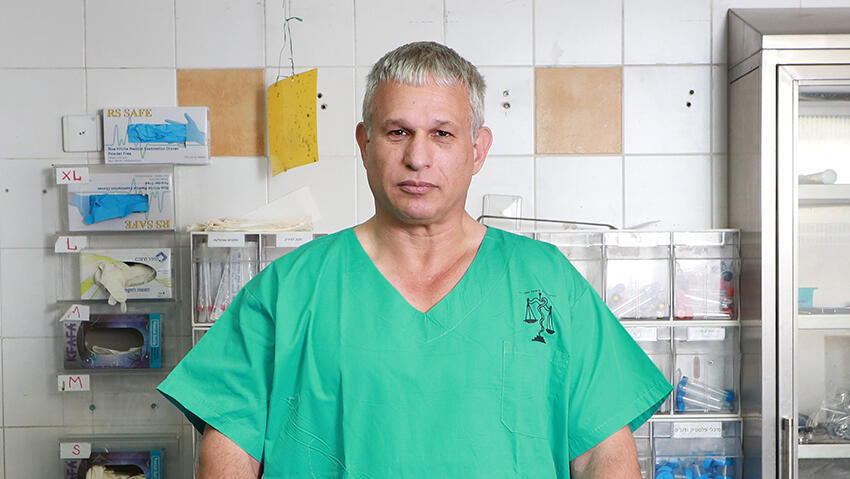
Dr. Chen Kugel
(Photo: Dana Kopel)
“The process that is done depends on the findings that are transferred, on the human remains that are brought, and certainly time leaves its marks,” Kugel said. Nevertheless, he emphasized that given the extensive experience the institute has accumulated, he is confident in the teams’ ability to identify all the remains.
“There has never been a mass-casualty event on this scale in which 100% of the remains were identified, and in Israel this has happened. So far we identified everyone. In the Twin Towers disaster, for example, where 2,700 people were killed, only about 1,700 have been identified to date. Given the experience we have accumulated, and despite the difficult condition that may be present in some of the hostage remains, we will identify them all. The length of time depends on the findings,” he added. He noted that the responsibility is particularly heavy: “Heaven forbid we make any mistake. There must be zero mistakes.”
Since the outbreak of the war, the institute has operated nonstop and has performed hundreds of identification procedures and treatment of the murdered and the dead from the Iron Swords war. In parallel to this intensive work, the center’s teams have worked throughout on the hostage issue, in cooperation with security and health agencies. To date, the center has identified 55 hostage remains that were held captive and brought to burial in Israel.
“October 7 has not ended for us,” said Bublil. “We have been working within this framework for the past two years. In the laboratory we tested many thousands of samples that arrived from the Gaza side throughout the period. Even after most of the identifications were completed, we did not stop trying to locate remains of hostage victims — and this work continues today. We hope this event will end and that the remains will finally be brought for burial.”
The National Center for Forensic Medicine notes that since October 7 identification capabilities and work have improved significantly, among other things thanks to added medical personnel and upgraded imaging systems. “Technologies were added, but what changed most is the experience,” explains Bublil. “If in the distant past, before the October 7 events, DNA extraction from bones was a process that lasted a minimum of eight hours for maximal yield, today in some cases it takes two to three hours only.”
Bublil added that communication between teams improved as a result of those lessons: “This is a dramatic event in every respect, which forced us to make many changes — and they have remained with us since.” She said, “The families are in front of our eyes. We want to bring the news that will allow them to bring their loved ones to an Israeli grave. This has immense significance.”
Mizrahi emphasized the human sensitivity involved in the mission: “This is work that carries great sensitivity, and it is a very complex moment. We do not forget that there are 48 hostages — we are waiting for all of them, and we treat the matter with great humility.”
The Ministry of Health called on the public during these sensitive days to act responsibly, to refrain from spreading rumors regarding the returnees and the remains, and to get updates only from official sources.