

Hamas is sticking to its position. Its senior terrorists continue to travel the world and bargain over a future plan for the Gaza Strip. Disarmament does not appear to be truly on the table, and the terrorist organization is expected to soon announce a new leader to replace Yahya Sinwar.
Hamas, the terrorist organization that launched the war on Oct. 7, continues to run much of the Gaza Strip and continues to negotiate in Cairo with representatives of President Donald Trump’s Board of Peace.
Senior Hamas terrorists have held several meetings in recent weeks with Nickolay Mladenov, who is managing the Gaza file for the Board of Peace, in an effort to reach understandings on moving to the next stage in the Strip under Trump’s 20-point plan. In recent weeks, Hamas has insisted that Israel must first meet the terms of the first stage and only then, it has made clear, will it agree to discuss moving to the next stage.
According to a report Saturday in the Saudi newspaper Asharq Al-Awsat, Hamas gave Mladenov a document stating that the issue of weapons would be handled in accordance with the rights of the Palestinian people — meaning as part of the establishment of a Palestinian state and the end of Israeli control, a condition Hamas has raised for many months.
In recent months, Israeli officials have repeatedly said fighting in Gaza could resume in order to disarm Hamas. Senior Hamas official Bassem Naim tried to push back against claims against the organization in an interview with Lebanon’s Al Mayadeen, saying Hamas was holding to the ceasefire while Israel continued killing Palestinians. His full remarks could not be independently verified.
According to Asharq Al-Awsat, after receiving Hamas’ answer, Mladenov left Cairo — and the Hamas delegation is expected to do the same. The reason, according to the report, is participation in the selection of the head of the political bureau, the terrorist organization’s leader.
When the war with Iran broke out, Hamas reportedly froze the vote for the head of the political bureau, citing internal organizational disputes. In recent days, reports said the process had resumed.
(Photo: REUTERS/Dawoud Abu Alkas)
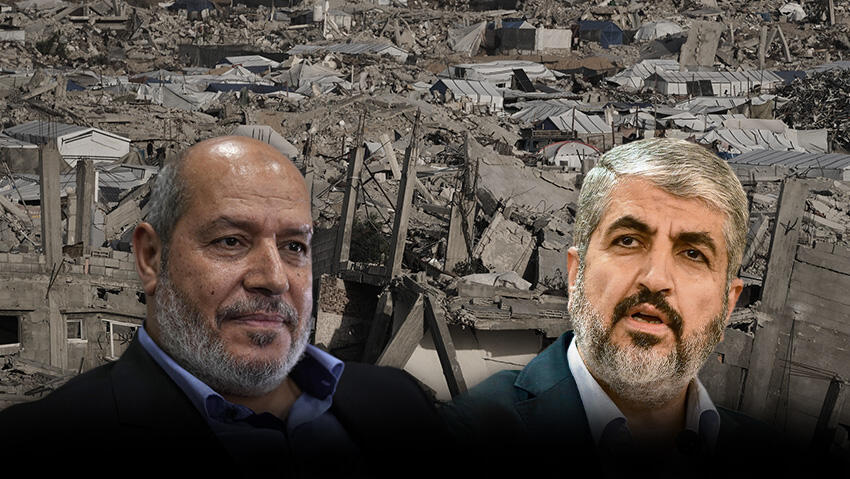
The two leading candidates to head Hamas are Khalil al-Hayya, who served as Hamas’ leader in Gaza, and Khaled Mashaal, Hamas’ leader abroad. Al-Hayya, who was born in Gaza, is seen as having the support of Hamas terrorists in Gaza. Mashaal, who led Hamas for years, is seen as having the support of the organization abroad. Al-Hayya is more identified with the Iranian axis, while Mashaal is more identified with the Muslim Brotherhood axis — Qatar and Turkey.
Qatar’s Al-Araby reported Saturday that “Gaza has completed the voting process,” and that the process determined who would succeed al-Hayya as Hamas’ leader in the Strip if he becomes head of the political bureau. According to the report, Hamas abroad and Hamas in the West Bank are expected to complete the voting process soon, and the announcement of the head of Hamas’ political bureau could be made this week.
Hamas has suffered major shocks throughout the war, since the Oct. 7 massacre. In July 2024, Ismail Haniyeh, head of the organization’s political bureau, was killed in Tehran. His place was taken by Sinwar, then Hamas’ leader in Gaza and one of the architects of the Oct. 7 massacre, who was killed three months later. Following the many eliminations during the war, Hamas began operating under a five-member leadership council that is temporarily managing the terrorist organization until a new leader is appointed.
Mashaal and al-Hayya are both members of that council, alongside Zaher Jabarin, Mohammed Darwish and Nizar Awadallah. A December report by the Saudi newspaper Asharq said the decision to dismantle the council and choose a permanent leader was based on two main factors: the ceasefire in Gaza, which ended the organization’s “state of emergency,” and sharp internal disputes over strategic issues, first and foremost the future of Hamas rule in Gaza and the organization’s regional alliances.
Mashaal currently serves as Hamas’ leader abroad and is considered one of the most powerful people in the organization’s political bureau. But his views differed from those of Sinwar, including on ties with Iran. He headed Hamas’ political bureau for 21 years, from 1996 to 2017, when he decided to step down and was replaced by Haniyeh. In 2021, he was again elected Hamas’ leader abroad in an attempt to return to the Palestinian political arena. In 1997, he survived a failed Mossad assassination attempt in Jordan.
Mashaal was indicted in the United States last year over his alleged involvement in the Oct. 7 massacre. He lives a life of luxury in Qatar, and his fortune has previously been estimated at $4 billion to $5 billion.
(Photo: Murat Cetinmuhurdar/Turkish Presidential Press Office/ REUTERS)
Al-Hayya, who was Sinwar’s deputy, left Gaza before Oct. 7 and has since grown stronger inside the organization. He led Hamas’ negotiating team in talks on the ceasefire and hostage deal on behalf of the terrorist organization, and also attended Haniyeh’s funeral in Tehran after his killing in 2024.
The New York Times reported that al-Hayya was part of the small military council Sinwar convened for two years to plan the Oct. 7 attack, and that he was also the special envoy for secret talks on the matter with Iran and Hezbollah.
Meanwhile, the Security Cabinet will convene Sunday evening and discuss the situation in Gaza, against the backdrop of Hamas’ continued refusal to agree to a disarmament framework. If Hamas continues to stand by its refusal, Israel is expected to prepare for renewed fighting, and that will also be discussed by the Cabinet.
However, Israel is preparing for the possibility that the United States will not give a green light for renewed fighting. In fact, the assessment is that the Americans will not allow Israel to “run wild” in Gaza, just as the United States is limiting Israel in Lebanon.
Renewed fighting in Gaza requires a decision by the political echelon, but Israel faces international constraints. In addition, there is the question of whether the IDF can operate at full force in Gaza while it is heavily occupied in Lebanon. The assessment is that as long as the northern front is burning, the IDF will have difficulty conducting high-intensity fighting in Gaza and will be able to act surgically in the current format of limited strikes. There is also the possibility of renewed war with Iran, which would take up most of the IDF’s attention.
A source in the Board of Peace said the plans will succeed only if Hamas is fully disarmed — by agreement or by war. Without full disarmament, there will be no reconstruction or investment in Gaza.
Against the backdrop of reports that the U.S. headquarters in Kiryat Gat will close, Israeli officials familiar with the matter said the reports were not surprising, given that the United States is busy with Iran and has largely lost interest in Gaza.
(Photo: AP Photo/Ariel Schalit)
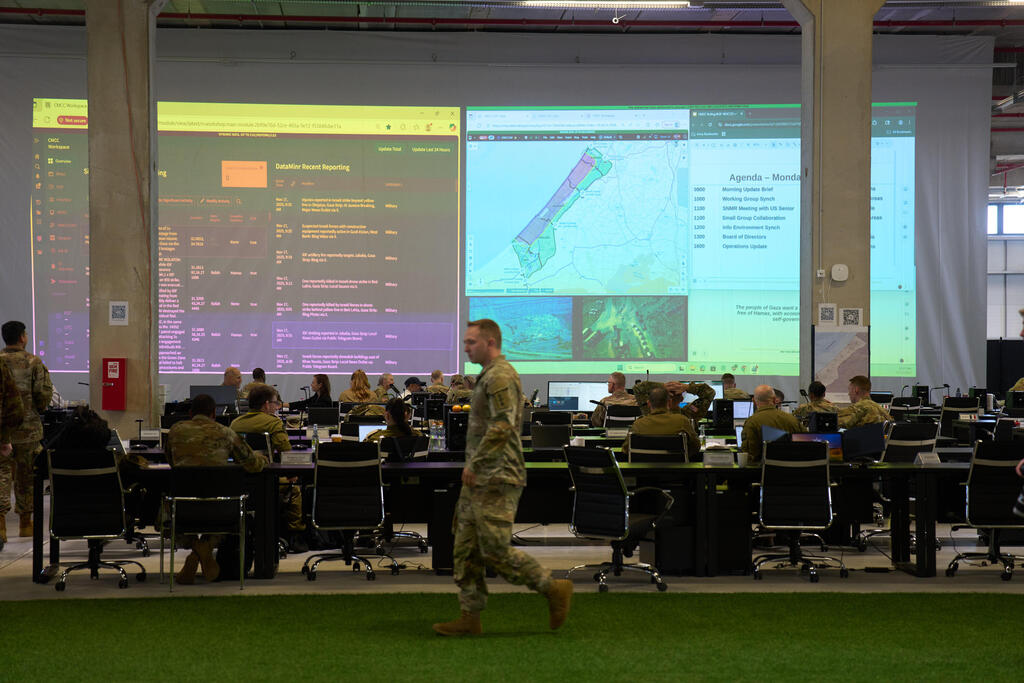
More than six months after it opened with great fanfare, the multinational headquarters in Kiryat Gat, established by the United States after the hostage deal and ceasefire in Gaza, is expected to be closed by the Trump administration, officials familiar with the matter told Reuters on Friday.
Diplomats and other officials said the move to close the U.S. military-run headquarters, which has not yet been officially announced, shows the difficulties the United States faces in trying to monitor the ceasefire while Israel takes control of additional areas in Gaza and Hamas rebuilds more and more of its strength in the Strip.
The closure of the Civil-Military Coordination Center, the headquarters’ official name, would be the latest blow to Trump’s plan for Gaza’s future, which is already shaky because of Hamas’ refusal to disarm and continued IDF strikes since the ceasefire was declared in October.
Trump’s Board of Peace for Gaza denied the report, saying any claim that the coordination headquarters would close was incorrect. It said the headquarters was advancing efforts to continue delivering aid at an unprecedented level in modern history, that far more people were receiving food and that nutrition had improved dramatically, according to the U.N. It also said the headquarters had played an essential security role, with the ceasefire holding despite predictions by experts, and that work was underway to establish a transitional government in Gaza and an international stabilization force.
According to seven diplomats familiar with the CMCC’s activity, the U.S.-led center will soon close, and responsibility for delivering humanitarian aid to Gaza, as well as monitoring developments in the Strip, will be transferred to a U.S.-commanded international security force expected to deploy in Gaza. U.S. officials have described the move in closed conversations as “reorganization,” but diplomats said it would in practice close the center once the International Stabilization Force takes up its role — a force Washington has so far struggled to establish.