


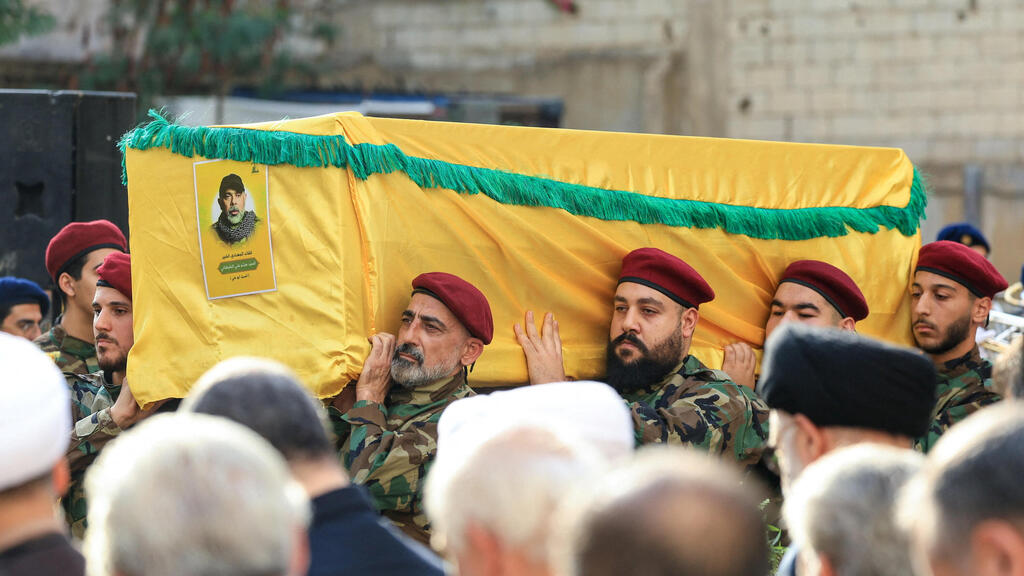
Amid turmoil inside Hezbollah following the killing of its military chief Haytham ‘Ali Tabataba’i, the Hezbollah-aligned newspaper Al-Akhbar on Tuesday acknowledged the “distress” caused by what it called a “severe blow.” The paper’s front page headline read: “The assassination of Tabataba’i — the enemy clings to madness.”
Hezbollah has not yet issued an official response, and Al-Akhbar wrote that the organization is maintaining deliberate ambiguity over how it will react, while refusing any “bargaining” over its weapons. The paper suggested Hezbollah is using the killing to strengthen its domestic position in Lebanon.
“The enemy is paving the way for a new round of aggression, and collaborators from within Lebanon are helping by calling for immediate disarmament,” the newspaper wrote, criticizing the Lebanese government. It added: “Once again, enemy leaders revel in a victory euphoria. They managed to inflict a harsh blow on Hezbollah. They act as though they can do more unless the Lebanese government agrees to dismantle Hezbollah’s arsenal, even by force, and close this chapter.”
Al-Akhbar claimed Israel “is ready for another round of fighting, just as it was last year,” and said Hezbollah’s official statements since the strike reveal both its internal difficulties and its attempts to maintain legitimacy in Lebanon and protect its weapons.
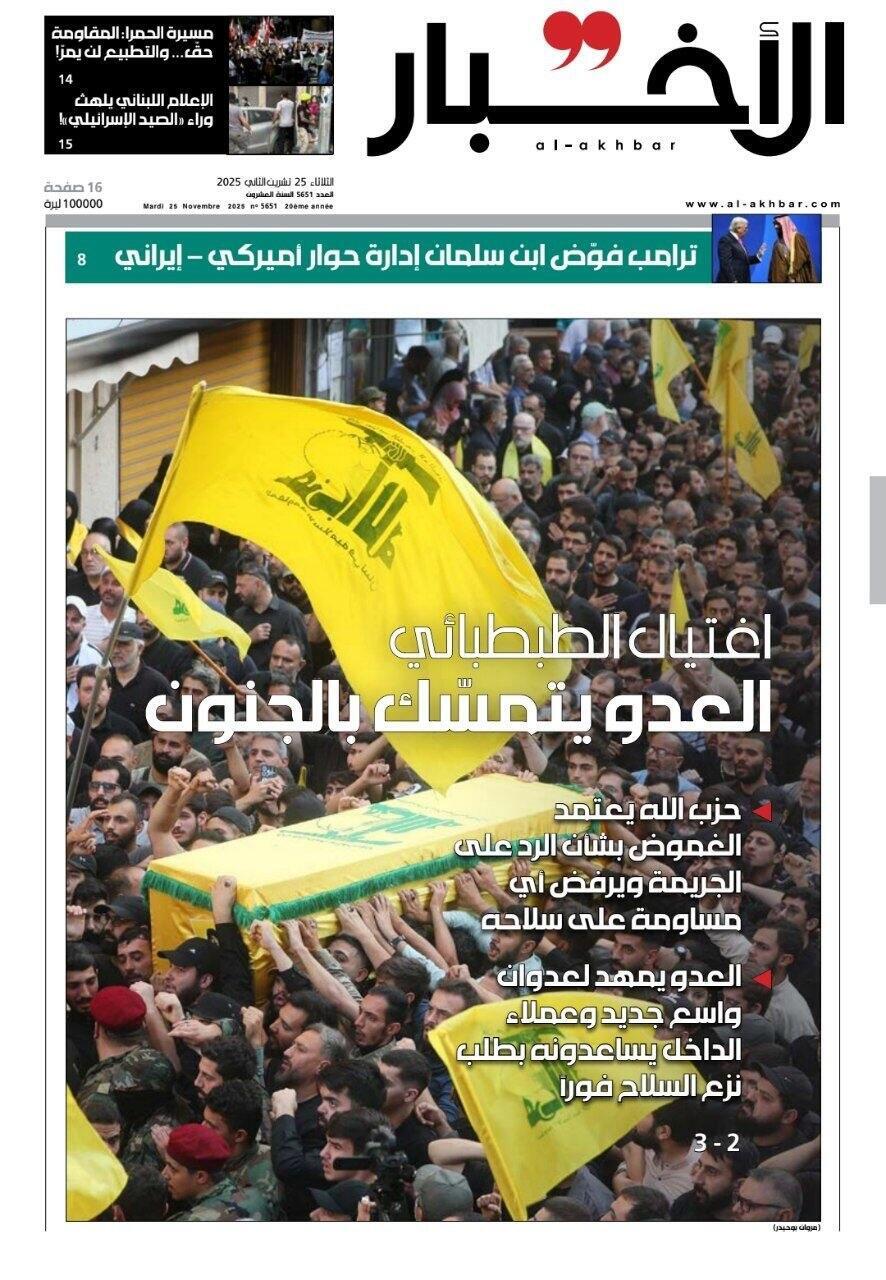
Al-Akhbar front page
The strike comes as Lebanon’s new leadership — President Joseph Aoun and Prime Minister Nawaf Salam — pushes to consolidate all weapons under state control and disarm Hezbollah, in line with an agreement reached with Israel last year.
Lebanese officials expressed concern that the strike has given Hezbollah new justification to resist disarmament. Parliament Speaker Nabih Berri told the Lebanese daily Al-Joumhouria that the most dangerous aspect of Tabataba’i’s killing is that it returned Dahiyeh and Beirut to “the circle of Israeli targets.”
He called the strike “a very dangerous development, showing there are no real guarantees for protecting Beirut and Dahiyeh in light of the enemy’s ongoing violations.” Berri accused Israel of escalating at a pace “unchecked” by the cease-fire monitoring body, which he said is focused on watching the Lebanese Army while ignoring Israeli violations.
He added that Israel “is exploiting Lebanon’s fragile internal situation to continue its violations, using the country’s divisions for its own interests.”
Amid renewed concerns over Iranian influence in Lebanon, Mohsen Rezaei, a member of Iran’s Expediency Council, said Monday that the “resistance” in Lebanon is now stronger than it was under former Hezbollah leader Hassan Nasrallah. Rezaei said Iran does not dictate policy to other states but argued Hezbollah should “reconsider its patience and restraint strategy because Israel is exploiting it,” adding there must be a “point of no return,” which Lebanon’s resistance factions themselves must determine.