

On October 6, 2023, Israel appeared to be on the verge of a historic shift in its position in the Middle East, edging closer than ever to genuine regional integration. The Abraham Accords had already created a new framework with the United Arab Emirates, Bahrain and Morocco, while advanced U.S.-brokered negotiations were underway toward normalization with Saudi Arabia. Even relations with Turkey, after years of severe crises, were warming.
One day changed the picture. Three years of war, bloodshed and regional confrontation have dramatically reshaped the political map. Arab and Muslim governments now issue frequent condemnations of Israeli military action in Gaza, Lebanon, Iran and Yemen, even as Israel argues it was attacked first in each arena. Much of Israel’s relationship with Gulf states has moved back below the radar. The question is no longer simply how the wars will end, but whether Israel can still integrate into the region or is drifting toward the position of a militarily powerful but politically isolated state surrounded by increasingly hostile public opinion.
Gallery
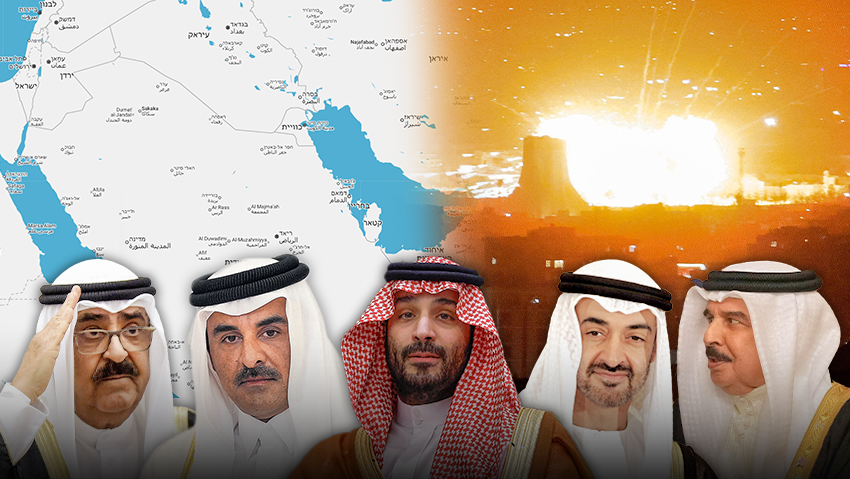
Qatar’s Emir Sheikh Tamim bin Hamad Al Thani, Saudi Crown Prince Mohammed bin Salman, Bahrain’s King Hamad bin Isa Al Khalifa, UAE President Sheikh Mohamed bin Zayed Al Nahyan and Kuwait’s Emir Sheikh Mishal Al-Ahmad Al-Jaber Al-Sabah
(Photo: Getty Images; Hamed Jafarnejad/ISNA/WANA via Reuters; Jonathan Ernst/Reuters; Shutterstock; Bandar Algaloud/Saudi Royal Court/Handout via Reuters; Alastair Grant/Pool/AFP; AP; Yasser Al-Zayyat/AFP; Alex Brandon/AP; Evelyn Hockstein/Pool/AFP; Ryan Lim/AFP; Atta Kenare/AFP)
Useful behind closed doors
Israel has never been completely isolated in the Middle East. Even during periods of intense hostility, it maintained political, intelligence and security channels with Arab countries. Secret contacts existed from the state’s earliest years, while relations with Egypt and Jordan eventually became formal peace treaties in 1979 and 1994. Those agreements did not erase political disagreements, but they created shared interests in border security, intelligence, water, trade, U.S. assistance and regional stability.
That distinction remains important today. A senior Israeli official involved in relations with Arab states said ties with Egypt and Jordan are now primarily security-based. Formal peace remains intact, but it does not necessarily translate into political closeness or warm public relations. Regional states, he said, operate according to interests, not only sentiment. For many of them, Israel’s principal value lies in its intelligence, defense systems, cyber capabilities, early-warning technology and ability to confront internal and external threats. Israel, in that sense, is less an ideological partner than a strategic asset.
But this also exposes a weakness. Relationships built almost entirely around intelligence and security may survive for years without producing durable public peace. When ties remain hidden, Israel can become something like the region’s “mistress”: useful behind closed doors, but not legitimate enough to embrace openly. Since October 7, public ties have become increasingly rare even with Abraham Accords states.
Bahraini geopolitical adviser and commentator Ahmed al-Kooheji, who lives in the United States, told ynet that Israel’s relations with Bahrain and the UAE differ fundamentally from its ties with Saudi Arabia and other Gulf states. “The countries that signed the Abraham Accords gave Israel a central role in their national security systems,” he said. “The security and intelligence partnership became part of the regional deterrence equation, as was demonstrated during the wars with Iran.”
He said Bahrain and the UAE view Israel as a strategic ally capable of providing advanced technology and direct security support, reflected in joint cyber and air-defense projects. Saudi Arabia, however, operates according to a different set of calculations. “Riyadh balances its leadership role in the Islamic world with its strategic interests with major powers,” al-Kooheji said, making its relationship with Israel subject to broader political and religious considerations. Israel, he argued, has therefore not simply “retreated” across the region. Its position differs from one country to another: a direct security partner in Bahrain and the UAE, but still an observer or undeclared partner in Saudi Arabia and elsewhere.
The Abraham Accords model
The Abraham Accords demonstrated that this cycle could be broken, at least before the war. Various Arab states had maintained different levels of contact with Israel before signing. What changed was the move from secret rooms to official relations: aviation, trade, investment, tourism, technology and joint ventures.
The senior Israeli official argues that this remains the model for the future. Israel’s security advantage, he said, must be expanded into agriculture, industry, water technology, economic development and other visible forms of cooperation.
Abu Dhabi does not choose camps
In the UAE, officials and commentators describe ties with Israel as having survived the regional upheaval, while stressing that partnership does not eliminate political disagreement. Sultan al-Ali, an Abu Dhabi media figure, told ynet that UAE-Israel relations over the past three years have remained based on “shared interests and cooperation,” despite clear differences, particularly over the Palestinian issue.
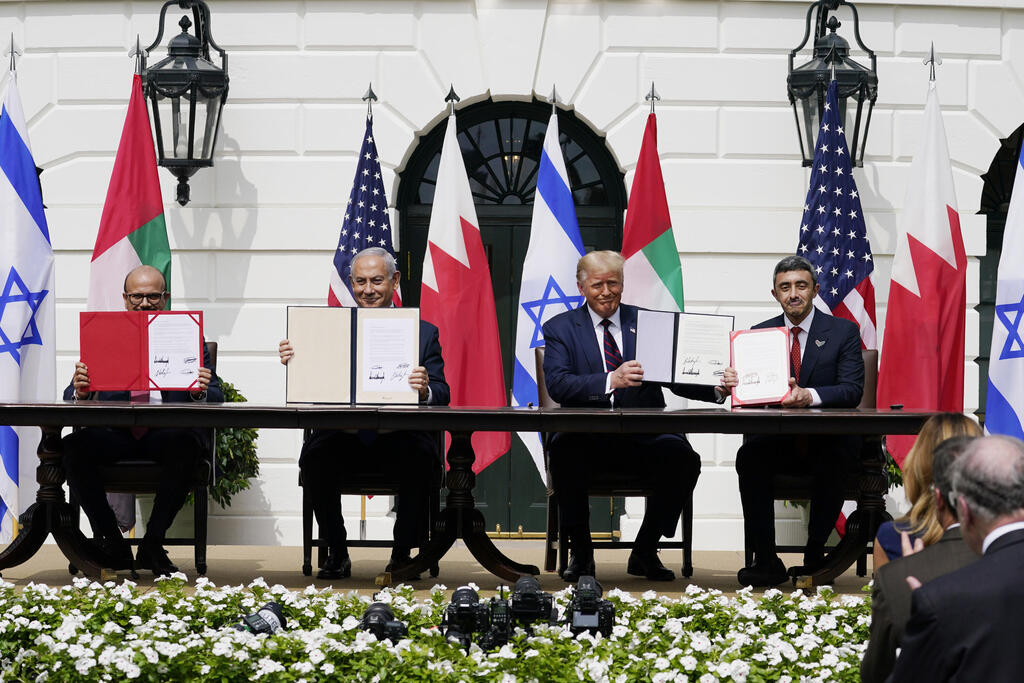
Abraham Accords signing ceremony
(Photo: Alex Brandon/AP)
The UAE, he said, has maintained its call for de-escalation, civilian protection, a two-state solution and the establishment of an independent Palestinian state. At the same time, Abu Dhabi does not see its relationship with Israel as joining a geopolitical camp. “The UAE pursues a balanced and open foreign policy toward countries across the region,” al-Ali said, based on dialogue, reducing tensions, economic partnerships and development. He described Emirati policy as driven not by bloc politics or polarization, but by national interests and regional stability.
Saudi Arabia is the real test
Saudi Arabia remains the biggest test of whether Israel can restore the regional momentum it had before October 7. On the eve of the attack, normalization with Riyadh appeared closer than ever. Washington was seeking to connect a U.S.-Saudi defense pact, civilian nuclear cooperation and Saudi-Israeli normalization. Even after the war began, U.S. officials made clear that the work done beforehand was not necessarily dead. But by 2026, the political price had changed dramatically.
Saudi commentator Abd al-Hamid al-Ghobain told ynet that Riyadh’s regional approach begins from a basic premise: “You cannot build a strong economy and major development projects in a region standing on the brink of war.” Saudi national interests, he said, are therefore directly linked to political, security and economic stability. “Stability here is not a moral slogan,” he said. “It is a strategic necessity for the Saudi development project itself.”
Saudi Arabia now states explicitly that normalization will not happen without an “irreversible path” toward the establishment of a Palestinian state. Al-Ghobain stressed that this is not simply a tactical negotiating position. “Each Gulf state has its own calculations and interests,” he said. “Regarding Saudi Arabia, its position is clear and public: There is no normalization without a genuine path leading to the establishment of an independent Palestinian state. This is not a temporary bargaining chip, but a stable political principle in the Saudi position.”
A precise return to October 6, 2023, therefore appears unrealistic. But a return to the potential that existed then may still be possible. Saudi and Israeli strategic interests have not disappeared. They now come with a much heavier political price. At present, Israel shows little willingness to pay that price on the Palestinian issue, and many in the region believe normalization will not happen as long as Prime Minister Benjamin Netanyahu remains dependent on far-right coalition partners.
Al-Kooheji argued that if Israel cannot achieve tangible progress on the Palestinian question, it should at minimum avoid escalation that could provide Arab governments with an excuse to delay or undermine normalization. Yet he also noted that the Palestinian issue itself has become more complicated in Gulf politics. As some Palestinian factions moved closer to Iran, he said, they lost considerable public and political support in the Gulf. National security increasingly became the dominant priority, encouraging Gulf governments to view Israel through the prism of strategic interests rather than traditional solidarity with the Palestinians.
Syria may also enter the picture
Ahmed al-Sharaa’s Syria could also become part of Israel’s regional equation, despite Israeli suspicions toward the Sunni leader and his intentions. Damascus has openly discussed the possibility of a security agreement with Israel, and al-Sharaa has said such an arrangement could become a gateway to broader peace.
But the relationship remains highly sensitive, with the Golan Heights still a central obstacle. Israel also views the emerging axis among al-Sharaa, Saudi Arabia and Turkey with concern, seeing it as a factor that could make an agreement more difficult. The United States continues trying to mediate between the sides and has pressed for renewed negotiations.
A new regional security architecture
Even as Israel seeks to preserve and expand its own relationships, Middle Eastern states are building new security systems that do not depend on it. One of the most significant is the so-called Mecca Agreement among Saudi Arabia, Pakistan and Turkey, designed to create a mechanism of collective deterrence.
Al-Ghobain said Saudi Arabia had repeatedly tried to establish an Arab collective-security system but struggled to bridge the differing priorities of regional states. “The problem was that every country wanted the collective system to serve its own priorities and concerns,” he said. The Mecca Agreement, he argued, is built on a more limited principle: The security of the signatories is linked, and an attack on one affects the security of all.
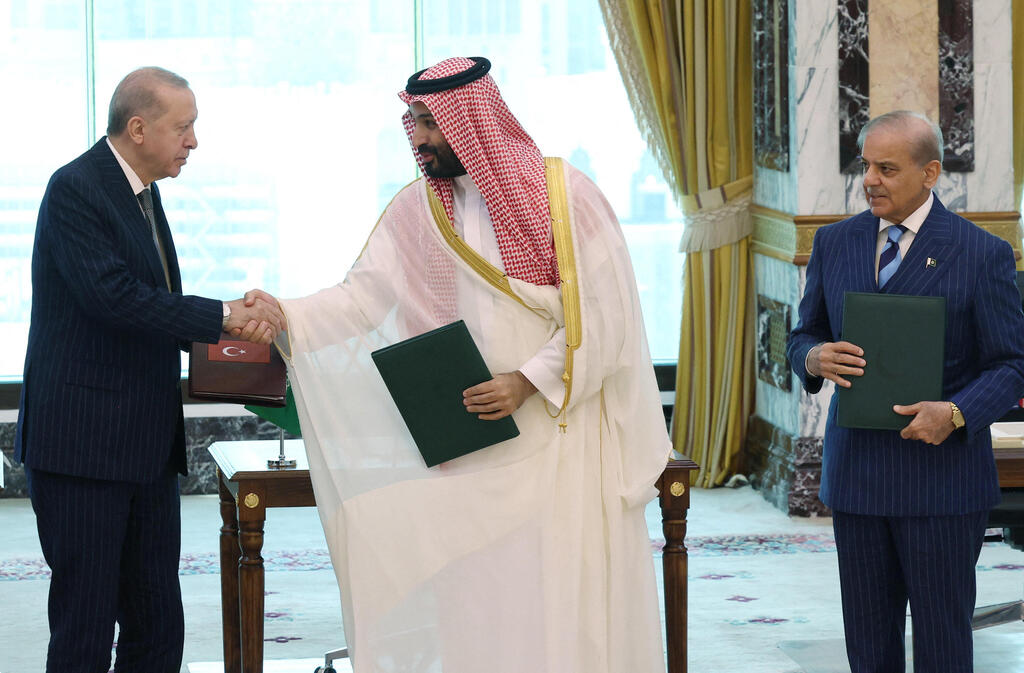
Signing of the Mecca Agreement between Saudi Arabia, Pakistan and Turkey
(Photo: Murat Cetinmuhurdar/Turkish Presidential Press Office/Handout via REUTERS)
He rejected the idea that the agreement is aimed specifically at Israel, Iran or any other state. “The agreement does not begin by defining the enemy,” he said. “It establishes the principle that anyone attacking a member state should understand that it is not confronting that country alone.” That does not automatically mean all three states would go to war, he added. The attacked country would determine the level of support it required, ranging from intelligence, logistics and ammunition to, if necessary, deployment of military units.
“Iran is not a target unless it attacks one of the signatory states, and Israel is not a target unless it attacks one of the signatory states,” al-Ghobain said.
Al-Kooheji views the arrangement differently, seeing it as part of a broader regional shift designed in part to deter Iran. Its signing in Mecca, he said, gave it symbolic and religious legitimacy while also opening the door to greater independence from the traditional U.S. security umbrella. Turkey and Pakistan’s ability to maintain channels with Tehran, he added, gives the alliance room to maneuver and may reduce the risk of a broader confrontation.
The fragile anti-Iran coalition
Unlike the public Mecca Agreement, the U.S.-led coalition against Iran is not a formal alliance but a changing network of shared interests. Israel, the United States and Gulf states share deep concerns over Iran’s missile program, arms shipments, shipping threats and pressure on energy routes. But this coalition remains fragile. Arab governments do not want to become an Israeli front against Tehran and prefer to preserve diplomatic channels of their own.
The Gulf itself is also far from unified. Al-Kooheji pointed to the different approaches of Qatar, Oman and Kuwait. Qatar and Oman, he said, continue trying to preserve their relationships with Iran, while Kuwait has taken a different approach centered more heavily on sovereignty and national security.
That is why a July 2026 phone call between President Isaac Herzog and Bahrain’s King Hamad bin Isa Al Khalifa stood out. The decision to publicize the call was viewed as a signal that, despite the regional tension and criticism directed at Israel, Bahrain did not intend to erase the infrastructure built between the countries. Al-Kooheji believes Bahrain’s decision to publicize the conversation was connected to the continuing war and intended to send Iran a message that regional states remain aligned against it.
The road back runs through Jerusalem
For Israel to take advantage of these opportunities, however, intelligence channels alone will not be enough. The senior Israeli official argued that Israel needs a single body capable of coordinating the diplomatic and security dimensions of these relationships and of expanding or limiting cooperation according to Israeli interests. The goal, he said, should be to transform secret relations into visible political and economic processes.
Al-Kooheji similarly argued that Israel must present itself as a reliable military and security partner. “Closer ties through security and intelligence agreements, and broader military cooperation, represent the most realistic path to building trust with Bahrain and the UAE, and also with Saudi Arabia if it decides to go down that path,” he said. “These countries see national security as their highest priority, and Israel is required to demonstrate its ability to contribute to protecting vital interests, especially in light of escalating regional threats.”
The real question, then, is not whether Israel can survive alone in the Middle East. It can. The question is whether it is prepared to invest in building the Middle East in which it wants to live. The Israeli official believes the potential that existed before October 7 can still be revived, but only if Israel first achieves what he called “a calm and stable domestic arena.”
At present, wars erupt and end in fragile agreements every few months, while across much of the Middle East Israel is still widely blamed for the instability. In other words, the road back into the region does not run only through Riyadh, Cairo or Amman. It also runs through Jerusalem.
If Israel can create domestic stability, a coherent regional strategy and a credible diplomatic path, October 6 may ultimately prove not to have been the end of an era, but the high point of a process that can still be revived under different circumstances. If not, Israel may discover that the military superiority that allows it to survive in the Middle East does not necessarily allow it to belong there.