

The meeting that ended earlier this evening at the White House between Prime Minister Benjamin Netanyahu and U.S. President Donald Trump was not supposed to take place at this time. At its conclusion, White House spokeswoman Karoline Leavitt said the meeting was “positive and productive,” after which the two left for the memorial service for Sen. Lindsey Graham.
The window of opportunity that opened following the tragic death of Sen. Graham allowed Netanyahu to travel to Washington to accompany him on his final journey and, along the way, secure the long-awaited meeting.
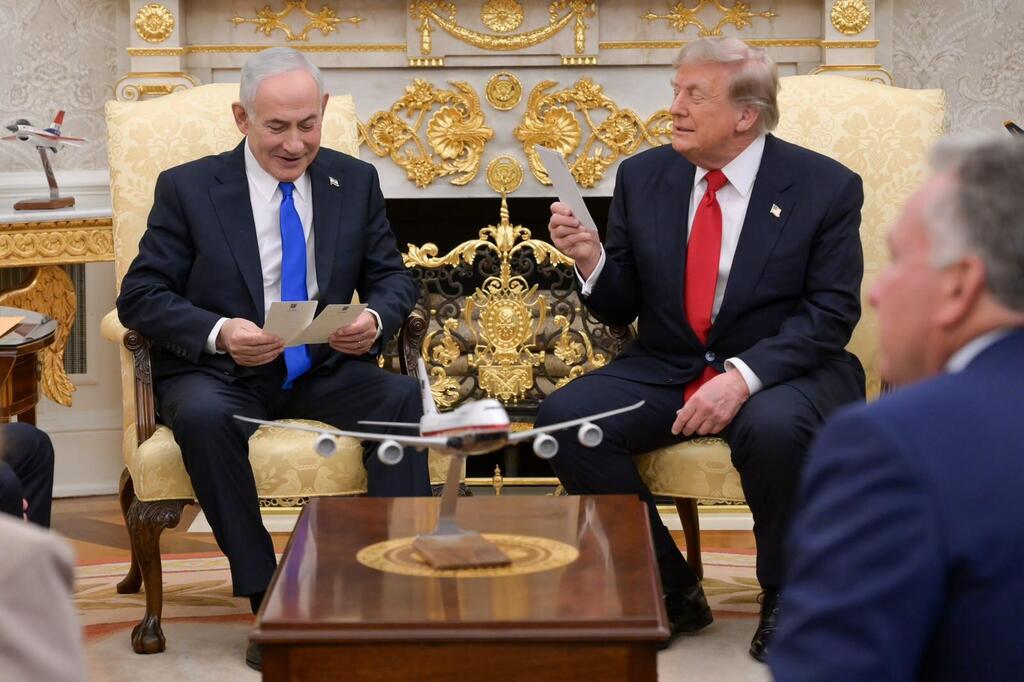
The meeting that ended earlier this evening at the White House between Prime Minister Benjamin Netanyahu and U.S. President Donald Trump was not supposed to take place at this time
(Photo: Maayan Toaf/GPO)
However, according to assessments, in order for the meeting to take place, Netanyahu had to pay a steep price: convening the cabinet and approving the entry of stabilization forces into Gaza.
It is no secret that Israel’s leadership struggled to coordinate this meeting, especially after, at the beginning of June, following another targeted killing in Lebanon, the president said Netanyahu was “crazy.”
Less interested in the 'mushroom cloud'
But during the meeting itself, Netanyahu attempted to raise the Iranian file. The prime minister arrived with the intention of sharing updated intelligence on continued efforts to develop a nuclear weapon, but Trump had already brushed aside the issue earlier in the day, making clear that he did not need additional information about the “mushroom cloud.”
What Trump likely sought to convey to Netanyahu, precisely now, when Israel is so close to elections and this is likely the final meeting before the public heads to the polls, was a sharp and clear political message.
It can be estimated that the president wanted to make clear that if Netanyahu is tasked with forming the next government, he will have to present a completely different coalition. By this logic, it is no coincidence that Netanyahu has recently begun speaking about a national unity government.
Trump is fully invested in the regional arena and frustrated with the current Israeli government, which is obstructing his plans, whether it is Finance Minister Bezalel Smotrich speaking about the Saudis as camel riders or provocative visits by National Security Minister Itamar Ben-Gvir to the Temple Mount, which even U.S. Ambassador to Israel Mike Huckabee, an evangelical Christian Zionist, condemned.
That frustration reached Vice President JD Vance, who explicitly mentioned the two ministers by name and said: “Itamar Ben-Gvir and Bezalel Smotrich, what is your proposal? If I was in the cabinet of the Israeli government, I might not be attacking the only powerful ally that I have anywhere left in the entire world.”
The president has a clear set of priorities and wants to continue the momentum of the Abraham Accords and bring Saudi Arabia into the initiative. All of this is alongside connecting the broader economic and strategic vision of the IMEC corridor.
Donald Trump is deeply invested in Lebanon. Last week, he hosted Lebanese President Joseph Aoun for talks on renewing flights and trade, alongside Aoun’s historic declaration of his intention to reach a peace agreement with Israel. This comes in addition to a delegation of American business leaders that visited Damascus for the first time two weeks ago and recent remarks by Syrian President Ahmed al-Sharaa that he intends to ultimately pursue a peace agreement with Israel.
 Dr. Kobi Berda Photo: Tal Givony
Trump has an ambitious vision of connecting a 3,000-year-old conflict between the two sons of Abraham, toward what he hopes will become his legacy and, above all, the Nobel Peace Prize he so strongly desires.
Meanwhile, the continuation of direct fighting with Iran is influenced primarily by domestic American considerations. The countdown began two and a half weeks ago, on Friday the ninth of the month, when Trump submitted an official notification to Congress regarding a return to hostilities, which are expected to end just before the U.S. midterm elections.
At this point, he faces three main options.
The first is a continuation of the naval and economic blockade alongside targeted strikes. The second is a ground invasion to seize what he describes as the collection of nuclear dust. The third is the capture or bombing of energy facilities on Kharg Island.
In any case, as we have seen so far, both sides involved in the fighting, Iran and the United States, prefer at this stage not to draw Israel directly into this confrontation.
Dr. Kobi Berda is a lecturer at the School of Multidisciplinary Studies at the Holon Institute of Technology (HIT) and a research fellow at the Jewish People Policy Institute (JPPI).