

Turkish President Recep Tayyip Erdoğan said over the weekend that Turkey has no interest in the territory or sovereignty of other nations, amid growing regional friction with Israel, Greece and Cyprus.
Speaking at a naval ceremony in Istanbul where he commissioned new military vessels, Erdoğan said Turkey “does not want any tension, crisis or conflict with any country,” and added that his government’s “only desire is peace and stability for our neighbors.” He also issued a pointed warning that “Turkey will not allow violations of its rights or what belongs to it,” language seen as an assertion of Ankara’s maritime and strategic claims.
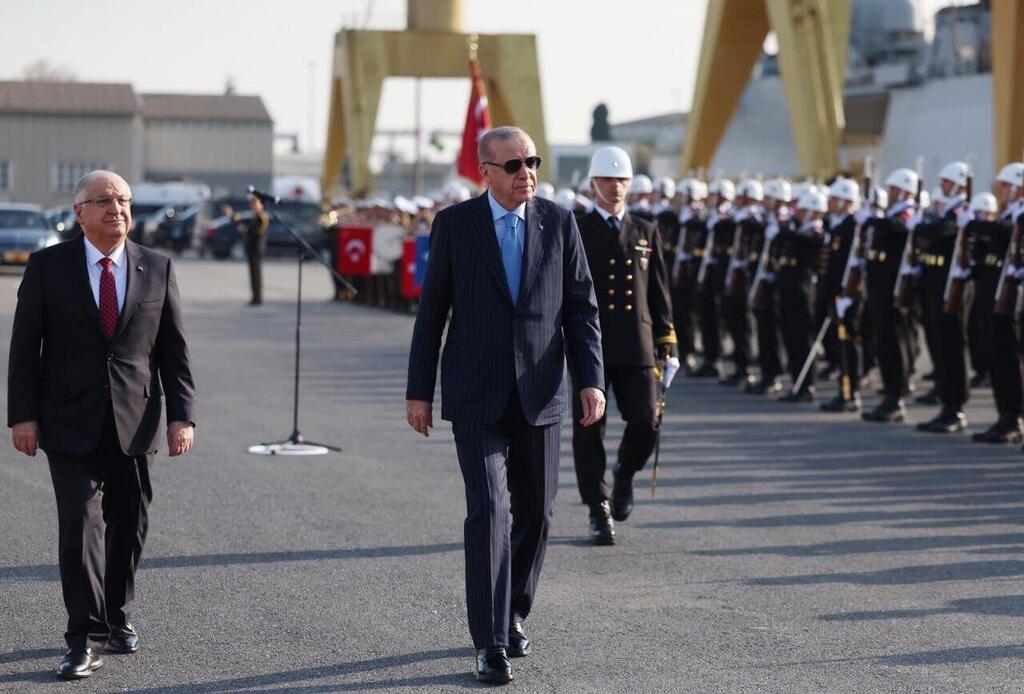
The remarks come ahead of a trilateral summit in Jerusalem Monday, where Prime Minister Benjamin Netanyahu is set to meet Greek Prime Minister Kyriakos Mitsotakis and Cypriot President Nikos Christodoulides to deepen security and energy cooperation amid tensions with Ankara.
Israel has denied press reports about establishing a joint intervention force with Athens and Nicosia, but senior defense officials told local media that the Ministry of Defense, under Defense Minister Israel Katz, has begun early planning discussions. Formal action has not yet been taken, and government sources said they are awaiting instructions from Netanyahu and Katz.
At the Istanbul ceremony, Erdoğan highlighted several new naval assets, including the TCG Hızır Reis submarine and armed unmanned vessels, saying they were intended to “defend peace, independence and the future,” not to prepare for war. Turkey’s expanding naval capability falls under its controversial “Blue Homeland” (Mavi Vatan) doctrine, which aims to extend Turkish influence across the Aegean Sea, Eastern Mediterranean and Black Sea.
The strategy, developed over two decades, challenges established maritime boundaries and has drawn strong objections from Greece and Cyprus, who say it threatens their sovereign rights and access to energy resources. Critics also note that Turkey is not a signatory to the U.N. Convention on the Law of the Sea, which governs maritime boundaries.
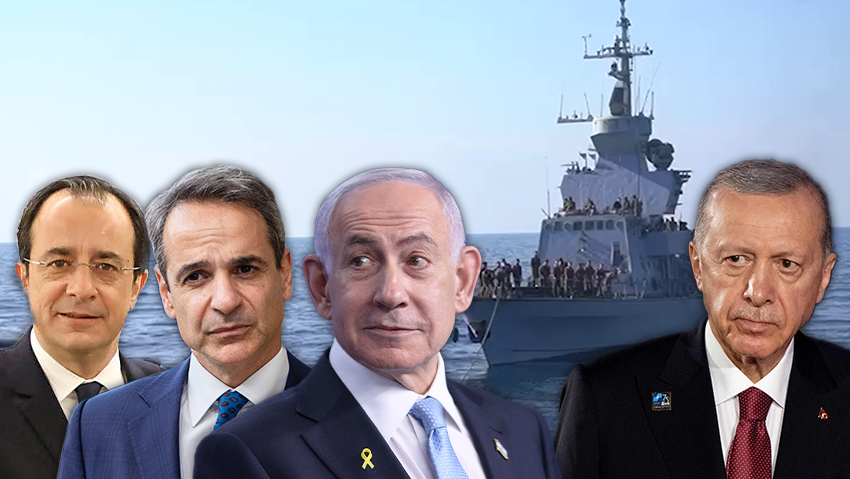
(Photo credit: Andrew Harnik/Getty Images North America/AFP, Alex Kolomoisky, AFP Photo/HO/IDF Spokesperson)
Tensions have occasionally spilled into the air, with Turkish military jets entering Greek airspace and prompting intercepts by Greek fighters. Israel’s growing cooperation with Greece and Cyprus — including air, land and sea exercises — reflects a shared interest in countering Ankara’s assertiveness.
While both Greece and Turkey are NATO members, longstanding disputes — especially over Cyprus — have kept relations strained. Observers say that if Israel contributes additional intelligence and airpower to its cooperation with Athens and Nicosia, it could significantly shift strategic calculations in the Eastern Mediterranean.
Israeli officials say the country does not seek a military confrontation with Turkey. Still, Erdoğan’s rhetoric — coupled with Ankara’s close ties to U.S. leadership and proposals to deploy Turkish troops to a future stabilization force in Gaza — has pushed Jerusalem to strengthen political, diplomatic and military ties with Greece and Cyprus as a deterrent.