


Prime Minister Benjamin Netanyahu is once again calling for a national unity government, reviving a political tactic he has used repeatedly over his long career: bringing rivals from the center or center-left into a coalition otherwise anchored by his traditional right-wing and religious partners.
The latest appeal comes as Yashar! leader Gadi Eisenkot moves toward receiving the mandate to form Israel’s next government. President Isaac Herzog announced that Eisenkot, who was recommended by 67 lawmakers compared with 46 for Netanyahu, would be tasked with forming a coalition. Netanyahu, meanwhile, has publicly declared that “this is a time for unity” while showing no sign that he intends to abandon the parties that make up his existing bloc. ynet
Gallery
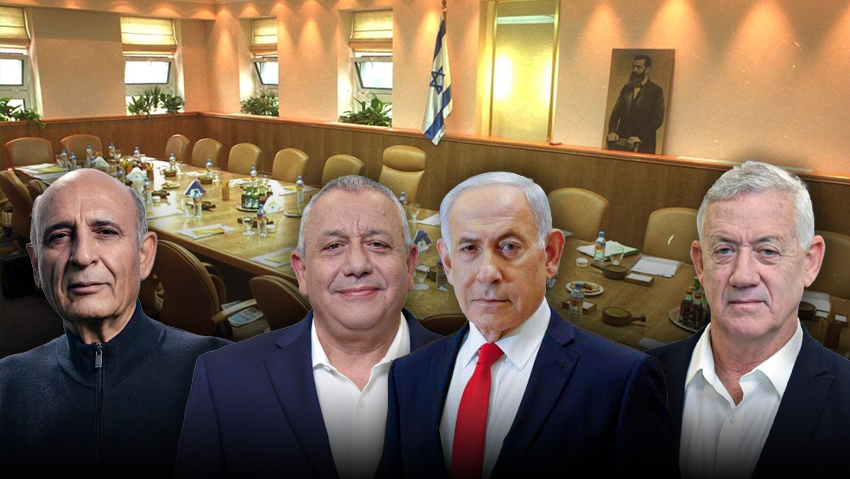
Benny Gantz, Benjamin Netanyahu, Gadi Eisenkot and Shaul Mofaz
(Photo: Ryan Frois, Gabriel Baharlia)
Netanyahu has made similar moves before. Some produced formal unity governments, others collapsed before an agreement was signed, but all were accompanied by intense political friction and eventually came apart.
2009: Labor joins Netanyahu
Kadima, led by Tzipi Livni, emerged as the largest party in the 2009 election with 28 seats, one more than Likud. But Netanyahu secured the support of 65 lawmakers and received the mandate to form a government. After Livni refused to join him, Netanyahu turned to Labor leader Ehud Barak, whose party had fallen to 13 seats.
Barak initially declared that Labor belonged in the opposition and set conditions for joining the coalition. He objected, among other things, to Avigdor Liberman determining who would head key law-enforcement institutions. Eventually, however, Barak concluded that a narrow right-wing government presented its own problems and agreed to join Netanyahu as defense minister and deputy prime minister.
The arrangement immediately triggered deep opposition inside Labor. In January 2011, amid mounting pressure from party colleagues to leave the coalition, Barak split from Labor with four other lawmakers and established the Independence faction, which remained in Netanyahu’s government through the end of the term.
2012: the 94-seat coalition that lasted 70 days
In spring 2012, Netanyahu’s government appeared headed for early elections. Hours before the Knesset was due to vote on dissolving itself, however, he struck a surprise agreement with Kadima leader Shaul Mofaz, creating a 94-seat coalition. Mofaz was appointed minister without portfolio and deputy prime minister.
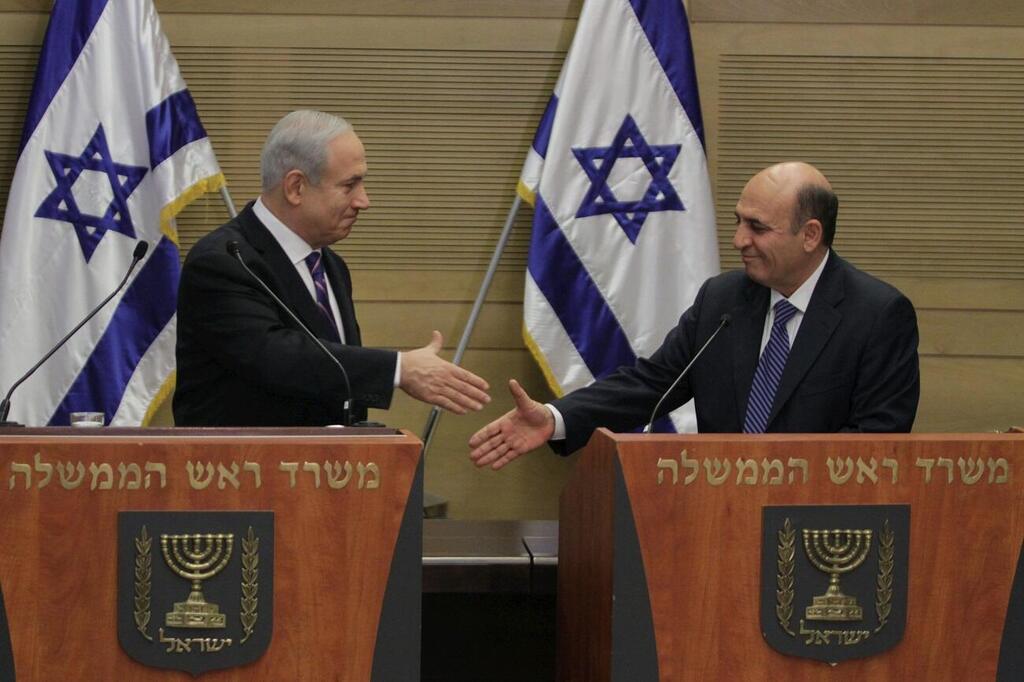
Shaul Mofaz and Benjamin Netanyahu. Their unity government collapsed after 70 days
(Photo: Alex Kolomoisky)
Netanyahu described the deal as a way to restore stability without elections and form a broad national unity government. The move was especially striking because Mofaz had repeatedly promised his voters that he would not join Netanyahu.
The coalition’s central objective was to pass legislation expanding military service among the ultra-Orthodox. It never happened. Mofaz demanded mandatory service and personal sanctions for draft evaders, while Netanyahu’s ultra-Orthodox partners threatened to bring down the government. Seventy days after joining, Kadima left. Mofaz accused Netanyahu of choosing “the draft dodgers,” while Netanyahu argued that reform had to be introduced gradually.
2015: the Herzog talks that never produced a deal
After the 2015 election, Netanyahu formed a narrow right-wing and ultra-Orthodox coalition with only 61 lawmakers. Over the following year, reports emerged of secret contacts with then-opposition leader Isaac Herzog over a possible unity government.
According to those reports, Netanyahu offered Herzog’s Zionist Union eight or nine senior ministries and discussed a regional diplomatic initiative backed by the United States and Jordan. Herzog denied that substantive negotiations had taken place, calling the reports fabricated.

Isaac Herzog
(Photo: Attila KISBENEDEK / AFP)
Whatever contacts did occur ultimately went nowhere. Opposition inside Labor was fierce, and Netanyahu simultaneously opened negotiations with Liberman. He eventually handed Liberman the Defense Ministry and brought Yisrael Beytenu into the coalition instead.
2020: Netanyahu and Gantz agree to rotate
In May 2020, after three consecutive elections failed to produce a decisive result and with the coronavirus pandemic gripping Israel, Benny Gantz entered a unity government with Netanyahu under a rotation agreement. Netanyahu was supposed to serve first as prime minister, with Gantz taking over after 18 months.
Netanyahu had framed the proposal as a response to a national and global emergency. Gantz initially denounced the offer, but ultimately joined, arguing there was no viable alternative. The partnership survived only about seven months.
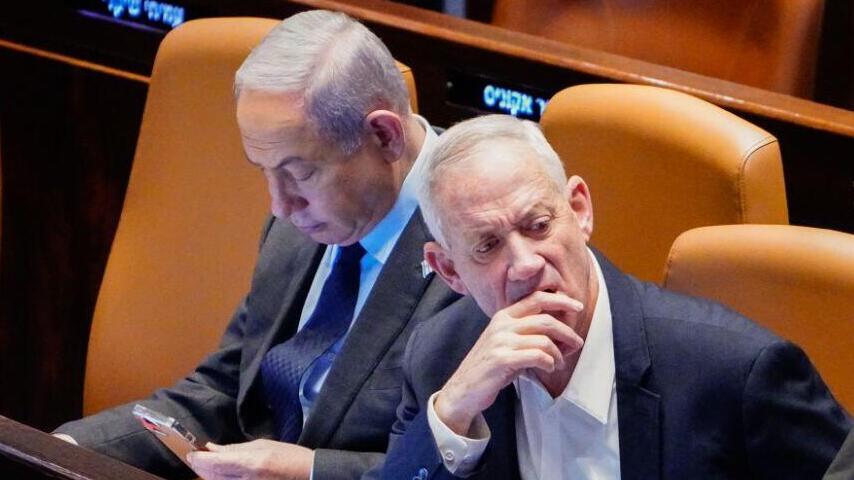
Benjamin Netanyahu and Benny Gantz
(Photo: Shalev Shalom)
The coalition collapsed in December after failing to approve a state budget. Under the Basic Law created for the rotation government, failure to pass the budget by the deadline triggered the Knesset’s dissolution, allowing Netanyahu to remain transitional prime minister rather than hand the premiership to Gantz. Likud had pushed for a one-year budget despite the coalition agreement’s provision for a two-year framework, turning the budget dispute into the central fault line of the government.
2023: the wartime emergency government
Gantz joined Netanyahu again only days after Hamas’ October 7, 2023 attack, this time without a rotation agreement. The purpose was explicitly wartime: Gantz entered a small war cabinet with Netanyahu and then-defense minister Yoav Gallant as Israel launched its campaign in Gaza.
The arrangement lasted roughly eight months. It eventually unraveled amid disagreements over management of the war, the absence of an agreed postwar plan for Gaza, efforts to secure the hostages’ release and renewed disputes over ultra-Orthodox military service.
In May 2024, Gantz gave Netanyahu a deadline to adopt a broader strategic plan. A month later, he pulled his National Unity faction out of the government, accusing Netanyahu of turning the idea of unity into “an empty slogan” and arguing that the prime minister was preventing Israel from moving toward what Gantz called “true victory.” He also demanded a date for elections.