

Last week, when Benjamin Netanyahu announced his decision to appoint his military secretary, Maj. Gen. Roman Gofman, as the next Mossad director, he said the choice was based in part on Gofman’s “creativity, initiative, cunning and deep understanding of the enemy.”
The Prime Minister’s Office described Gofman as “a highly accomplished officer” and listed his many senior roles in the IDF, including command of the 7th Armored Brigade, the Bashan Division and the Defense Ministry unit that oversees government activities in the territories. But the broader public knows little about the security worldview and thinking of the man tapped for one of the most strategically sensitive positions in Israel’s defense establishment.
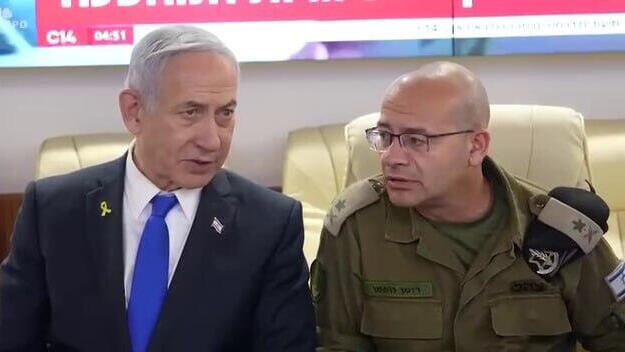
Some insight can be found in the period Gofman spent at the National Security College, Israel’s top institution for training senior military, security and government officials for leadership roles. Gofman began his studies there in September 2019, shortly after completing his command of the 7th Brigade. When he finished the program, he received a master’s degree in political science from the University of Haifa, was promoted to brigadier general and appointed commander of the Bashan Division.
In one of the papers he wrote during his studies, Gofman proposed a radical solution to the Iranian nuclear crisis: selling Israeli nuclear warheads to Egypt, Saudi Arabia and Turkey. The paper, titled Yesterday’s Doomsday, was written in late 2019 as part of a course taught by Dr. Anat Stern. It presents a hypothetical future scenario in which an Israeli prime minister describes a dramatic strategic shift in 2025, following a major Iranian leap toward nuclear weapons. Instead of thwarting regional nuclearization through traditional military or diplomatic tools, Gofman’s paper envisions a highly unconventional response: a controlled transfer of nuclear weapons to three key Middle Eastern states in order to create a new multi-polar strategic balance.
According to the hypothetical scenario, Israel ostensibly threatened to spread nuclear weapons in the region as leverage to draw in the major powers — the United States, Russia and China. The threat, Gofman wrote, led each power to “adopt” one state (Saudi Arabia, Egypt and Turkey, respectively) and arm it with nuclear weapons.
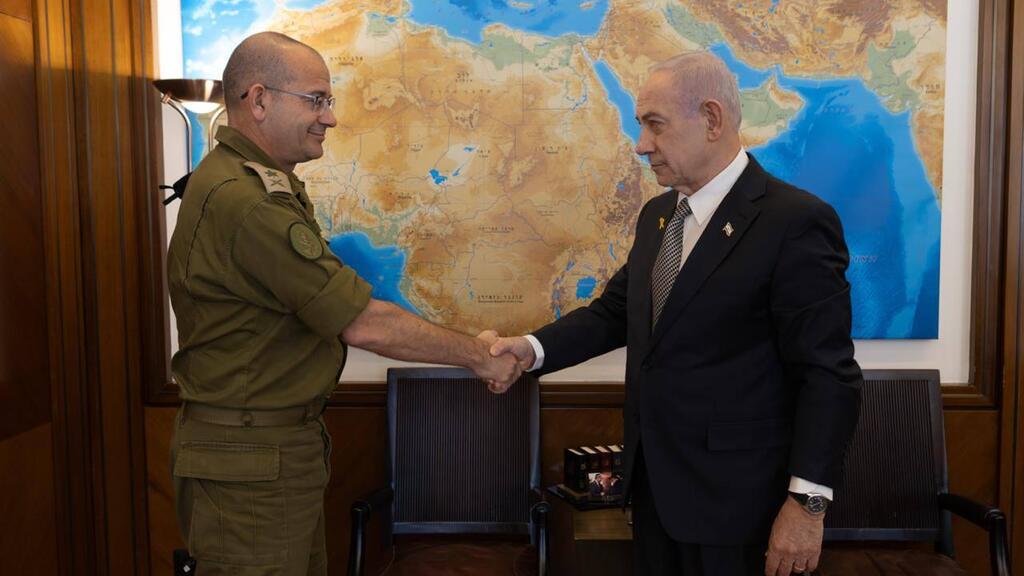
(Photo: Prime Minister's Spokesperson's Office)
The idea outlined in the paper may raise eyebrows. On one hand, even as a theoretical academic exercise, it reflects creative strategic thinking and a willingness to challenge basic assumptions. On the other hand, the proposal to proliferate nuclear weapons across the Middle East, even in a fictional context, could be seen as a drastic departure from Israel’s security doctrine. Dr. Stern did not respond to a request for comment from Shomrim regarding the course or Gofman’s paper.
Will the general manipulate the captain?
Further insight into the thinking of the Mossad chief-designate appears in another academic work: a research proposal Gofman submitted with a fellow student on the relationship between the “operational commander” and the “strategic captain” — that is, between senior security officials and political leaders. In the proposal, they argue that the operational commander’s responsibilities extend beyond simply executing orders. They say such a commander must adopt a strategic outlook, influence policy shaped by the political leadership and maneuver within complex situations where no clear policy has been defined.
The two developed a theory around the “discourse space” between commander and leader, arguing that the commander must deepen and broaden that dialogue to shape policy — whether through “direct discourse,” through “maneuvering via networks” or through “maneuvering by action.”
The academic framework raises a broader question: does Gofman, a senior officer in Israel’s security establishment, see himself as a strategic actor expected to shape and influence national policy or as a soldier whose role is to carry out the directives of elected officials?
The IDF Spokesperson’s Unit did not respond to Shomrim’s request for comment.