

U.S. President Donald Trump unexpectedly announced Tuesday that he had agreed with Prime Minister Benjamin Netanyahu to end American aid to Israel, worth approximately $4 billion annually, by the end of this year. If implemented, the decision would bring to a close more than 75 years during which Israel has become the largest cumulative recipient of U.S. foreign assistance since World War II.
The current memorandum of understanding is not scheduled to expire until 2028, and officials at Israel's Finance Ministry were reportedly caught off guard by Trump's remarks. But what exactly does American assistance include, and how did it become one of the cornerstones of relations between the two countries?
Gallery
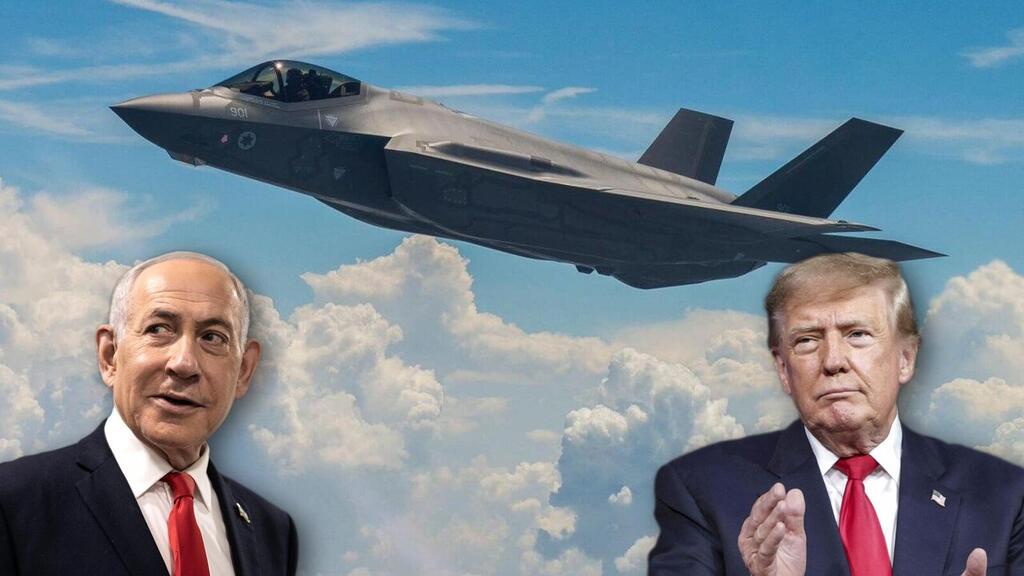
US President Donald Trump and Prime Minister Benjamin Netanyahu
(Photos: Lockheed Martin, Jewel Samad/Pool Photo via AP, Alex Wong/Getty Images North America/AFP)
A modest loan and France as Israel's military patron
American assistance to Israel began in 1949, a year after the country's establishment, with a $100 million loan from the U.S. Export-Import Bank. For approximately two decades, assistance remained modest and consisted primarily of economic loans. During those years, Israel's principal military patron was actually France, which supplied advanced military equipment and technology.
In 1962, Israel purchased its first advanced American weapons system, Hawk surface-to-air missiles. In 1968, a year after the Six-Day War, President Lyndon Johnson's administration approved the sale of Phantom fighter jets to Israel. The deal established a precedent for American support of Israel's qualitative military edge over its neighbors, as Washington stepped into the vacuum left by France under President Charles de Gaulle.
The major turning point came in 1971, when Israel began receiving substantial economic grants and Congress designated a specific amount of assistance for Israel in legislation for the first time. Two years later, the Yom Kippur War broke out. On October 19, 1973, President Richard Nixon requested $2.2 billion in emergency assistance from Congress to replace Israeli military losses and counter Soviet arms supplies to Egypt and Syria. Of that amount, $1.5 billion was allocated as military grants, the largest such package Israel had received at the time, with the remainder provided as a loan. Since the war, organized efforts have also sought to build bipartisan congressional support for aid to Israel.
Camp David and the transition to military aid
The 1979 peace treaty with Egypt ushered in a new era. To facilitate the end of hostilities and Israel's withdrawal from the Sinai Peninsula, the United States provided the two countries with a combined $7.5 billion in assistance, divided in a three-to-two ratio in Israel's favor.
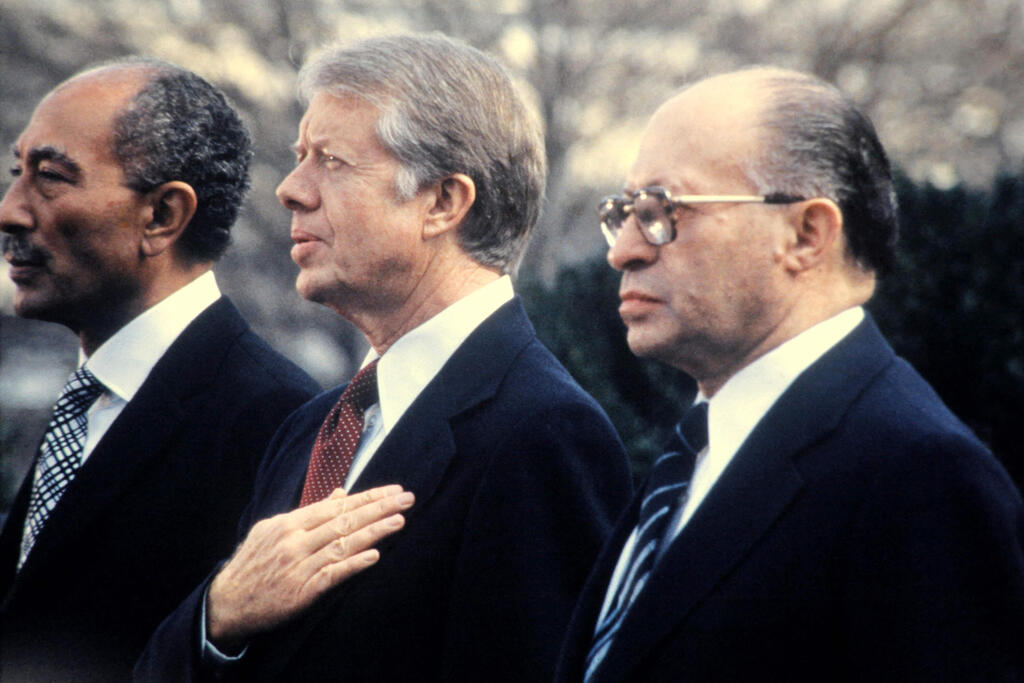
Prime Minister Menachem Begin, U.S. President Jimmy Carter and Egyptian President Anwar Sadat
(Photo: Consolidated News/AFP)
For many years, American economic assistance helped subsidize Israel's struggling economy. But during the 1990s, as the country's high-tech industry began to flourish, the situation changed. In July 1996, during his first term as prime minister, Netanyahu announced in an address to a joint session of Congress that Israel would begin gradually reducing American economic assistance.
Beginning in 1999, economic aid was reduced by $120 million annually, while military assistance increased by $60 million each year. By 2008, Israel had stopped receiving American economic grants, and nearly all subsequent assistance was military.
Since the late 1990s, American assistance has been governed by 10-year memorandums of understanding. The first, negotiated under President Bill Clinton, covered 1999 through 2008 and guaranteed at least $26.7 billion. In 2007, President George W. Bush's administration agreed to a $30 billion military package for 2009 through 2018, allowing Israel to spend up to 26.3% of the money on purchases from its domestic defense industry.
The current agreement was signed on September 14, 2016, during President Barack Obama's administration. It provides $38 billion for 2019 through 2028, including $33 billion in military grants and $5 billion for missile defense. However, the agreement gradually eliminates Israel's ability to spend American assistance on domestic purchases, meaning that nearly all the money is directed toward American-made products. The change has adversely affected Israel's defense industry.
At the same time, the United States has helped finance Israel's missile defense systems. Since 2011, Washington has provided more than $6 billion for Iron Dome alone, covering batteries, interceptors, joint production and maintenance. It has also partnered with Israel in developing the Arrow missile defense systems and David's Sling.
The war and the total bill
Following the October 7, 2023, Hamas-led attack, the Biden administration approved an emergency assistance package of approximately $14 billion, which was subsequently increased to $17.6 billion. In fiscal year 2024 alone, Israel received $12.5 billion, according to congressional figures, more than three times the amount provided the previous year.
How much money has Israel received altogether? According to the Congressional Research Service, approximately $175 billion was transferred between 1946 and 2025 in nominal dollars. Of that amount, around $124.5 billion was military assistance, $34.3 billion was economic aid and $16.1 billion was missile defense funding.
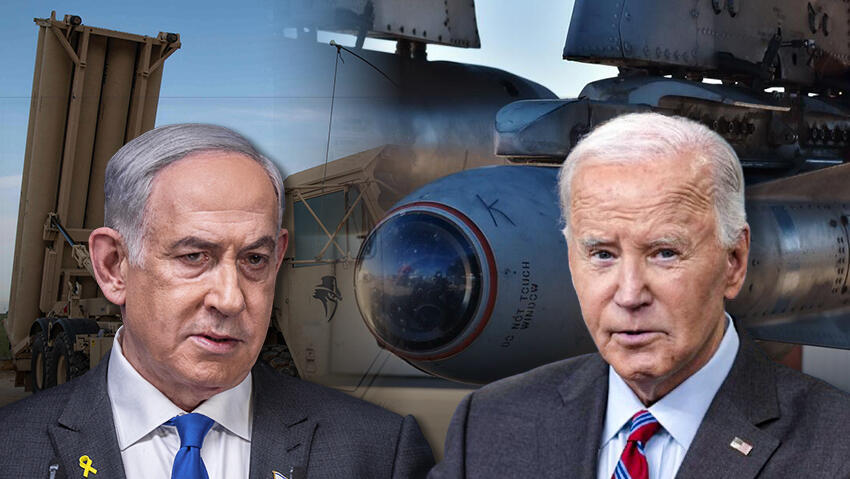
Former US president Joe Biden and Prime Minister Benjamin Netanyahu. Biden approved an emergency military assistance package following the October 7 attack
(Photos: Susan Walsh/AP, Haim Goldberg/Flash90, AFP, U.S. Army/Staff Sgt. Cory D. Payne, Michael Fitzsimmons/Shutterstock)
Adjusted for inflation, the figures rise considerably. U.S. State Department data put cumulative assistance at approximately $298 billion in 2024 dollars, while the Council on Foreign Relations estimates the total at around $330 billion, including missile defense funding.
That era may now be approaching its end. In January, Netanyahu told The Economist that he would not seek a full renewal of the existing assistance package and wanted to reduce American aid over the following decade. The two countries have been negotiating a new cooperation agreement to replace the current memorandum of understanding, with funding expected to focus on joint defense research and development.
The remaining question is whether that transition will take place in 2028, as originally planned, or as early as next year, as Trump announced.
‘Where will Israel find $8 billion? Through taxes on citizens’
American assistance to Israel has become increasingly controversial in recent years. Progressive Democrats have called for reductions in aid, while parts of the Republican Party oppose spending American taxpayer money to finance foreign countries.
Trump can now present the move to voters as a reduction of billions of dollars in foreign spending, while Netanyahu can portray the transition as a move away from American dependence and toward greater Israeli defense independence.
Senior Israeli economic officials, however, warned ynet that the consequences could be severe if Trump's announcement is implemented. "If Trump's statement is correct, this is a very serious decision for the Israeli economy. Giving up two years of American assistance effectively means $8 billion. Where are we supposed to get that money? Obviously, through taxes on citizens," they said.
Another senior economic official expressed anger that Democratic administrations, despite being perceived by some as less supportive of Israel, had provided generous assistance, while Trump and the Republicans were now moving to eliminate it.
The official also argued that Trump's announcement, made on the day tens of millions of Americans were voting in the congressional midterm elections, was effectively an election campaign maneuver.