

The United States launched a wave of strikes against Iran overnight Tuesday into Wednesday after Washington said Tehran attacked three commercial vessels in the Strait of Hormuz, further threatening a fragile ceasefire agreement between the two countries.
US Central Command (CENTCOM) announced shortly after midnight Israel time that American forces had begun strikes in Iran in response to what it described as Iranian attacks on civilian-manned ships.
US strike in the Iranian port city of Bandar Abbas


Iranian media reported explosions in the southern port cities of Sirik and Bandar Abbas, on Qeshm Island and on Kharg Island, Iran’s main oil hub.
CENTCOM said the strikes were intended to “impose a heavy cost on Iran for striking ships manned by innocent civilians,” adding that Iranian actions were “unjustified, dangerous and a clear violation of the ceasefire.”
About five hours later, CENTCOM announced that the operation had concluded, saying precision weapons were used to strike more than 80 targets.
According to the US military, the targets included air defense systems, command and control networks, coastal radar sites, anti-ship missile capabilities and more than 60 small boats belonging to Iran’s Islamic Revolutionary Guard Corps in and around the Strait of Hormuz.
“US forces are ready and prepared to act against Iran in the event of further violations of the agreement,” CENTCOM said.
A US official told CNN that the strikes on Iran were “disproportionate.”
In response, Iran said it launched attacks on US targets in Bahrain and Kuwait, triggering air raid sirens in both countries. The Islamic Revolutionary Guard Corps said it carried out strikes on 85 American military targets and claimed it shot down a US MQ-9 drone.
Footage of strikes in Iran released by US Central Command (CENTCOM)
(Video: CENTCOM)
The Kuwaiti military said its air defenses were confronting “hostile” missile and drone attacks.
Iran’s Khatam al-Anbiya Central Headquarters condemned the US strikes as a “blatant act of aggression” and warned that Iranian forces would respond with a “crushing response.”
The command said Tehran would not allow Washington to interfere in the management of the Strait of Hormuz, adding that “the only safe route” for commercial ships and oil tankers was one determined by Iran.
Iranian Parliament Speaker Mohammad Baqer Qalibaf accused Washington of violating the ceasefire framework.
“The era of bullying and extortion is over,” Qalibaf wrote on X. “We don’t fold.”

Meanwhile, US Defense Secretary Pete Hegseth is expected to arrive in Israel on Wednesday for his first visit to the country since taking office. Hegseth is scheduled to meet with Prime Minister Benjamin Netanyahu and Defense Minister Israel Katz.
According to CNN, one of the goals of the visit is to ease Israeli concerns over the possibility that the United States could approve the sale of advanced F-35 fighter jets to Turkey. Hegseth is currently in Turkey attending the NATO summit alongside US President Donald Trump.
Oil sanctions return
Before the strikes, the United States revoked a license that had allowed Iran to sell oil on international markets, after at least three tankers were attacked in the Strait of Hormuz.
A US official said Iran’s actions in the waterway were “completely unacceptable” and warned there would be consequences, in what appeared to be a signal of possible military action.
Following Washington’s decision, oil prices jumped sharply, rising by about 5%.
Iranian President Masoud Pezeshkian denied that Tehran had violated the agreement.
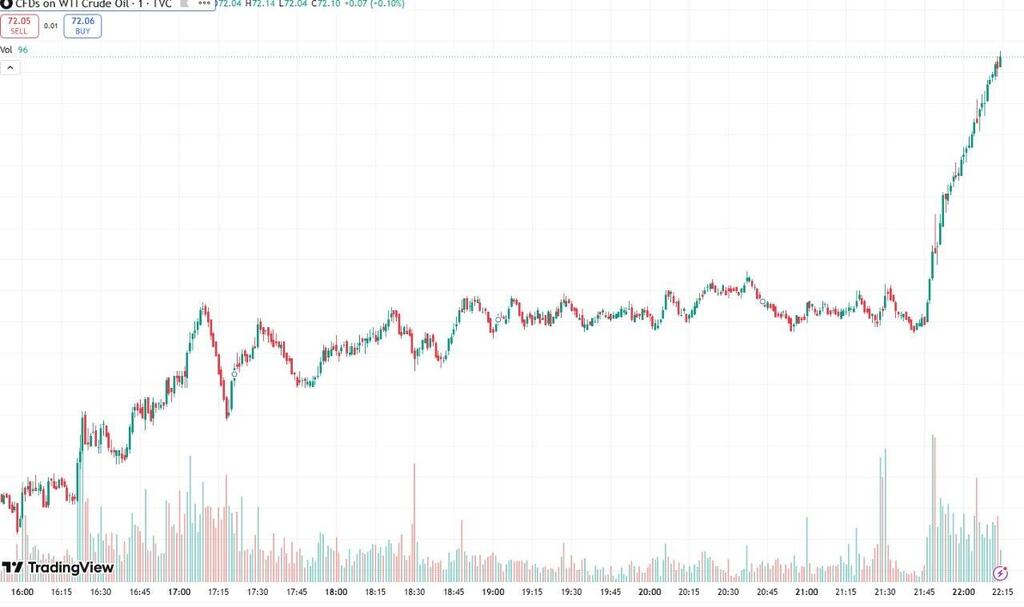
Oil price surge following US decision
“We emphasize the importance of maintaining lasting stability and will not accept any violation of promises or deviation from the memorandum of understanding,” he said. “We fulfilled our commitments under the memorandum in good faith and with a sense of responsibility. Experience has shown that Washington does not honor its commitments.”
Iran’s Foreign Ministry also condemned the renewed oil sanctions, saying Washington would be responsible for the consequences and that Tehran would take any steps necessary to protect its national interests and security.
Tanker attacks escalate tensions
The latest confrontation followed a series of attacks on commercial vessels in the Strait of Hormuz.
A Qatari liquefied natural gas tanker was hit and suffered damage to its engine room after reporting a fire, while a Saudi-flagged oil tanker was also damaged near Oman, according to maritime security sources.
UK Maritime Trade Operations (UKMTO) also reported that another tanker was struck by a drone launched by Iran.
According to CENTCOM, the affected vessels included the oil tanker Al Rekayyat, sailing under the Marshall Islands flag; the Saudi-flagged oil tanker Wedyan; and the Liberia-flagged Cyprus Prosperity.

Strait of Hormuz
(Photo: REUTERS/Stringer)
Qatar condemned the attacks as a “serious violation” that threatened regional security and called on Iran to immediately stop actions endangering maritime safety.
Iran rejected the accusations, calling them questionable and contrary to good neighborly relations.
The attacks came after US-Iran talks in Qatar last week failed to produce significant progress toward a permanent agreement.
After those talks, US President Donald Trump expressed optimism, saying Iran’s nuclear dismantlement was progressing and that the meetings had been “very good.”
The talks have since been paused as Iran held ceremonies marking the funeral of former Supreme Leader Ali Khamenei. Large crowds gathered in Tehran and other cities, calling for revenge against the United States and Israel.
First published: 06:04, 07.08.26