


French President Emmanuel Macron is facing a steep political decline at home while positioning himself as a leading European voice on foreign policy, including sharp criticism of Israel’s conduct in Gaza.
Macron’s popularity in France has been plummeting for over a year and his centrist coalition suffered a crushing defeat in the European Parliament elections on June 9, losing decisively to far-right leader Marine Le Pen. In a surprising move following the loss, Macron dissolved the French National Assembly and called snap elections.
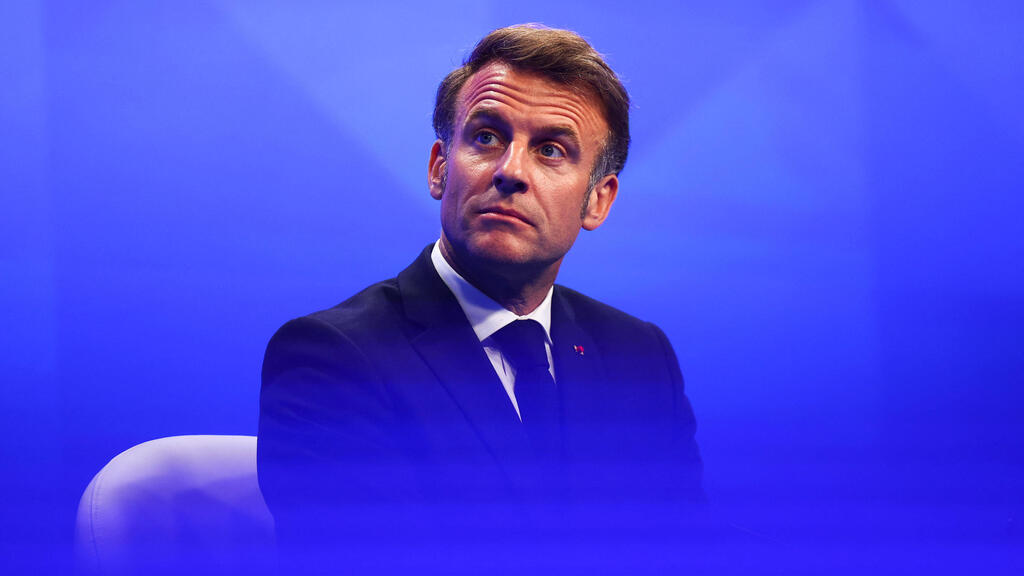
Those elections, held in two rounds less than a month later, dealt Macron yet another blow. Now leading a minority government, he’s forced to rely on political opponents to pass legislation and his domestic credibility is at a low point, with growing public ridicule.
In an apparent attempt to salvage his legacy, Macron has turned to foreign policy. He’s launched a series of diplomatic initiatives, one of which targets the Middle East.
Sensing widespread criticism — and even hostility — toward Israel among parts of the French public, Macron has aligned himself with the prevailing sentiment, using it to cast himself as a European leader advocating for tougher measures against Israel.
Macron has also cultivated closer ties with Saudi Arabia, positioning himself as a serious player in the Arab world — not leaving the arena entirely to U.S. President Donald Trump.
Meanwhile, Israel appears to have misread the growing hostility in Europe and failed to respond diplomatically or strategically. The government has placed all its bets on Trump’s reelection, while neglecting European relations entirely — both in terms of diplomacy and public messaging.
This vacuum has been filled with aggressive Israeli rhetoric toward European leaders, especially Macron, exacerbating Israel’s negative image across the continent. The tensions peaked with an unprecedented statement from the Foreign Ministry, accusing Macron of launching a “crusade” against Israel and of seeking to “reward jihadist terrorists with a Palestinian state.”
French President Emmanuel Macron and Prime Minister Benjamin Netnyahu in joint statement
(Video: GPO)


The statement ended with the words, “There’s no doubt its national holiday will be October 7.” The ministry also claimed that Macron “isn’t interested in the facts” and accused him of promoting sanctions against a country “under multi-front attack in an attempt to destroy it.”
The Israeli statement came in response to Macron’s remarks during a press conference in Singapore, where he said, “It’s now clear that the current situation cannot continue. The humanitarian blockade has created an unbearable reality on the ground.
“If a solution isn’t provided within hours or days, we’ll need to toughen our collective stance and implement the standards we’ve set — meaning ending processes that require respect for human rights, which isn’t the case right now and imposing sanctions.”
This wasn’t Israel’s first public rebuke of Macron. Some 10 days earlier, Foreign Minister Gideon Sa’ar criticized a joint statement by France, the UK and Canada threatening sanctions on Israel, linking it to Macron’s push for unilateral recognition of a Palestinian state.
Get the Ynetnews app on your smartphone: Google Play: https://bit.ly/4eJ37pE | Apple App Store: https://bit.ly/3ZL7iNv
“This war is being used as a pretext to promote Macron’s plan,” Sa’ar said. “Macron even banned Israel from participating in Paris defense exhibitions. That’s already a form of sanctions. Let me be clear to all countries — especially those with colonial pasts — we’re a free, proud and independent nation fighting for its survival. We won’t accept foreign dictates regarding our national security.”
Prime Minister Benjamin Netanyahu also accused Macron of siding with a “murderous Islamist terror group” and “amplifying its false propaganda while falsely accusing Israel of war crimes.” In his sharply worded statement, Netanyahu wrote: “Israel is fighting a multi-front war for its existence after the October 7 massacre committed by Hamas, including the murder and abduction of dozens of French citizens.”
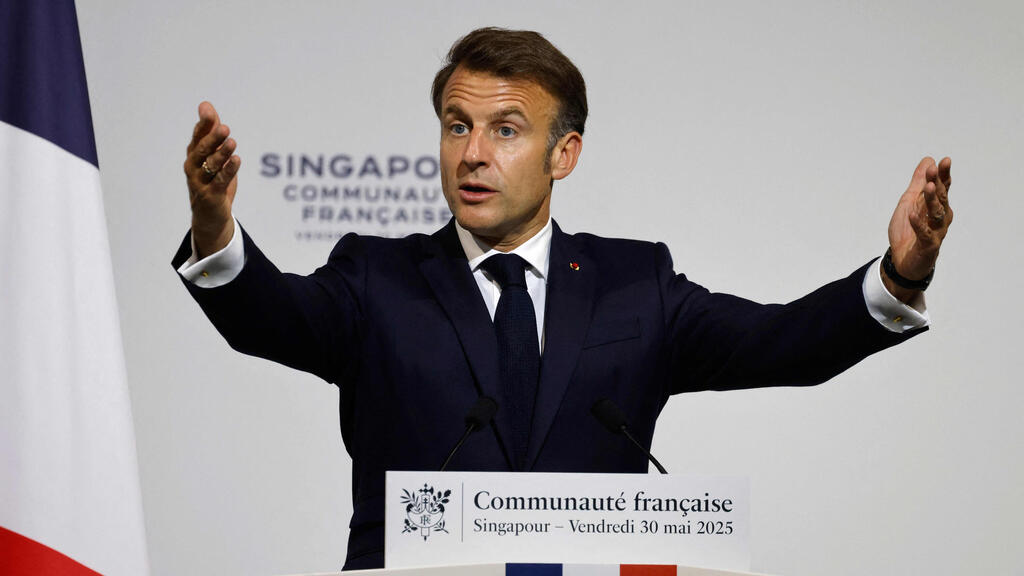
French President Emmanuel Macron
(Photo: Ludovic MARIN / AFP, Ludovic MARIN / AFP)
Sa’ar added: “Instead of standing with the democratic West against Islamist terror groups and calling for the hostages’ release, Macron is once again asking Israel to surrender and reward terror.”
Defense Minister Israel Katz escalated further: “We remember what happened to Jews in France when they couldn’t defend themselves. President Macron should stop lecturing us. A true friend of Israel should support us in our war against Hamas and the Iranian axis of evil threatening to wipe Israel off the map — not try to block our right to self-defense.”
'An open question in Europe'
Macron later harshly criticized Israel's conduct in Gaza during a televised interview, accusing it of creating “an unprecedented humanitarian disaster.” He called the situation “unacceptable—a disgrace, a scandal.” However, he stressed that any next steps must include the release of hostages and the disarmament of Hamas.
Throughout the interview, Macron refrained from using the term “genocide” but underscored, “It’s a humanitarian disaster and it’s shocking.” He described a recent visit to the Egypt-Gaza border, where he saw “injured children and women, one with a shattered spine who hadn't been treated for six months.”
He claimed massive humanitarian aid from multiple countries had been blocked by Israel: “The aid was there, blocked by the Israelis—that's unacceptable.” Macron placed direct blame on Netanyahu for the situation: “I’ll say this clearly—what Netanyahu’s government is doing today is unacceptable.”
He added that “since March, all humanitarian routes have been closed. There’s a complete blockade. No water, no medicine, no evacuations, no doctors allowed in. It’s a horrifying situation.”
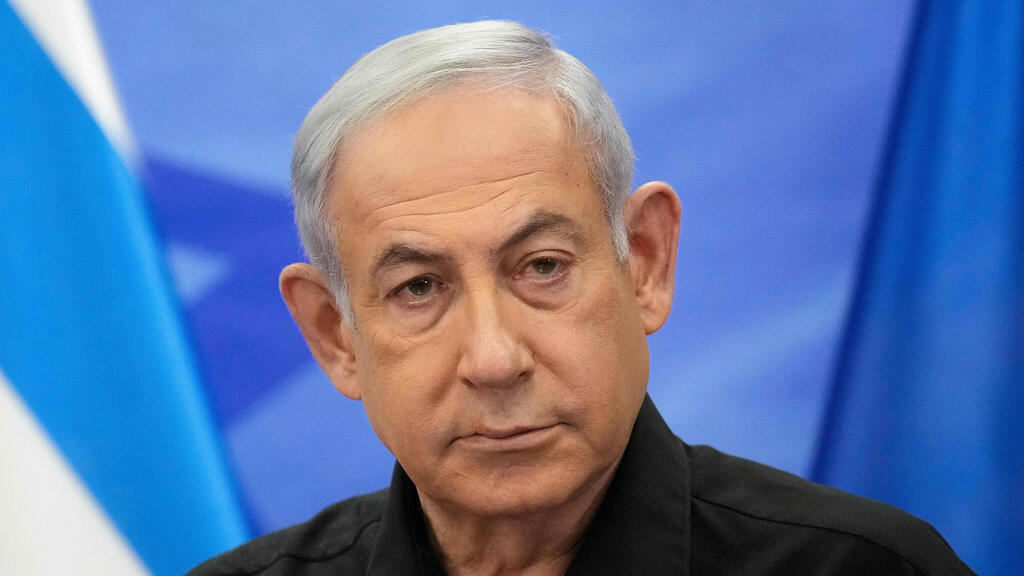
Prime Minister Benjamin Netnyahu
(Photo: Christophe Ena / POOL / AFP )
When asked why France hasn’t imposed sanctions on Israel, Macron responded that decisions had already been made to scale back offensive military support, saying France only provided military equipment, “mainly against attacks from Iran.”
He added that broader European action might be necessary: “We can’t continue as if nothing happened—we’ll need to ramp up pressure. It’s an open question in Europe.” Despite his criticism, Macron reiterated France’s recognition of Israel’s right to defend itself after the October 7 attack, noting it was the deadliest assault on French civilians since the Nice terror attack.
Still, he stressed, “A democracy must fight differently. The answer is not to attack Gaza indiscriminately.” He concluded by reaffirming his stance that the only solution is political: the establishment of a Palestinian state alongside Israel, mutual recognition and security for both peoples.
With tensions rising between Paris and Jerusalem, the upcoming international conference in New York—initiated by France and Saudi Arabia—could further strain relations. Much depends on the outcome of the summit and whether Macron “goes the extra mile” and formally recognizes a Palestinian state.
If he does—and that remains uncertain—Israel is preparing retaliatory measures, including imposing sovereignty over Area C of the West Bank and taking punitive actions against France, such as shutting down the French consulate in Jerusalem.
France is not expected to remain passive in the face of such a move and is likely to respond with equally harsh measures, raising the risk of a serious diplomatic clash.
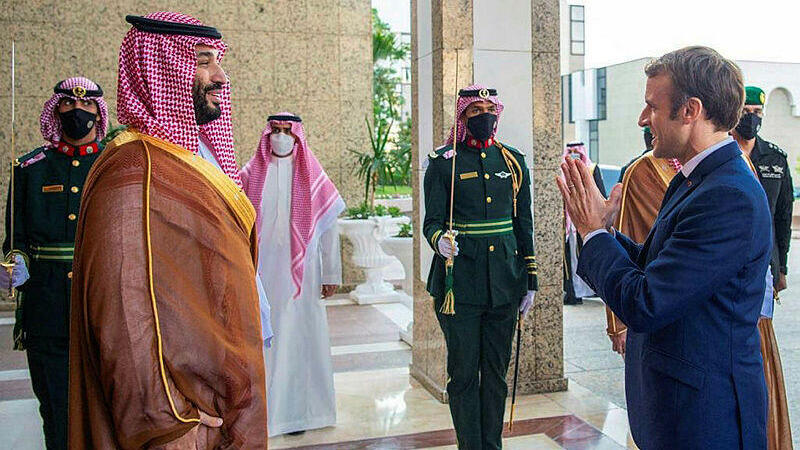
Saudi Crown Prince Mohammed bin Salman and French President Emmanuel Macron
(Photo: AP)
A deterioration in France-Israel ties could also impact other European countries. Macron is unlikely to be the only European leader to clash with Israel—others may draw conclusions and follow with sanctions of their own.
Former Israeli ambassador to France Daniel Shek commented on the tensions, saying, “This is a textbook case of Israel turning a friendly president—an ally who defended our right to self-defense and worked on the hostage issue more diligently than our own government—into an enemy.”
Shek stressed, “Even now, he’s not an enemy. He’s a friend of Israel who disagrees with the Israeli government. Anyone who thinks the world will patiently wait through 20 months of war, destruction and blockade until we finish leveling Gaza is mistaken.”
Shek added that “this erosion of patience isn’t just a French phenomenon—it’s happening across Europe. We must recognize that we’ve reached a point where threats of sanctions could materialize.
“Israel bears responsibility for this deterioration, as it treats every call to end the war as if it were a call to destroy the country. What Macron and many others are actually saying is that it’s time to end the war and release the hostages. That, in the eyes of our government, is apparently his biggest ‘crime.’”