


Foreign Minister Gideon Sa'ar announced a series of retaliatory measures against Britain on Tuesday evening after London unveiled economic sanctions targeting Israeli settlements in the West Bank, escalating a diplomatic dispute over settlement policy and the future of a two-state solution.
The measures include closing the British Consulate in Jerusalem, removing British representatives from the Gaza multinational coordination headquarters in the southern city of Kiryat Gat, ending British involvement in training Palestinian Authority security forces in Ramallah and barring 12 British elected officials from entering Israel.
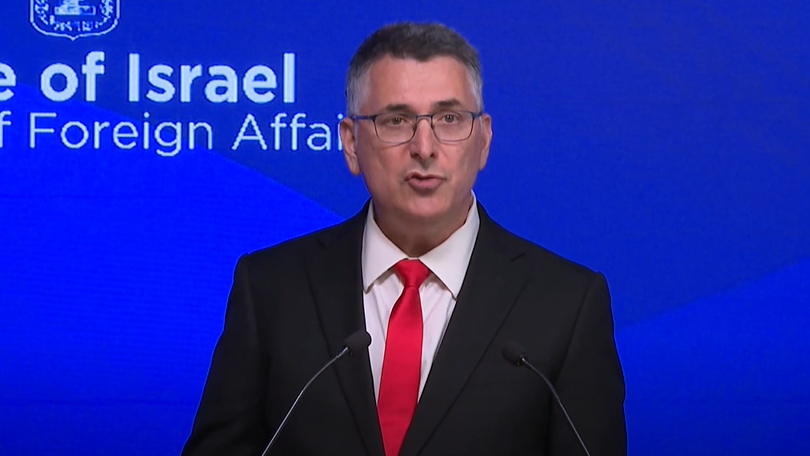
Sa’ar said the 12 officials had been involved in what he described as antisemitic and anti-Israel activity and had denied Israel’s right to exist. They were later identified as lawmakers Jeremy Corbyn, Zarah Sultana, Naz Shah, Diane Abbott, Hannah Spencer, Carla Denyer, Sian Berry, Ellie Chowns, John McDonnell, Richard Burgon and Adrian Ramsay, as well as Fahad Ansari, director of Riverway to the Sea.
“Britain initiated and led the current move — it planned it long in advance,” Sa'ar said. He added that Israel could take measures against other countries involved in the initiative at its discretion.
“The message to every government that harms us is this: Whoever acts against Israel, Israel will act against them, and they will lose their influence and relevance,” Sa'ar said. “Steps against Israel will not go unanswered.”
Britain announced Tuesday that it would impose economic sanctions on Israeli settlements in the West Bank as part of what Foreign Secretary Ed Miliband described as a policy aimed at preserving the possibility of a two-state solution. Britain said it would restrict settlement goods and target companies providing services including construction, financing and real estate to settlements. London said the measures were directed at settlements rather than Israel itself and that broader trade with Israel would continue.
Britain also said it would maintain its suspension of 30 arms export licenses related to Israeli military operations in Gaza and refuse licenses for weapons sales that it determines contribute to settlement activity in the West Bank.
The announcement came alongside a joint statement from Britain, Canada, Denmark, Finland, France, Iceland, Ireland, Norway, Poland, Portugal, Spain and Sweden saying they intended to impose trade restrictions on settlements they consider illegal under international law. The countries accused the Israeli government of undermining prospects for a two-state solution and called on it to halt settlement expansion and address settler violence.
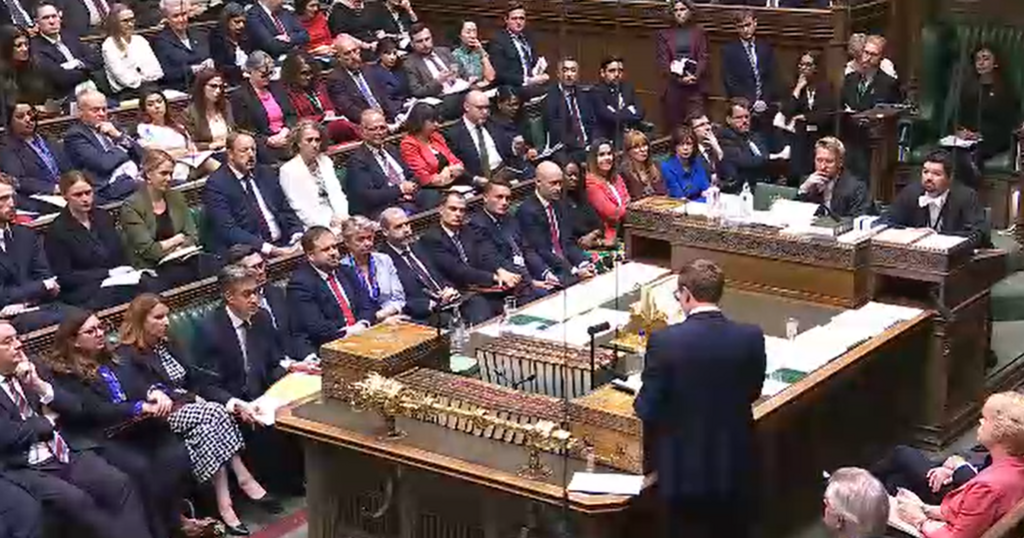
The British Parliament
(Photo: Reuters)
Most of the international community considers Israeli settlements in the West Bank illegal under international law, a position Israel disputes.
Sa'ar accused Britain’s Labour government of acting for domestic political reasons ahead of the party’s conference later this month.
“The British move is morally distorted and constitutes blatant interference in the affairs of a sovereign state,” Sa'ar said. “The Jewish people have a right to live throughout the Land of Israel no less than the British have a right to live in Britain or the French in France.”
Sa'ar also invoked the 1917 Balfour Declaration, in which Britain expressed support for the establishment of a “national home for the Jewish people” in Palestine. He argued that Jewish rights in what is now the West Bank were encompassed by the subsequent British Mandate for Palestine.
“A boycott of products from Judea and Samaria is a despicable practice that harms a productive, law-abiding population,” Sa'ar said, using the biblical names commonly used in Israel for the West Bank. “Sanctions on services are abhorrent.”
Sa'ar also accused the British government of interfering in Israel’s election campaign, saying London was attempting to influence Israeli voters and pressure Israel into accepting a Palestinian state.
“The Labour government’s decision constitutes blatant interference in the election campaign of a sovereign state,” he said. “It is a crude and unacceptable attempt by a foreign country to influence the election.”
Sa'ar asserted that the Israeli public overwhelmingly opposes Palestinian statehood, pointing to the Oslo peace process of the 1990s, the establishment of the Palestinian Authority, Israel’s unilateral withdrawal from Gaza in 2005, the second Palestinian intifada and the Hamas-led Oct. 7, 2023, attack on Israel.
“After everything we have seen,” Sa'ar said, Israelis reject what he described as the establishment of “a jihadist terrorist state in the heart of the Land of Israel.”
Britain says its measures are intended to achieve the opposite objective. Miliband said the two-state solution was the guiding principle of British policy and accused settlement expansion of undermining the possibility of creating a Palestinian state alongside Israel. British officials stressed that the measures were not intended as a boycott of Israel as a whole.
Sa'ar rejected the argument that international pressure could bring the sides closer to resolving the conflict.
“The Israeli-Palestinian conflict is an age-old conflict,” he said. “Unfortunately, the Palestinians have always rejected proposals for a solution and have never moved away from terrorism and incitement.”
“This conflict will not be resolved by declarations from London and Paris,” he added. “An anti-Israel approach only moves us further away from a solution instead of bringing it closer.”
A senior British official told ynet that the decision to impose sanctions on settlements in the West Bank followed growing concern over settler violence.
“The extremists have completely lost it. The violence is severe,” the official said. “More than 2,200 Palestinians have been displaced from their homes since January. From the British government’s perspective, it’s impossible to ignore this. They felt they had to do something.”
The official said Israel had not informed Britain of any planned retaliation. “If there are steps, you enter into a tit-for-tat, and that doesn’t benefit anyone,” the official said, adding that “UK-Israel relations are strong.”
The confrontation follows warnings earlier Tuesday from President Isaac Herzog, who called the sanctions a “grave miscalculation” and also characterized them as interference in Israel’s elections. Herzog urged foreign governments to abandon sanctions in favor of dialogue and argued that restrictions could also hurt Palestinians employed by settlement businesses.
The Labour government had previously sanctioned individual Israeli settlers and unauthorized outposts over alleged violence against Palestinians and unauthorized development. The new measures significantly broaden that approach by targeting trade in goods and potentially services connected to West Bank settlements.