


After achieving near-complete air superiority over western Iran—the gateway to the Islamic Republic—Israeli UAVs have maintained dominant surveillance over Tehran for three consecutive days. The recent strike on the Arak heavy-water reactor not only neutralized a symbolic nuclear asset but also cleared a path toward a far more critical target: Israeli air dominance over southern Iran, home to some of the country’s most fortified and strategically vital sites, including the underground enrichment facility near the village of Fordow.
Dozens of Israeli fighter jets that struck the Arak reactor at dawn also destroyed air defense batteries and radar systems south of Tehran. This was part of a broader campaign to dismantle Iranian air defense networks and open the skies for deeper strikes against the country's nuclear infrastructure. The Fordow area—deep in southeastern Iran—is shielded by some of the regime’s most advanced domestically produced surface-to-air missile (SAM) systems.
Attacks on Iran


Until now, only probing attacks had been carried out around Fordow, in Isfahan, and at other military bases farther east—areas less accessible to Israel. These actions lacked the full freedom of maneuver that the Israeli Air Force is now pushing for: to enable cost-effective, locally conducted “stand-on” strikes, instead of long-range “stand-off” operations using expensive weaponry.
Western Iran is already under persistent Israeli aerial control, with daily operations aimed at sealing off Iranian missile launch tunnels to block further strikes. According to IDF intelligence, the priority is not to destroy every ballistic missile—of which Iran has thousands—but to target their launch systems. Many of these launchers, the IDF has discovered, are concealed in southeastern Iran. The Air Force aims to use this momentum to strip these areas of SAM threats, thereby increasing detection and strike capabilities against these launchers.
Get the Ynetnews app on your smartphone: Google Play: https://bit.ly/4eJ37pE | Apple App Store: https://bit.ly/3ZL7iNv
The IDF estimates suggest that about half of Iran’s surface-to-surface missile launchers have already been destroyed. The policy is clear: “What’s identified gets hit,” using a joint effort between fighter jets and large UAVs constantly patrolling high-interest areas under intelligence command.
On Wednesday, Iran claimed to have downed another Israeli UAV. Meanwhile, U.S. sources reported that Israel’s stockpile of Arrow interceptor missiles is running low. This week, for the first time, the IDF also employed the Navy’s highly advanced (and expensive) “LARD” missile from the Barak Magen (Lightening Shield) defense system to intercept Iranian drones.
Israel’s Defense Ministry confirmed Wednesday that multiple cargo planes have landed as part of an ongoing military airlift. Since the beginning of the campaign against Iran, 14 cargo aircraft have arrived, though at a slower pace compared to the post–October 7 global support effort.
Unlike the earlier war with Hamas, the ministry is withholding details on the origin and contents of this aid, revealing only that missions from Germany and the U.S. were involved. The secrecy is such that the ministry even obscured aircraft markings to conceal the operating carrier.
It is widely believed that much of this support is aimed at sustaining Israel’s aerial campaign against Iran for weeks or longer.
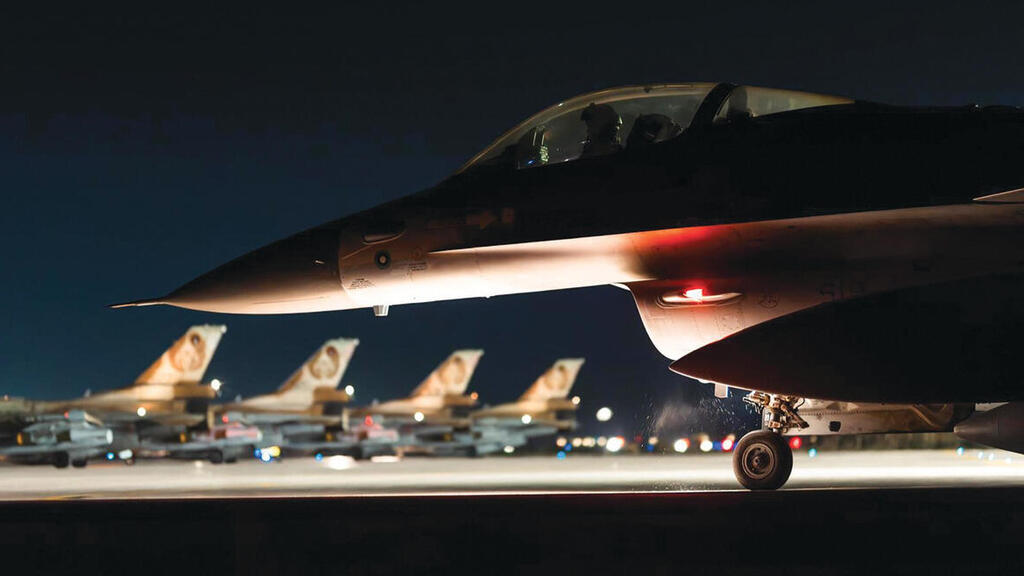
Air Force jets preparing for attack on Iran
(Photo: IDF Spokesperson's Unit)
From the outset, Israel’s defense leadership prepared for a prolonged campaign, structuring a multi-phase, flexible operation designed to eventually return the country to a manageable routine. The aim is to avoid prolonged disruption of essential services—especially education and international travel through Ben Gurion Airport.
Home Front Command officials explained that the easing of certain restrictions—allowing work in protected facilities—stems from both intelligence assessments and the responsible behavior of the public, which has helped limit fatalities to 24, far fewer than the hundreds predicted in pre-war scenarios.
The IDF believes Iran will continue to test more advanced weapons, including the cluster munitions missiles fired Wednesday that struck the Tel Aviv Stock Exchange district in Ramat Gan. The missile penetrated the first basement level of a newly built parking garage. On-site analysis revealed that the missile contained dozens of bomblets—each roughly the size of an average Gaza-launched Grad rocket—capable of dispersing mid-air over a radius of up to eight kilometers. The damage caused by such munitions in a dense urban area is extensive and highly destructive.