

A wounded soldier beside her asked to recite “Shema Yisrael.” But officer Bar Manshouri refused to accept that it was the end.
“I told him, ‘We are absolutely not saying Shema Yisrael. I have children and I need to get back to them,’” she recalled.
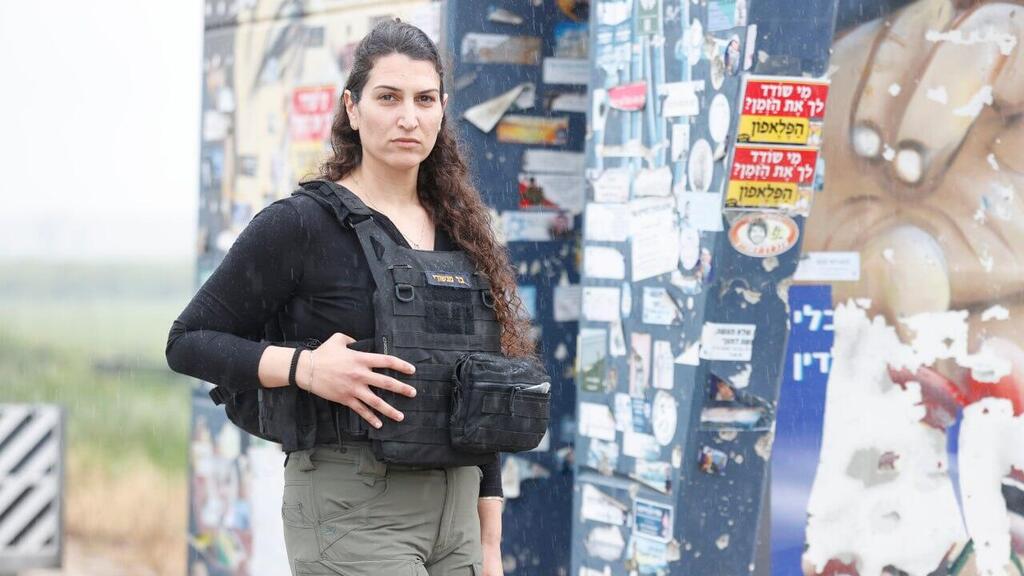
Moments earlier, she had entered a face-to-face battle with Hamas terrorists inside the Sderot police station, the same building where she worked daily. Today, two and a half years after that morning, and after 17 years in uniform, Manshouri no longer wears it, but continues her mission in a new role.
At 35, carrying both physical and emotional scars from October 7, Manshouri has taken on one of the most significant challenges of her life. After a long career in the Israel Police, during which she fought in the battle for the Sderot station and lost colleagues, she now serves as head of the newly established security department of the Shaar HaNegev Regional Council.
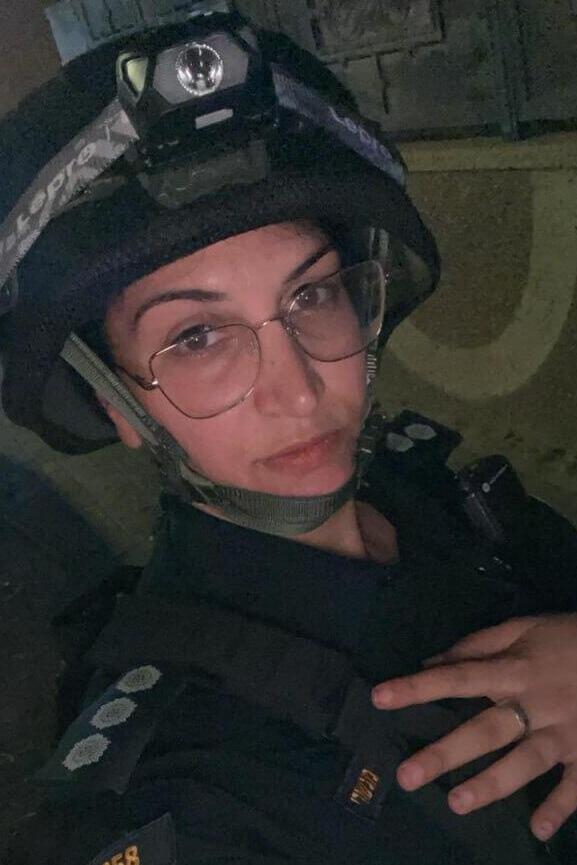
Bar Manshouri in combat, days after October 7
A resident of Kibbutz Nir Am, married and a mother of two, she is now building a system meant to protect the community she calls home.
“I only took off the uniform physically,” she said with a slight smile. “Not in my heart, not in my character, not in the way I speak. It’s part of who I am.”
On the night between October 6 and 7, Manshouri had just finished a particularly demanding shift as the duty officer at the Sderot station. Among the incidents handled that night was a case involving a violent civilian, led by her subordinate, First Sgt. Mor Shakuri, who was killed hours later in the battle with terrorists.
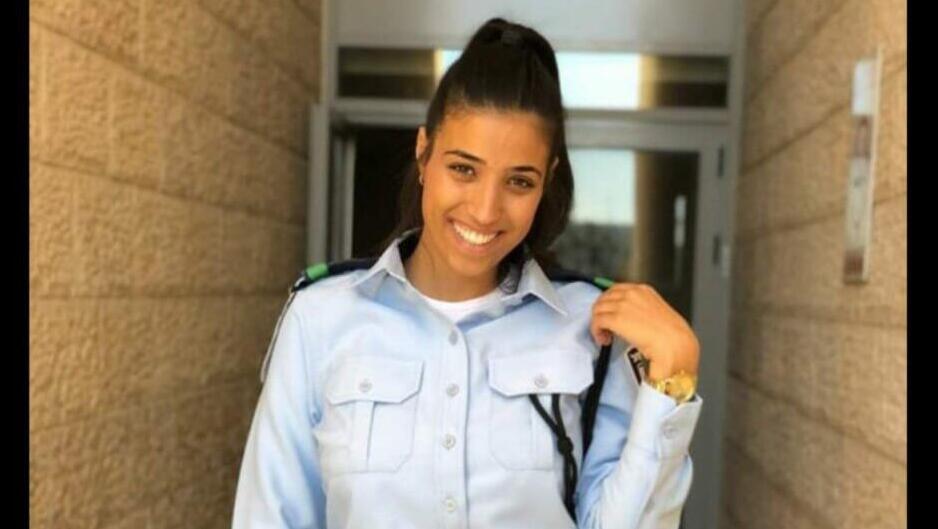
First Sgt. Mor Shakuri
(Photo: Israel Police)
Manshouri returned home to Nir Am and managed just 17 minutes of sleep before the sirens began. Within minutes, she was back in uniform and on her way to the station, where she encountered a reality she had never imagined.
“The district commander declared ‘Parash Peleshet’ — terrorist infiltration. That’s the order,” she said. “We’re used to responding to events, but this time we were the event.”
When she arrived, terrorists had already barricaded themselves inside the station. She made the decision to enter and fight alongside four other officers.
“I was in fight mode. I shut down all emotions,” she said. “I took a deep breath and went into a kind of combat I never imagined I would face.”
Inside, the battle was chaotic and brutal. Early on, she saw her subordinate, Sgt. Maj. Eliyahu Aroush, lying dead, just an hour after he had messaged her joking about wanting to leave early.
She said another officer, Dennis Blanki, saved her life twice, once by shielding her from grenades and again by warning her not to step into an exposed area moments before he himself was killed.
“Just before we were rescued, we lined up and opened fire. Then two explosive charges were thrown at us and wounded all of us. At that point, I was already outside, injured, barely able to hear,” she said.
Around 10 a.m., a special counterterrorism unit arrived and managed to extract them. “When people say ‘they captured the station,’ I say absolutely not. The officers fought for the station until the very end.”
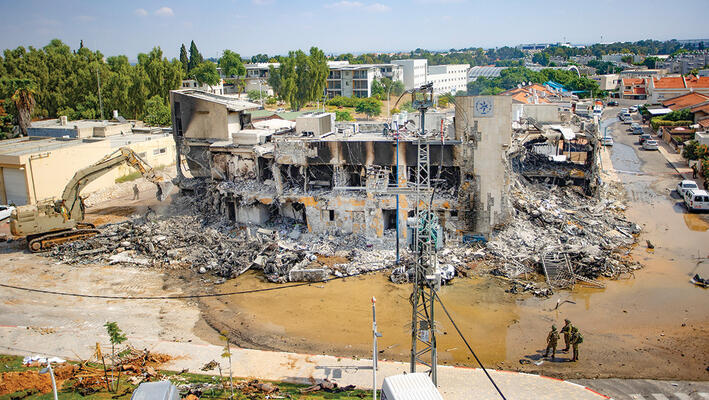
Sderot police station
(Photo: Gil Nechustan)
The aftermath was just as difficult. In the weeks that followed, the station buried eight officers.
“You can’t explain what it means for one station to bury eight officers in two weeks,” she said. “My family was evacuated, I wasn’t with my children, I couldn’t function as a mother. I felt contaminated by everything I had been through. It took me a long time to understand again who I am.”
Despite her injuries, including shrapnel wounds and hearing damage, Manshouri continued to serve, taking part in evacuations and attending funerals. But eventually, she made the difficult decision to leave the police.
“I left with a lot of appreciation. If I meet someone, I’ll tell them why they should join the police. But for me personally, everything changed, my family, my home, Nir Am, Shaar HaNegev,” she said. “It was a very hard decision, but a complete one.”
Shortly after leaving, she took on her new role, establishing a regional security system that includes municipal policing, an emergency operations center and broader preparedness planning.
Her vision is clear: to build a civilian security system capable of protecting communities and critically evaluating itself.
“I’m not a feminist. I simply don’t see a glass ceiling,” she said. “My message is: aspire, learn, invest, work hard. That’s how I’ll raise my daughter and my son.”