

The Kremlin said Monday morning that US President Donald Trump has invited Russian President Vladimir Putin to join the Board of Peace, a body that under Trump’s plan is meant to oversee the reconstruction and governance of Gaza. According to reports, the United States is considering expanding the board’s mandate to include additional international issues, including the war in Ukraine. The Kremlin said Putin, who launched the largest war in Europe since World War II, is currently reviewing the proposal to join the body, which Trump has presented as one intended to promote peace worldwide.
In recent days, it has been reported that Trump invited a range of world leaders to join the Board of Peace, including the leaders of Turkey, Egypt, Argentina, Canada, France, Germany, Australia, Albania and Bahrain. ‘The members of the board will be announced soon, but I can say with certainty that this will be the greatest and most prestigious body ever created, anywhere,’ Trump said of the new initiative.
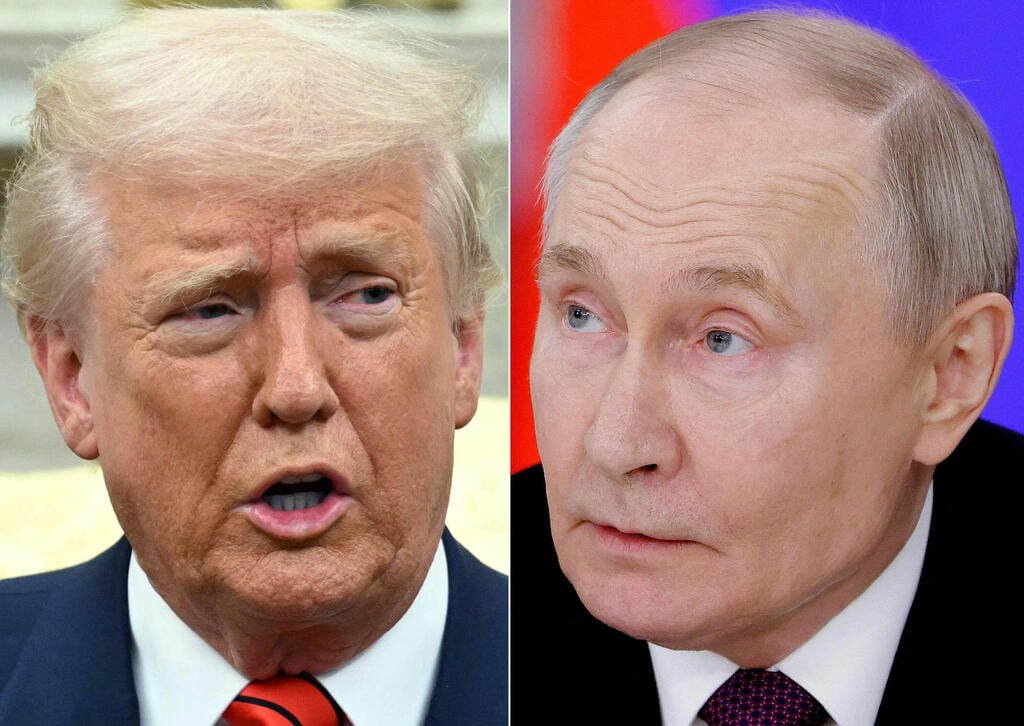
US President Donald Trump and Russian President Vladimir Putin
(Photo: Mandel NGAN, Maxim Shemetov / various sources / AFP)
According to a report by Bloomberg, Trump is demanding that any country seeking permanent membership on the Board of Peace contribute at least $1 billion in the first year after signing the accession charter. A draft document on the board’s establishment obtained by Bloomberg states: ‘Each member state shall serve on the board for no more than three years from the date of signing, subject to the approval of the chair. The three-year term limit shall not apply to states that contribute more than $1 billion in cash to the Board of Peace in the first year after the charter enters into force.’
Many aspects of the board’s powers and vision remain unclear. The New York Times noted that critics have questioned whether Trump is seeking to create a US-controlled alternative to the United Nations Security Council. In an interview with Reuters, given before the board’s formal announcement over the weekend, Trump said: ‘I think it will start with Gaza, and later it will address other conflicts as they arise.’ When asked about its goals, the US president, who will chair the Board of Peace, replied: ‘Like countries that go to war with one another.’ The Financial Times reported that officials in the US administration have raised the idea of expanding the board’s activities to include Ukraine and Venezuela. Western and Arab diplomats expressed concern about granting such authority to the body, while a source familiar with the matter said administration officials believe it could serve as ‘a possible substitute for the United Nations that would deal with conflicts beyond the war in Gaza.’ A US official, however, denied the report and told the Financial Times that the board would focus only on Gaza ‘and nothing beyond that.’ Trump himself has signaled that its activities could expand in the future.
The members of the Board of Peace announced so far, in the White House’s official statement marking the start of its activities over the weekend, are US Secretary of State Marco Rubio; envoy Steve Witkoff; the president’s son-in-law Jared Kushner; former British prime minister Tony Blair; American Jewish billionaire Marc Rowan; World Bank President Ajay Banga; and Robert Gabriel, deputy US national security adviser. Over the weekend, the White House also announced the establishment of an additional body that will operate beneath the Board of Peace and above the technocratic Palestinian government that is meant to manage day-to-day affairs on the ground in place of the Hamas administration. According to the White House, the interim body will be known as the Gaza Executive Board, or the managing committee, and will include, among others, Israeli-Cypriot businessman Yakir Gabay, Turkish Foreign Minister Hakan Fidan and Qatari official Ali al-Thawadi.
The inclusion of senior figures from Qatar and Turkey in the same interim body, which is expected to wield significant influence over developments on the ground, sparked sharp criticism in Israel. Prime Minister Benjamin Netanyahu issued an unusual statement saying the composition of the body was not coordinated with Israel and ‘contradicts its policy.’ Netanyahu said he instructed Foreign Minister Gideon Sa’ar to raise the matter with US Secretary of State Marco Rubio.