


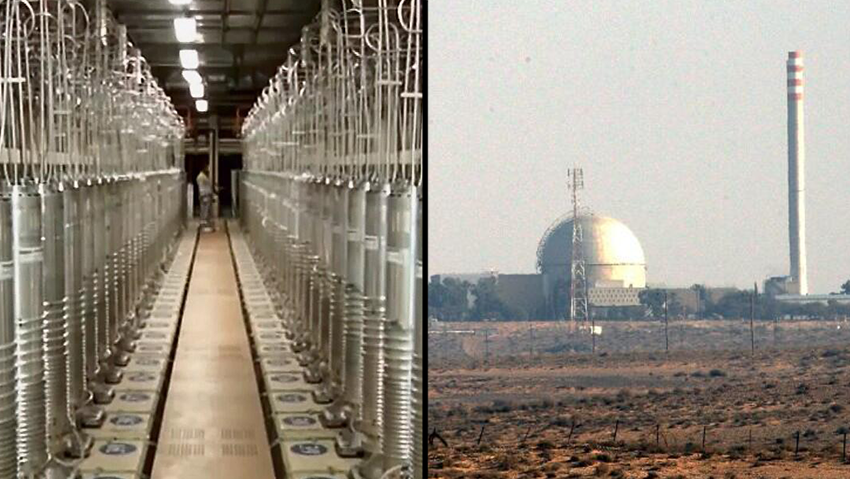
Growing discussion across Arab media has focused on the risks of strikes on nuclear facilities as the war between Israel, the United States and Iran intensifies, particularly following reported attacks near Iran’s Natanz enrichment site and a missile strike toward the Dimona area.
Saudi-owned Al Arabiya reported that the escalation has raised questions about the potential consequences of damage to nuclear sites, including Israel’s nuclear research center in the Negev. Experts cited in the report urged a measured, science-based assessment of the risks, warning against both exaggeration and complacency.
Amgad al-Wakeel, a former head of Egypt’s Nuclear Power Plants Authority, said in a public post that there is a critical distinction between a nuclear explosion and a radioactive leak.
“A strike on a nuclear facility does not necessarily lead to a nuclear explosion like an atomic bomb,” he wrote, adding that the primary risk is a radioactive leak caused by damage to reactor systems or cooling infrastructure — a scenario he said can often be technically contained.
He also noted that weather conditions, particularly prevailing winds, play a significant role in determining the spread of any radioactive material. In the eastern Mediterranean, winds typically move from west to east, potentially directing any radioactive plume away from central Egypt and toward more sparsely populated areas east or southeast of Dimona, while raising concerns for neighboring Jordan.
Al-Wakeel added that the Dimona facility is located roughly 70 to 80 kilometers from the Sinai border and more than 400 kilometers from Cairo and the Nile Delta, making the likelihood of significant impact on those areas minimal due to natural dispersion.
Jordanian and regional officials have also emphasized preparedness. Jordan’s Atomic Energy Commission said it operates 26 radiation monitoring stations nationwide that function around the clock and have detected no abnormal radiation levels despite recent military developments, including strikes on Iranian nuclear-related sites.
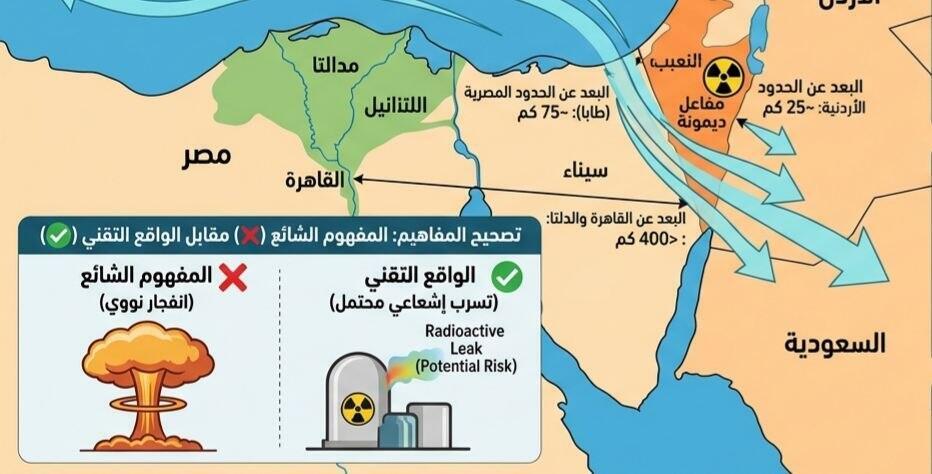
Post by Amgad al-Wakeel on strikes on nuclear reactors
Earlier reporting in Jordanian media warned that any damage to sensitive nuclear facilities in Iran could pose broader environmental risks across the region, particularly in the Gulf, though the impact on Jordan would likely be geographically limited.
In Iraq, authorities said early in the war that emergency monitoring systems had been activated to detect any increase in radiation levels, with no changes recorded so far.
Despite heightened public concern and increased discussion online, there have been no confirmed reports of radioactive contamination linked to the current conflict.
The International Atomic Energy Agency said following the recent Iranian strike toward the Dimona area that it had received “no indication” of damage to Israel’s nuclear research facility.