



Prime Minister Benjamin Netanyahu issued his first public statement Monday evening on the composition of a possible new government since election night, making clear that he does not intend to abandon his existing political allies or relinquish his demand to lead the next coalition.
Netanyahu signaled that he wants to keep the Religious Zionist, Otzma Yehudit and Shas parties in any future government, while insisting that he should remain prime minister even if a coalition agreement is reached with Gadi Eisenkot, chairman of Yashar!.
Gallery
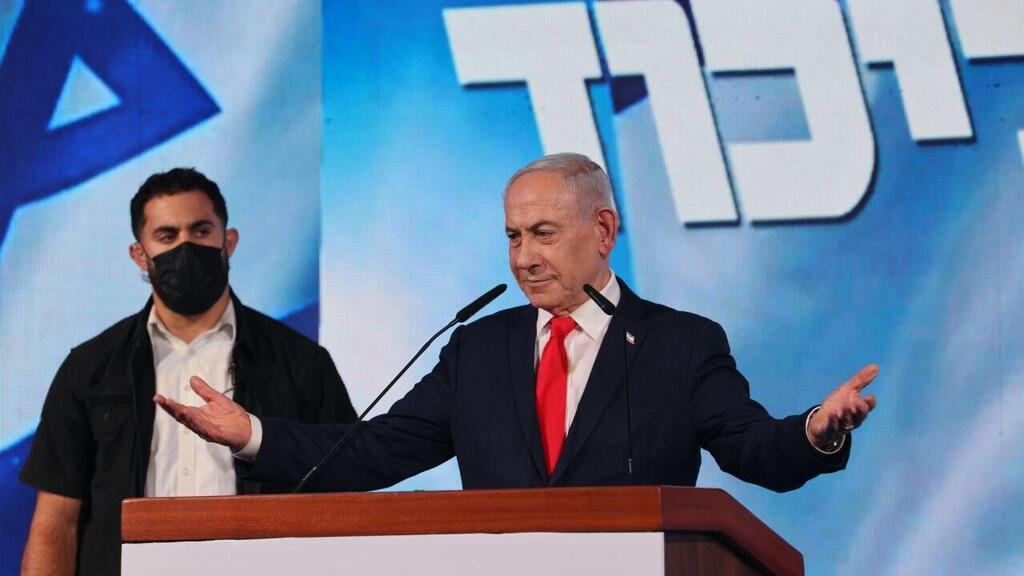
Prime Minister Benjamin Netanyahu speaks to Likud Party representatives
(Photo: Alex Kolomoisky)
"The Israeli public does not want a government dependent on Ra'am and the Joint List, parties that support terrorism and deny the existence of the Jewish state," Netanyahu said, referring to the Arab parties.
"From day one, our hand has been extended toward forming a broad national government. A clear majority of the Jewish public chose Likud as the largest party and chose me as prime minister to lead the next government," he said. "We aspire to establish a broad government with our partners and with any party that wishes to join and does not support terrorism. I am open to discussing this."
Netanyahu privately leaves door open to rotation agreement
Despite his public insistence on leading the next government, ynet reported Monday morning that Netanyahu has not ruled out a rotation agreement for the premiership as part of a national unity government.
Asked during private conversations whether he would consider sharing the prime minister's office on a rotating basis, Netanyahu reportedly replied: "We are examining everything. I am not completely ruling out any option."
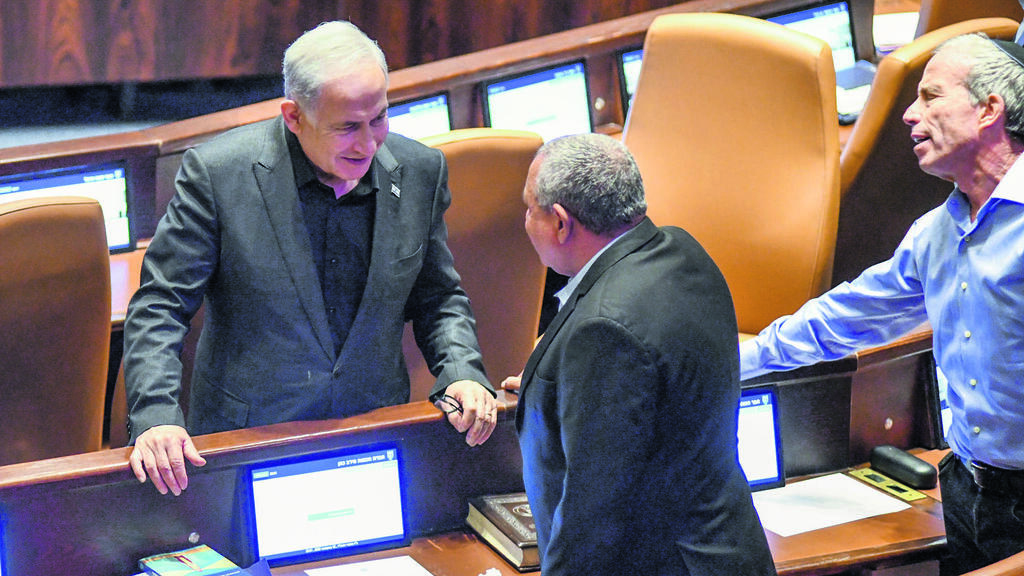
Netanyahu and Eisenkot in the Knesset plenum during the last government
(Photo: Rafi Katz)
Sources close to the prime minister who discussed the issue with him said they came away with the impression that he had deliberately left the possibility open and was seriously considering all available alternatives. One associate, however, stressed Sunday that "no proposal to establish a unity government has yet been made."
The comments contrast with statements by Likud ministers and lawmakers in recent days, who have suggested that a rotation agreement is unlikely because Netanyahu would not agree to serve as prime minister for only part of a government's term.
Coalition chairman Ofir Katz went further Sunday, issuing an ultimatum that a unity government would be impossible if the anti-Netanyahu bloc moved to remove Knesset Speaker Amir Ohana from his position.
Yet Netanyahu himself has not closed the door on a possible rotation agreement with Eisenkot, despite having avoided public discussion of the issue until Monday.
Likud fears a coalition that could keep Netanyahu out of power
Behind Netanyahu's calculations lies a significant political concern: the possibility that Eisenkot and the anti-Netanyahu bloc could establish a government with the participation or parliamentary support of both ultra-Orthodox and Arab parties.
Netanyahu fears that such a coalition, whether supported by Arab parties from within the government or from outside it, could remain in office for an extended period, effectively removing him from the premiership.
"Our concern is that a government with Arabs and ultra-Orthodox parties, even with Shas's six seats, could last an entire term," a senior Likud official said.
The possibility presents Netanyahu with a difficult choice as coalition negotiations approach. While he publicly insists on preserving his existing right-wing alliances and leading any future government, his private remarks suggest he is keeping additional options open to avoid being excluded from power.