

Differences are emerging between Israel and the United States over how and when to end the war with Iran, even as the allies maintain close coordination during the conflict, according to a report by The Wall Street Journal citing U.S. officials and others familiar with the discussions.
President Donald Trump has suggested in recent days that the fighting could end soon, saying the American military campaign against Iran is largely complete. Israeli leaders, however, have continued to signal broader goals for the war, highlighting a potential gap between the allies over the scope of the campaign and the conditions for stopping it.
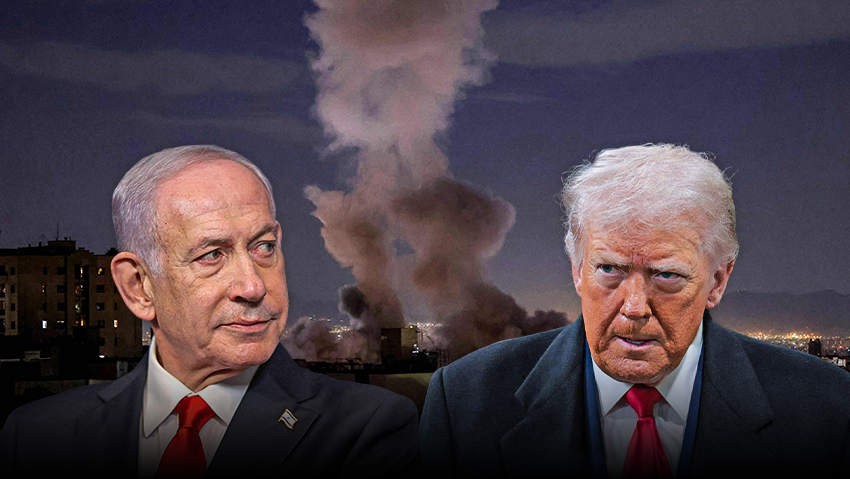
(Photo: ATTA KENARE / AFP, JOE RAEDLE / AFP, Anna Moneymaker / AFP)
Trump and Prime Minister Benjamin Netanyahu have spoken nearly every day since the war began, sometimes multiple times a day, the Journal reported, citing U.S. officials. Netanyahu has also held discussions with Secretary of State Marco Rubio and White House envoy Jared Kushner about the state of the fighting and possible ways to bring the conflict to an end.
Despite the close coordination, some officials in Washington are concerned Israel may want the war to continue longer than the United States does, according to the report.
Israeli officials have conveyed that their operations in Iran are closely tied to U.S. involvement and that Israel would likely halt its campaign once Washington ends its own military role, people familiar with the talks told the Journal.
White House press secretary Karoline Leavitt said the timing of any U.S. exit will be decided by Trump.
“The end of America’s involvement in this conflict will ultimately be determined by the commander in chief, when he feels the military objectives are fully met and the threat of the Iranian regime has been completely eliminated,” she said.
US strikes against the Iranian Navy
(Video: X)


The differing approaches have also been reflected in how the two countries are conducting the war.
Israel has continued targeting senior Iranian officials and has expanded its strikes to include parts of Iran’s energy infrastructure in an effort to increase pressure on Tehran’s leadership. According to the Journal, U.S. officials recently told Israel they were unhappy with attacks on Iranian oil and fuel facilities and asked that such targets not be struck again without American approval.
Earlier in the conflict, Pentagon policy chief Elbridge Colby told Congress that the strike that killed Iran’s supreme leader, Ayatollah Ali Khamenei, was part of Israeli operations. He contrasted that with U.S. strikes, which have focused on Iran’s missile forces, drones and naval capabilities.
Trump’s stated objectives for the war have also shifted. Early in the conflict he suggested regime change in Tehran could be a goal, but he later told reporters that the United States had already achieved most of its military aims.
Rubio and other senior U.S. officials have framed the campaign more narrowly, focusing on degrading Iran’s nuclear and missile programs rather than removing the government.
Secretary of War Pete Hegseth acknowledged the different priorities during a Pentagon briefing Tuesday alongside Gen. Dan Caine, chairman of the Joint Chiefs of Staff.
“Israel has been a very good partner,” Hegseth said, adding that where Israel has “different objectives, they have pursued them.”
Hegseth: Israel has been a very good partner
(Video: Reuters)
The war is also creating wider regional pressures. Iran has tightened its blockade of the Strait of Hormuz, a critical shipping route through which about one-fifth of the world’s oil normally passes, pushing oil prices above $100 a barrel this week, according to the Journal.
Trump said Monday that the U.S. Navy could escort oil tankers through the strait if necessary, raising the possibility that U.S. forces could remain involved in the conflict longer than planned.
In Israel, the war has broad public support. A poll conducted in early March by the Institute for National Security Studies found that about 82% of Israelis back the campaign, reflecting the direct threat posed by Iranian missiles that can reach Israel within minutes.
Some analysts say Israel has long viewed the conflict as an opportunity to weaken or potentially topple Iran’s leadership.
“Israel has dreamed for decades about a joint war to topple the Islamic Republic,” Chuck Freilich, a former Israeli deputy national security adviser now at the Institute for National Security Studies in Tel Aviv, told the Journal.
Analysts warn that ending the conflict could prove more difficult than launching it.
“It is much easier to start a war than to end one,” Ali Vaez, Iran project director at the International Crisis Group, told the Journal.
U.S. envoy Steve Witkoff is expected to travel to Israel next week to coordinate with Israeli leaders on the next phase of the war.