

Mojtaba Khamenei was not seen in public even at his father’s funeral, but senior figures from the terror groups backed by Iran, along with representatives from powers closely aligned with Tehran, did attend the memorial ceremony and the events that followed.
The ceremonies are taking place only this week, four months after the assassination of Ayatollah Ali Khamenei and as Iran and the United States remain in a fragile ceasefire. Some observers have said the gathering could expose senior Iranian officials and their proxies to an unprecedented level of surveillance and scrutiny.
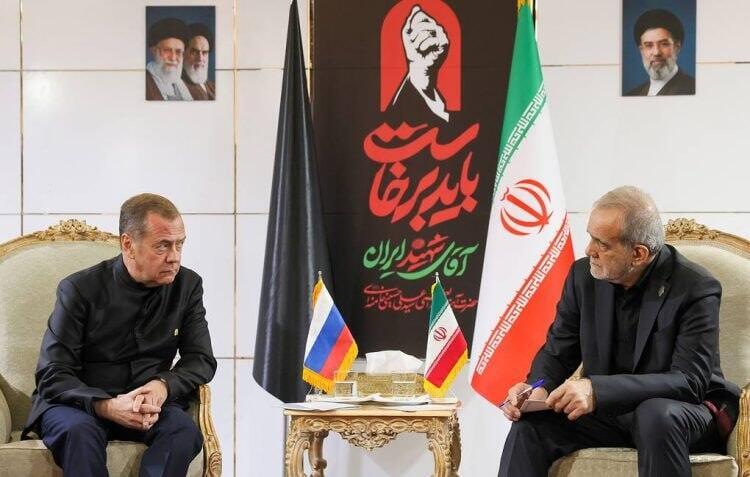
Former Russian President Dmitry Medvedev and He Wei, a senior Chinese Communist Party official, arrived for the funeral of Iran’s slain leader, who was killed on the first day of the war earlier this year. Both met with Iranian President Masoud Pezeshkian and with Parliament Speaker Mohammad Bagher Ghalibaf, one of the officials leading talks with the United States.
At the same time, Foreign Minister Abbas Araghchi, Ghalibaf’s partner in leading the negotiations, met with Hezbollah representatives who arrived in Tehran, as well as senior Hamas officials.
Among the Hamas officials who attended the ceremonies were Zaher Jabarin, Mousa Abu Marzouk, Izzat al-Rishq, Osama Hamdan and Mohammed Ismail Darwish. Hezbollah official Mahmoud Qamati was also present. Representatives from pro-Iranian Iraqi militias and the Taliban also attended the events.
Ziad al-Nakhaleh, secretary-general of Palestinian Islamic Jihad, said he had taken part in the farewell and tribute ceremonies for the “martyred leader,” adding that “Sheikh Khamenei loved Palestine, and the Palestinians returned that love and loyalty.”
Ahmad Vahidi, head of Iran’s Revolutionary Guard Corps, also emerged from hiding for the memorial ceremony and was seen in public for the first time since February. The British Telegraph reported that his presence underscored why the funeral itself could be significant for Israeli intelligence agencies, no less than any military response.
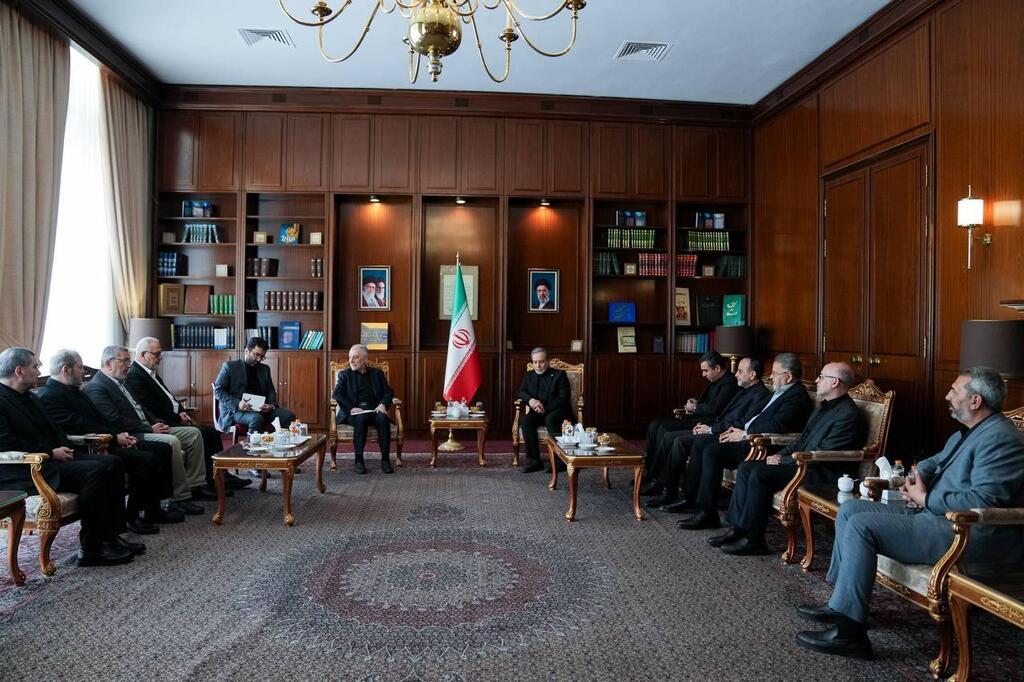
Iranian Foreign Minister Abbas Araghchi meets with representatives of Hezbollah
An Israeli security source told the British newspaper that it was not only Iran’s leadership that should be concerned. The source noted that Ismail Haniyeh, the head of Hamas’ political bureau, was assassinated while in Iran for Pezeshkian’s inauguration ceremony in 2024. The current funeral, the source said, could also “draw” high-value targets for Israel, including senior Hezbollah officials.
“Israel has made clear that there is no hiding place for terrorists, going back to the period after the Munich Olympics, when the Mossad tracked down and killed many of the leaders of Black September,” the source said. “The same message was sent when Haniyeh was killed in Tehran, a place he had visited many times and believed he was immune.”
Nearly a month after Khamenei was assassinated, IRGC navy commander Ali Reza Tangsiri was killed during Operation Roaring Lion. Iran announced his replacement only Saturday. Iranian media reported that Ali Ozmai had been promoted to the post. On X, he wrote: “Divine revenge against America and Israel is not far away at all.”
Russia and China were among the countries that sent representatives to the ceremonies. Iranian reports claimed that at least 13 countries, including several from Eastern Europe, Africa, the Gulf and East Asia, decided not to attend because of U.S. pressure. Iran’s Tasnim news agency reported that some of those governments later contacted Tehran through diplomatic channels to explain their absence.
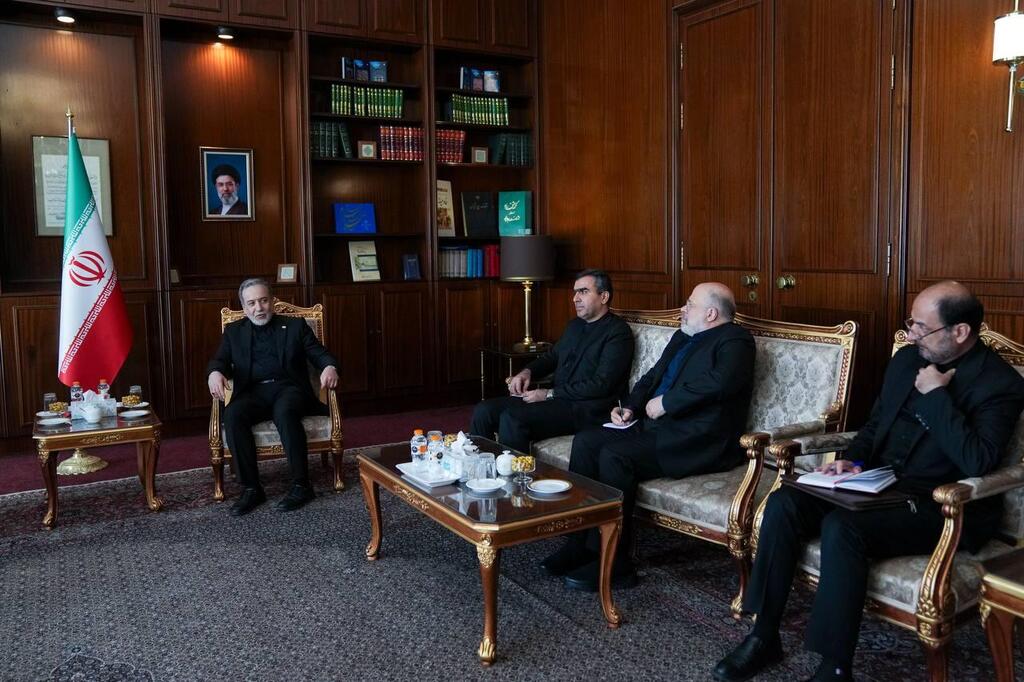
Araghchi meets with representatives of Hamas
According to Tasnim, U.S. officials conducted a “campaign” to deter foreign delegations from attending the mourning ceremonies in Tehran. The Iranian outlet claimed that U.S. Secretary of State Marco Rubio issued a confidential directive last week to American embassies, instructing them to tell host governments that attending the funeral would be considered “an unfriendly step that could have negative consequences” for relations with Washington.
Tasnim also claimed that two Arab diplomats said Rubio raised the issue in calls with counterparts in at least five Arab states. The outlet further alleged that U.S. ambassadors in Africa warned governments on the continent that attending the ceremony could endanger their access to American development aid.
The mass funeral ceremony began Saturday morning with Khamenei’s coffin placed in Khomeini Mosque. Beneath it stood the coffins of relatives killed at the start of Operation Roaring Lion.
Alongside the tears shed by senior regime officials before Ali Khamenei’s coffin, the ceremonies, taking place in three cities in Iran and two in Iraq, are also meant to serve as a show of force. Millions are expected to attend. Tehran is presenting the events as proof of survival after a war in which the regime withstood an attempt to topple it and, according to its own claims, emerged strategically strengthened by the control it says it gained over the Strait of Hormuz, the world’s key oil artery.
The funeral events began after a long delay. At first, the reason was the war, which continued for more than a month. But even after the April ceasefire, the ceremonies were postponed again and eventually scheduled for a symbolic date during Muharram, the holy Shiite month of mourning that culminates in Ashura, which marks the death of Imam Hussein in the seventh century.
That timing carries significant weight for Iran, which presents Khamenei not only as its national leader but as a leader of Shiites around the world. After his assassination, the regime has also sought to portray him as a kind of saint who sacrificed his life.