


Against the backdrop of the approaching Knesset election, media outlets around the world are extensively covering Prime Minister Benjamin Netanyahu’s statement Sunday that Israel rejects the Gaza Board of Peace’s 15-point document.
“It is a rare public rupture with Mr. Trump, with whom Mr. Netanyahu has conducted a dizzying and sometimes unpredictable partnership,” The New York Times wrote. The article later noted that Netanyahu is “facing a difficult election campaign,” and that although he promised “total victory” over Hamas after the October 7 massacre, the terrorist organization still controls parts of the Strip.
Gallery
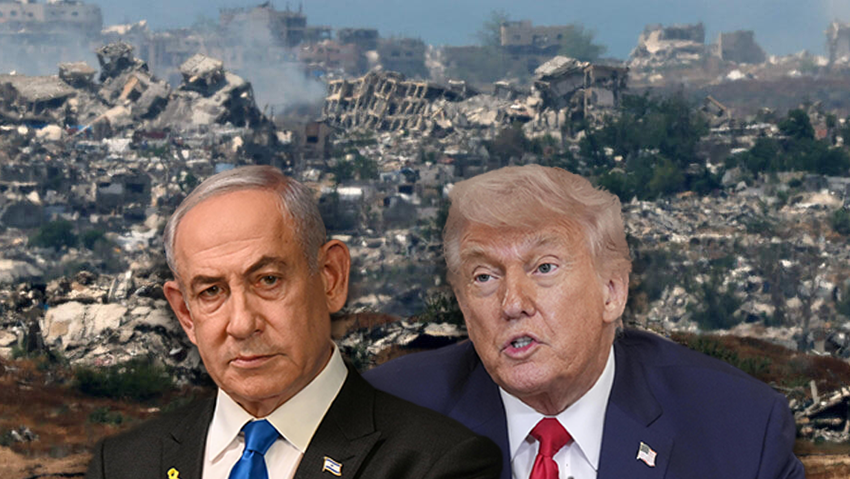
A rift between the sides? Netanyahu rejected the outline of the Gaza Board of Peace
(Photos: Jack Guez / AFP, Evelyn Hochstein/Reuters, Haim Tzach/GPO)
The Times referred to the initial ceasefire between Israel and Hamas, mediated by the U.S., which was reached last October, but noted that it only “postponed some of the most difficult questions until later — including Hamas’ control of the Strip.” Under Trump’s peace plan for Gaza, Hamas is supposed to give up its weapons, a central Israeli demand. But armed resistance to Israel, the report said, is a core principle in the terrorist organization’s worldview.
The prime minister's statement rejecting hte 15-point plan
(Video: Roy Avraham, GPO)


The BBC noted in the context of the current Gaza plan that, just a few months before Israel’s election, “it is unlikely the prime minister will want to grant concessions.” The report mentioned that the national security minister opposed the plan, and said far-right coalition members are calling for the Cabinet to vote again on the Gaza plan — and put an end to it.
CNN claimed that Netanyahu’s right-wing coalition is trailing in polls ahead of the election, and that “senior ministers in the government have signaled that they want to expand control. Far-right Cabinet members welcomed Netanyahu’s comments.” The article also quoted Finance Minister Bezalel Smotrich, who said that “the IDF cannot withdraw even one millimeter in the Gaza Strip.”
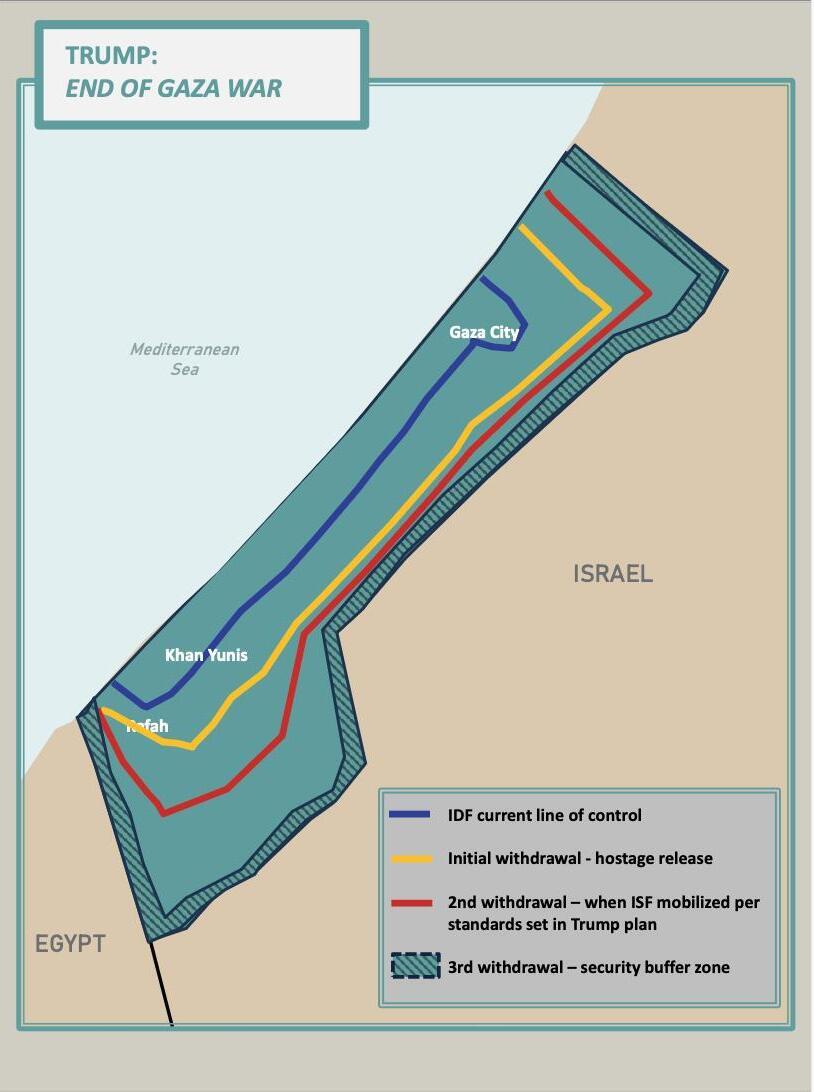
Map of the Gaza Strip according to the US plan to end the war
(Photo: The White House)
NBC wrote that Netanyahu is “facing an internal political struggle for survival ahead of elections expected in October, with the status of the wars in Gaza and Iran expected to be a decisive factor.” The article noted that the public rejection of the peace plan, which Trump has repeatedly presented as a key foreign policy achievement, comes after months of growing tension between the White House and Israel’s leadership over Iran.
'20 points' — yes. '15 points' — no.
In October, Israel agreed to Trump’s “20-point plan” to end the war in Gaza, which was published immediately after a meeting he held with Netanyahu. The plan included, among other things, the release of the hostages still held by Hamas, a ceasefire, the entry of aid into the Strip and a promise that Israel would not occupy or annex Gaza. According to the details published at the time, as the international force established control and stability, the IDF would withdraw according to milestones and conditions to be set among the IDF, the international force, Arab states and the U.S., until full handover of the Gaza Strip to them. It was further noted that only a security perimeter presence would be maintained until it was fully ensured that there was no terrorist threat from the Gaza Strip.
Now, however, Israel has rejected the new plan, which includes 15 points and was published about a week and a half ago. The Gaza Peace Council published the “road map” for implementing the plan, which sets out a gradual, time-limited and internationally supervised process for disarming terrorist organizations and militias and for a full Israeli withdrawal from the Strip. In the statement rejecting the plan, Netanyahu stressed that “the IDF will not carry out any withdrawal until Hamas is disarmed.”
These are the full details of the plan Israel accepted — and the one it did not:
The plan Israel refused to accept
The current plan, which includes 15 points, states that all parties must reaffirm their commitment to President Trump’s comprehensive plan to achieve peace in Gaza. “Through this process, the parties seek to end the cycle of destruction, ensure the completion of the Israeli withdrawal from the Gaza Strip, restore life to normal, enable Palestinian governance, reconstruction, security, recovery and economic development, rehabilitate the affected groups and facilitate the opening of a credible political path leading to self-determination and statehood,” the plan says.
The second clause calls on Israel to complete without delay all its remaining obligations under the Sharm el-Sheikh agreement, particularly the cessation of military operations. At the same time, it says, Hamas and the Palestinian factions will complete the cessation of all military operations in accordance with the Sharm el-Sheikh agreement and the peace plan. In parallel, the timetable and implementation mechanisms for this road map will be prepared within 14 days after all parties approve it, with the period subject to extension by decision of the International Verification Committee, or IVC. Once the timetable and implementation mechanisms are completed, the National Committee for the Administration of Gaza, or NCAG, will enter the Strip and begin carrying out its responsibilities.
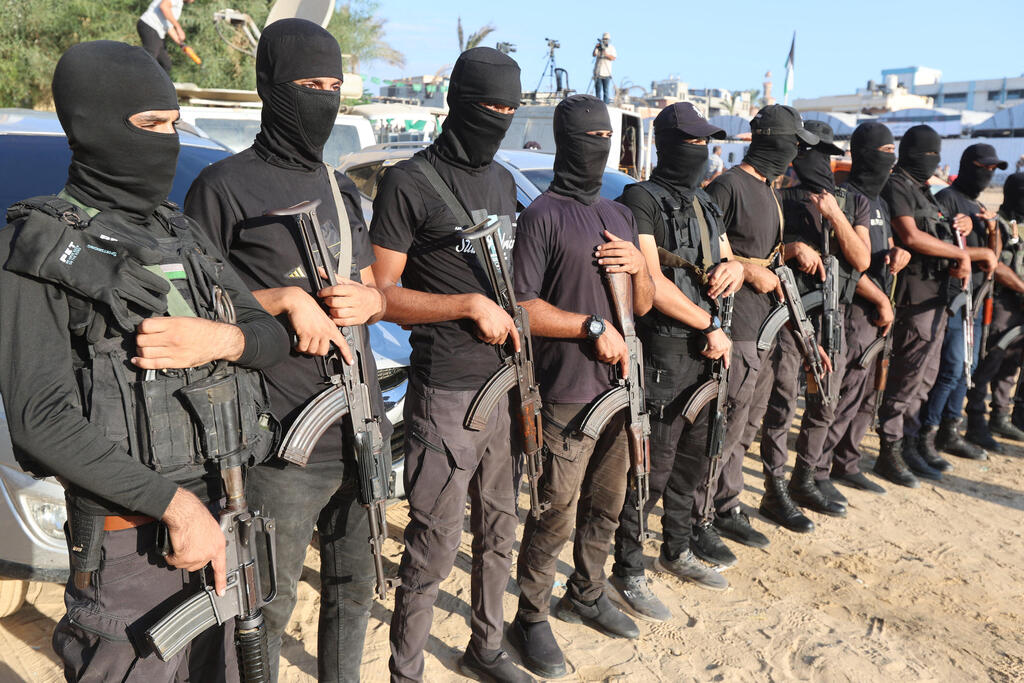
Hamas terrorists in Gaza
(Photo: Ramadan Abed/Reuters)
The third clause states that transition to the next stage will be conditioned on verified completion of the commitments set out in the previous stage. The IVC will monitor any violation by either side through an enhanced monitoring mechanism. The fourth clause says Hamas and the other factions agree that all civilian governance and security functions in the Gaza Strip will be transferred to the Gaza administration committee, in accordance with President Trump’s comprehensive plan. They also declare that the Gaza administration committee will enjoy full independence in carrying out its responsibilities, and that the factions will not interfere in its affairs during the transition period.
After the National Committee for the Administration of Gaza assumes full responsibility in the Gaza Strip, according to the plan, it will ensure the continuity of civilian institutions and public services. “The Gaza administration committee will work to assess legitimate obligations to suppliers, contractors and other parties — up to a total amount not exceeding $400 million — and address them,” it says.
The sixth clause states that the Gaza Strip will be administered according to the principle of “one authority, one law, one weapon.” The seventh clause states that newly trained police officers will be integrated into the existing police structures, and that all police personnel will undergo a comprehensive vetting and screening process.
Regarding the disarmament of the Strip, the eighth clause says a process of decommissioning and storing heavy weapons, weapons production sites, arms depots and tunnels “will begin after the completion of the remaining commitments under the Sharm el-Sheikh agreement, the entry of the Gaza administration committee into the Strip and the deployment of the international stabilization force.” It further says that the process will be linked to a gradual Israeli withdrawal from the areas under its control in the Gaza Strip and to the disarmament of armed militias. “The implementation of this road map, including the issue of weapons and other clauses in the comprehensive peace plan, will create appropriate conditions for a credible path toward achieving Palestinian self-determination and statehood,” it says.
The next clause in the plan states that personal weapons in the Gaza Strip will be subject to the provisions of the relevant Palestinian laws. In addition, militia weapons will be decommissioned and stored under the authority of the National Committee for the Administration of Gaza. Members of those militias will not be integrated into the security services or the police. The plan further says that a peace agreement will be signed in accordance with Palestinian norms and laws, and will include commitments to immediately stop internal violence, refrain from acts of revenge, shows of force, military parades and armed demonstrations.
The temporary international stabilization force, the plan says, will be deployed in the Gaza Strip to separate Israeli forces from areas under the control of the Gaza administration committee. The stabilization force will not carry out policing missions or tasks related to Palestinian society. In addition, it will monitor all parties’ compliance with the ceasefire, train the Palestinian police, ensure the protection and transfer of humanitarian aid and essential supplies to the Gaza Strip, and assist the Gaza administration committee, at its request, with any other task unrelated to policing.
Another clause states that Israeli forces will complete their gradual withdrawal from the Gaza Strip according to an agreed timetable, in a manner consistent with clause eight of this road map and in accordance with President Trump’s comprehensive plan, which includes a commitment not to force anyone to leave the Strip.
The final clauses state that the National Committee for the Administration of Gaza will be responsible for handling internal security incidents, and that the implementation of Gaza’s reconstruction and the provision of the required resources and funding will be carried out according to a plan and timetable to be prepared and supervised by the Peace Council and the Gaza administration committee, in accordance with relevant laws and international standards.
The plan Israel previously accepted
At the end of last year, Israel accepted Trump’s 20-point plan to end the war in Gaza. That plan stated that the Gaza Strip would become a demilitarized, terror-free zone that would not pose a threat to its neighbors; that the Gaza Strip would be redeveloped for the benefit of its residents, who had suffered more than enough; and that if both sides agreed to the proposal, the war would end immediately.
“IDF forces will withdraw to an agreed line to prepare for the release of the hostages. During this period, all military operations, including aerial and artillery bombardments, will be suspended, and the battle lines will be frozen until the conditions are met for a gradual and full withdrawal,” it said at the time.
In addition, the agreement stipulated that within 72 hours of Israel publicly announcing acceptance of the agreement, all hostages — living and dead — would be returned, and that afterward Israel would release 250 prisoners serving life sentences and another 1,700 Gazans arrested after Oct. 7, 2023, including all women and children detained in that context. Under the plan approved at the time, Hamas members who commit to coexistence and peace would be given the option of laying down their weapons and receiving amnesty. At the same time, anyone who wished to leave the Gaza Strip would be offered safe passage to receiving countries.
Upon acceptance of the agreement, the plan said, full aid would immediately flow into the Gaza Strip in quantities at least as large as those set out in the agreement of Jan. 19 last year, including restoration of infrastructure — water, electricity and sewage — rehabilitation of hospitals and bakeries, and the entry of equipment to remove rubble and open roads. Aid distribution would be carried out through the U.N. and its agencies, the Red Crescent and additional international bodies not affiliated with either side. The Rafah crossing would be opened in both directions under the same mechanism.
The plan stated that the Gaza Strip would be temporarily administered by a technocratic and apolitical Palestinian committee that would provide daily services and operate under the supervision of a new international transitional body, the “Board of Peace.” This body would set the framework and manage development funding until the Palestinian Authority completes its reform and can return to govern the Strip safely and effectively. In addition, it said, Trump’s economic plan for Gaza’s development would be prepared by a panel of experts, and a special economic zone would also be established with preferred tariffs and access arrangements to be set with participating countries. The agreement also stated that no one would be forced to leave Gaza, and anyone who wanted to leave and return would be able to do so.
Regarding the terrorist organizations in the Strip, the plan said at the time that Hamas and other factions would commit not to take part in any way in Gaza’s administration, all terrorist infrastructure would be destroyed and not rebuilt, and the demilitarization process would be conducted under international supervision, including a buyback and reintegration program for fighters. In addition, regional partners would provide guarantees for Hamas and the factions’ compliance with their commitments and to ensure that the new Gaza Strip would not pose a threat.
The U.S. said at the time that it would work with Arab and international partners to establish a temporary international stabilization force, to be known as the ISF, which would enter the Gaza Strip as soon as possible. The force would train and support vetted Palestinian police forces and coordinate its activity with Jordan and Egypt. It would work with Israel and Egypt to secure the borders and prevent weapons smuggling, while regulating the rapid and safe passage of goods.
Clause 16 of the agreement stressed that Israel would not occupy or annex Gaza. According to the details of the agreement approved at the time, as the international force established control and stability, the IDF would withdraw according to milestones and conditions to be set among the IDF, the international force, Arab states and the U.S., until full handover of the Gaza Strip to them. Only a security perimeter presence would be maintained until it was fully ensured that there was no terrorist threat from the Gaza Strip. The plan also stated that if Hamas delayed or rejected the proposal, the arrangement and aid would continue in terror-free areas transferred from IDF control to the international force.
The final clauses said an interfaith dialogue process would begin on the values of tolerance and partnership to change narratives among Palestinians and Israelis and emphasize the benefits of peace. It also stated that as Gaza’s development advances and the Palestinian Authority’s reform is implemented, conditions would be created for a credible path to Palestinian self-determination and statehood — the aspiration of the Palestinian people. The final clause stated: The U.S. will conduct dialogue between Israel and the Palestinians to reach agreement on a political horizon for peaceful and prosperous coexistence.