


Maj. Raz Peretz was killed on Oct. 7 during a heroic battle at the Kissufim military post near the Gaza border. His close friends from officers training, Maj. R. and his wife, Tal, commemorated him in the name of their daughter — who was born on Raz’s birthday — and his picture hangs in the room of the baby girl named in his memory.
Peretz, the headquarters company commander in Golani Brigade’s 51st Battalion, led his soldiers into a fortified roadside shelter and then went out to bring back ammunition, killing terrorists on the way.
Gallery
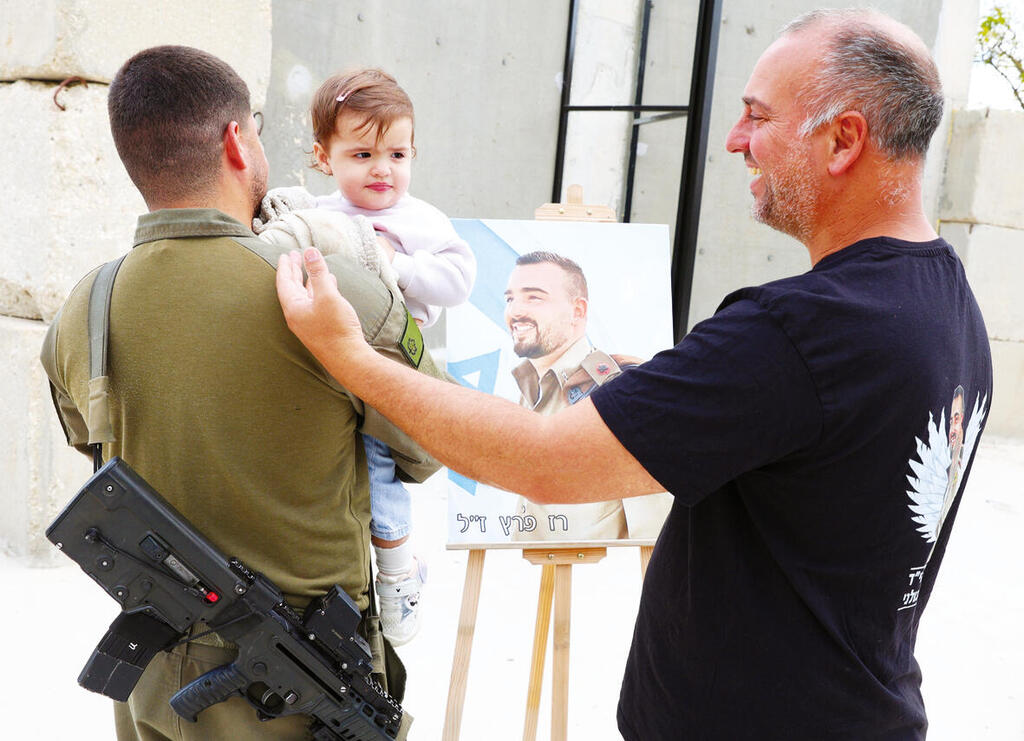
Maj. R. holds baby Ron as Roni Peretz, father of Maj. Raz Peretz (pictured in the back), watches from the side
(Photo: Elad Gershgorn)
When he returned to the shelter, he commanded his soldiers, who were not accustomed to combat, and even after suffering a wound to his left hand, he continued returning fire and charged toward the attackers. Six other soldiers were killed in that bloody battle: Staff Sgt. Evyatar Ohayon, Staff Sgt. Yogev Aharon, Staff Sgt. Or Esatu, Staff Sgt. Brando David Flores Garcia, Staff Sgt. Teshger Taka and Sgt. Uriel Segal.
Raz’s father, Roni, pieced together the details of the battle from testimony he collected. “Raz was a people person,” he said. “He always cared about others, the environment and the people around him. It comes through so clearly in the battle he fought. You can see how many circles of people he was looking after there: the guys in the shelter, the people at the Nova festival that he was messaging during the battle — when he understood that his life would soon end. He made sure to tell them not to stay there because the situation was catastrophic. That was what defined him.”
After enlisting in Golani as a fighter in the 13th Battalion, Raz met Maj. R., 28, from Kiryat Ata. They went through officers training together and later served in parallel as deputy headquarters company commanders and then as headquarters company commanders — Raz in the 51st Battalion and R. in the 12th.
“The soldiers were always on his mind, in first place. A Golani commander the way it should be,” R. said. “Before he was killed, Raz was offered a service program with incentives, but he wanted to work as a DJ, to make people happy at weddings. The army wanted him so badly because he was loved and good to everyone, but he was torn.”
On the day he lost his close friend, R. was fighting in Gaza with the 12th Battalion. “The company showed fighting spirit, resilience and strength. We acted out of a sense of purpose and responsibility,” he recalled. “For me it was symbolic to be there, in the place where Raz fell.”
Even before the war, on Aug. 17, 2023, R. married Tal. The two had met in officers training and in a logistics officers course they completed together with Raz.
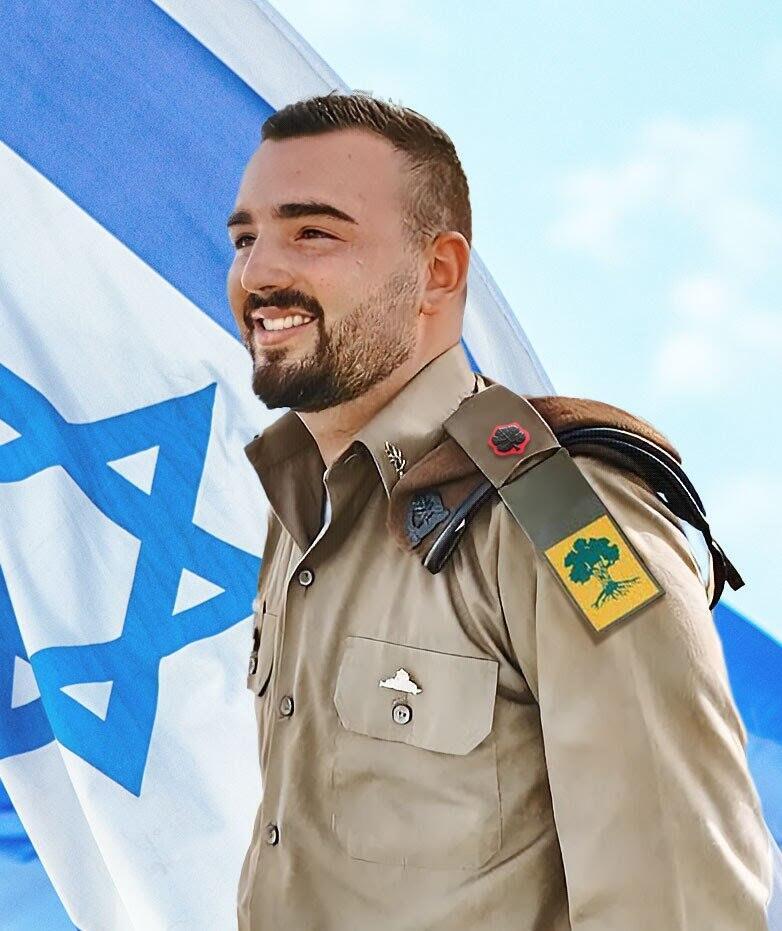
Maj. Raz Peretz
(Photo: Courtesy of the family)
“There is a custom that in the first year of marriage you don’t go to a cemetery, but on Memorial Day two years ago my wife insisted on going,” R. said. “When she got to Raz’s grave, she had strong pains. In retrospect we understood they were caused by pregnancy. The due date was in February, but I knew she would give birth on Jan. 25, Raz’s birthday, and that’s what happened. It was complicated for us to get pregnant, and when Ron was born I raised my hands to the sky and said, ‘Raz, thank you very much.’ On Saturday night I called Roni, and the next day he came to the hospital. It was emotional.”
They chose the baby’s name, Ron, because it begins with the Hebrew letter resh — like the names Raz and R. — and also reflects who Raz was for them.
“The call from R. made us smile and brought joy to our hearts,” Roni Peretz said. “My wife, Nava, and I came to the hospital and were very moved. Raz continues to live with us in different ways, and this is one of the most special.”
In closing, R. said: “Raz’s family prepared many things in his memory that hang in Ron’s room. She always holds the prayer card with Raz’s picture and shows interest in it. She will grow up with him, learn about him, and at the right time we will also bring her to the cemetery, to meet the person she was named for.”
'Omri was a model figure. We wanted him to be part of our family’s spirit'
Maj. Omri Chai Ben Moshe was killed in September 2025 by an explosive device in Rafah, in southern Gaza. Maj. T. served alongside him at different points, and the two fought shoulder to shoulder on Oct. 7. Their wives also became friends during the war. T. and his wife named their son Achiya after him.
Ben Moshe was killed on Sept. 18, 2025, by an explosive device in Rafah’s Janina neighborhood. Three other officers were also killed in the incident: Cpt. Eran Shelem, Lt. Ron Arieli and Lt. Eitan Avner Ben Itzhak.
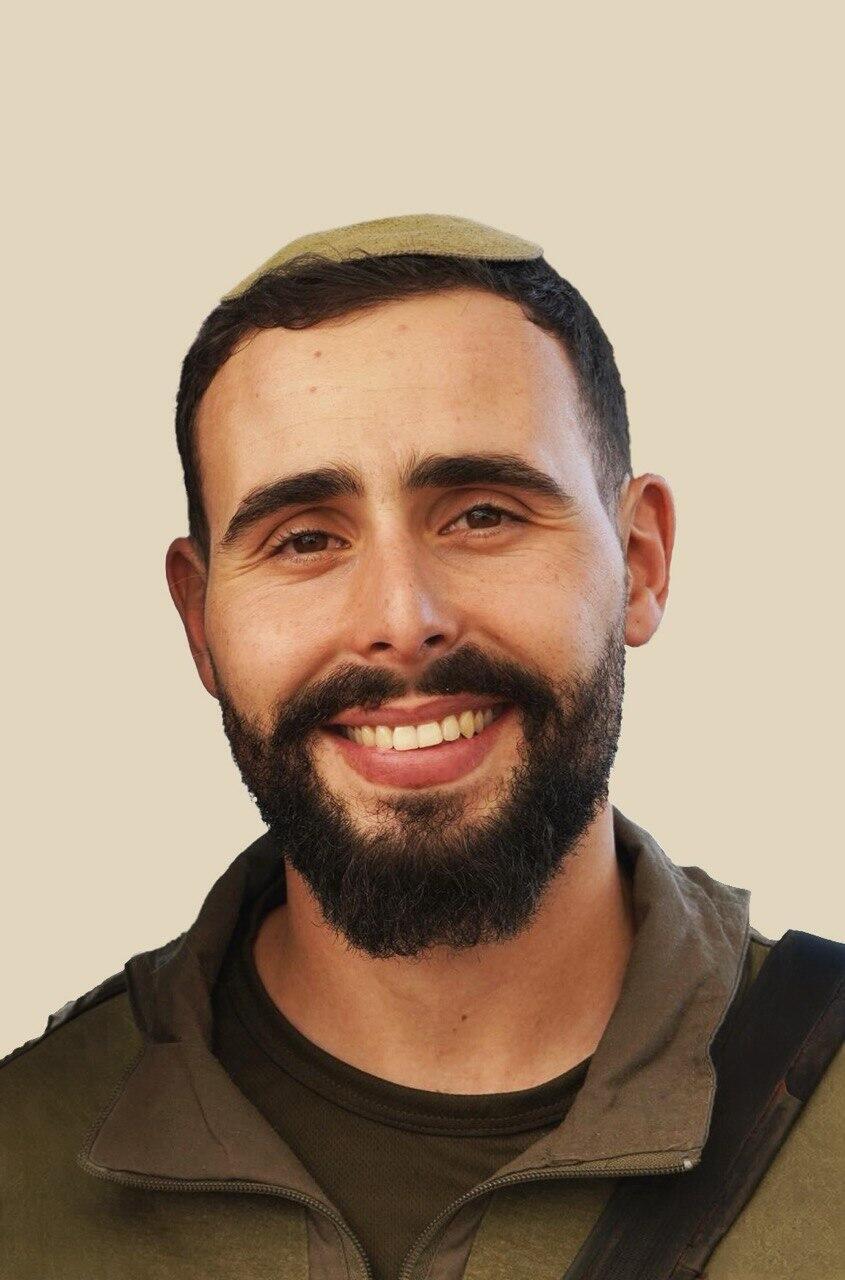
Maj. Omri Chai Ben Moshe
(Photo: IDF)
“It’s the most painful loss I have experienced,” said his friend, Maj. T., 29, from Bruchin, an Israeli settlement in the West Bank. “We were parallel in our positions and overlapped in many areas. We were both battalion commanders, both religious, both parents, both in the same category.
"Only after he fell did I discover who he had been behind the scenes, not only in my direct encounters with him. I understood how he left such a mark on me, first as a company commander in the battalion, and even more today, when I’m an officer at Bahad 1,” he added, referring to the IDF officers' school. “I take Omri as the headline of what an exemplary Israeli officer should be.”
On the morning of Oct. 7, T. was at prayer in a synagogue. “I was in a company commanders course then, without my phone, and we didn’t hear any sirens,” he recalled. “Suddenly the sexton said we would shorten the prayers because there was a disaster in the south. I went out immediately, and the first image I saw in the news was the terrorists’ pickup truck in Sderot.”
On his way south, T. spoke with his close friend Omri Chai Ben Moshe, who was also in the company commanders course. “I was talking practicalities, and he was talking about a historic war,” T. said. “That was his character: He connected every experience and situation to the past. It came through even in the chaos of Oct. 7, that he looked at it from a perspective of faith, that there was a larger process here.”
The two met up at their unit, signed out weapons and continued together into fighting in the area around Gaza. Other officers who had been in studies and were looking for a framework to join also attached themselves to them.
“So they could activate us, we called our force ‘Banmush’ — Omri’s nickname. He was the most senior and active among us. To this day we still have a WhatsApp group by that name. We never imagined that this random name would turn us into a group of friends with a shared fate,” T. said.
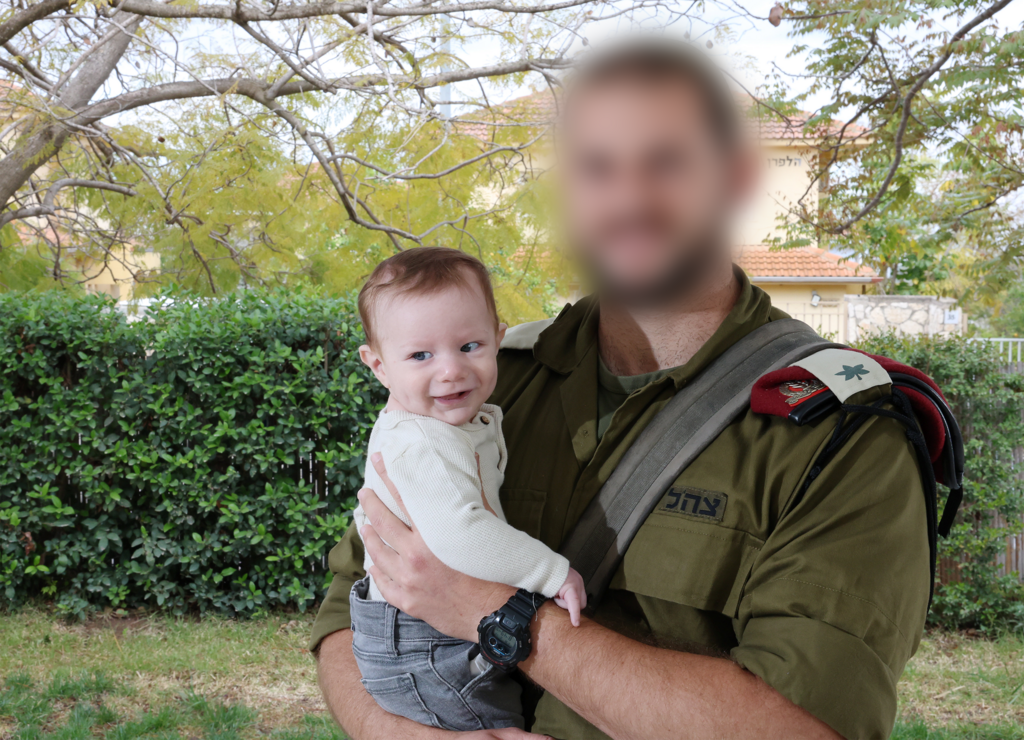
Maj. T. holds baby Achiya
(Photo: Shaul Golan)
After they completed the course, the two met again in the field. “It was in Lebanon, in November 2024,” T. said. “I was a training company commander and he was commander of Company A in the 890th Battalion” of the Paratroopers Brigade.
“We were happy to work together again. I always saw him as a model figure and was influenced by his faith in the justice of the path. He became religiously observant during his officers course, and the army was part of his spiritual world. For him, being at the center of the fighting and operational work was a privilege. From his perspective, it was like serving God.”
At Omri’s funeral, T. and his wife, Hillel, who was already pregnant, decided to name their son in his memory. “It was clear to me that Omri would forever be part of our home, part of the spirit of our family,” T. said. “Throughout the war our wives became close friends, and to this day they strengthen one another. We knew he would have a part in our son’s name.”
Why did they choose the name Achiya?
“The beginning is the initials of Omri Chai, and the continuation means ‘friend of God’ — the opening of a biblical verse. In addition, the prophet Ahijah the Shilonite acted in a period of divided monarchy for the sake of unity. For Omri, creating shared dialogue, unity and comradeship were missions no less important than fighting the enemy.”
In conclusion, T. added emotionally: “Whatever path our son Achiya takes and chooses, he will know he has a responsibility on his shoulders, that he is part of a mission — in Omri’s memory and in memory of the model figure he was.”
Two sons are named after friends killed in battle
Maj. Roey Chapell, a company commander in the Nahal Brigade’s reconnaissance unit, was killed on Oct. 7. Maj. Dvir Zion Revah, a company commander in the 932nd Battalion, was killed Jan. 6, 2025, in the Gaza Strip. Their friend, Maj. A., named his sons Elroi Haim and Kfir Zion in their memory.
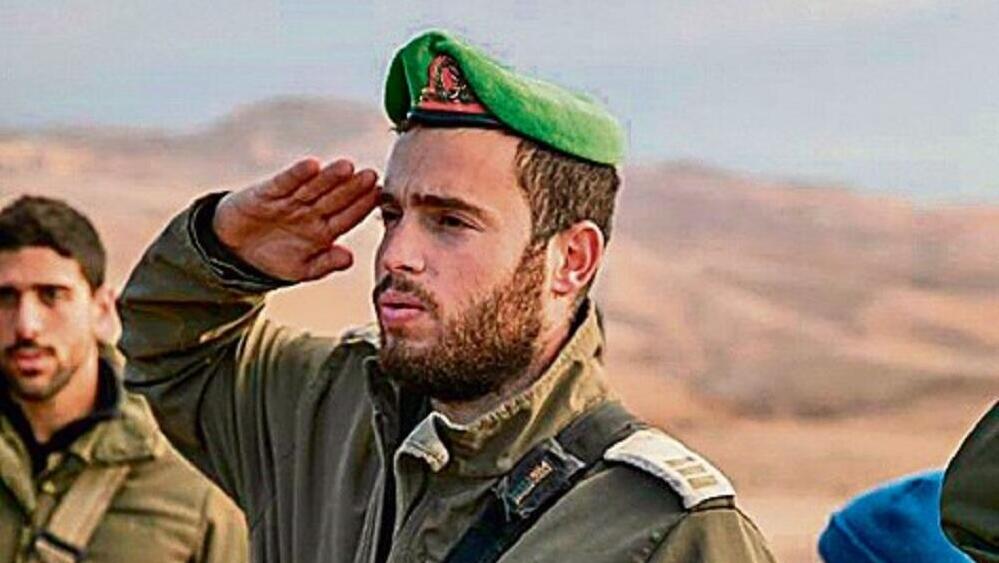
Maj. Roey Chapell
(Photo: IDF)
Maj. A., 29, who is set to be appointed deputy commander of the Nahal Brigade's 931st Battalion, chose to give his two sons names that carry the memory of friends he lost. Elroi, his middle son — younger brother to 4-year-old Hadar — was named after Maj. Roey Chapell, a company commander in the Nahal reconnaissance unit who was killed in fighting on Oct. 7.
“I grew up in the 932nd Battalion and Chapell was in the reconnaissance unit,” A. said. “After the company commanders course, we met again as commanders at the training base. We were a strong group among the staff and stayed in touch even after we split up.”
According to A., “Chapell believed in everyone who served under him. The soldiers with the hardest and most problematic stories — he would fight for them constantly, never give up on them or on their potential. The soldiers he believed in became the ones who fought on Oct. 7. His belief in people, his ability to see the good, to believe in process and complexity — those were things we wished for our Elroi.”
Elroi was born two months after the outbreak of the war, but his name had been chosen even before that. “My wife dreamed about the circumcision ceremony, and in the dream I said the baby’s name was Elroi and explained that it was in Chapell’s memory,” he said. “She woke up in the morning and said that was the name she had chosen.”
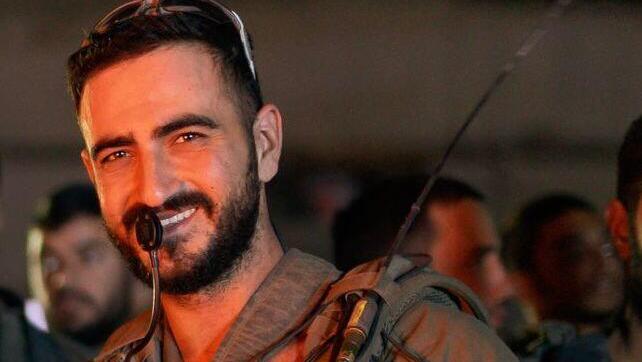
Maj. Dvir Zion Revah
(Photo: IDF)
The second name they gave him was Haim, or “life.” “Out of bereavement, we wanted to add light,” A. said. “Despite the darkness, there is continuity, hope and goodness.”
Four months ago, A.’s youngest son was born and was given the name Kfir Zion, in memory of Maj. Dvir Zion Revah, a 932nd Battalion company commander, was killed on Jan. 6, 2025, by an anti-tank missile strike in Beit Hanoun in northern Gaza.
“We were best friends. Talking all the time, in the army and at home,” A. said painfully. “If there was a dilemma, he was the first phone call. Over the years our connection only deepened. I introduced him to his wife, a childhood friend of mine. Our wives, both named Or, became friends, the children are friends. We used to go on trips together. We were each other’s address for the most personal things there are, like flowers for your wife on a holiday, and in routine life, as commanders, we spoke openly about everything. The closest connection there is.”
A. received word of Dvir’s death while he was in a study period. “When you’re a company commander and there are soldiers waiting for you, in a moment like that you take a deep breath and you have to stay at your best for your guys,” he said. “But when I got the message that Dvir had fallen, I wasn’t in the field and I didn’t know what to do with myself. It’s terrible. I lost my best friend. It’s hard, there is an emptiness, and there is no good way to deal with it.”
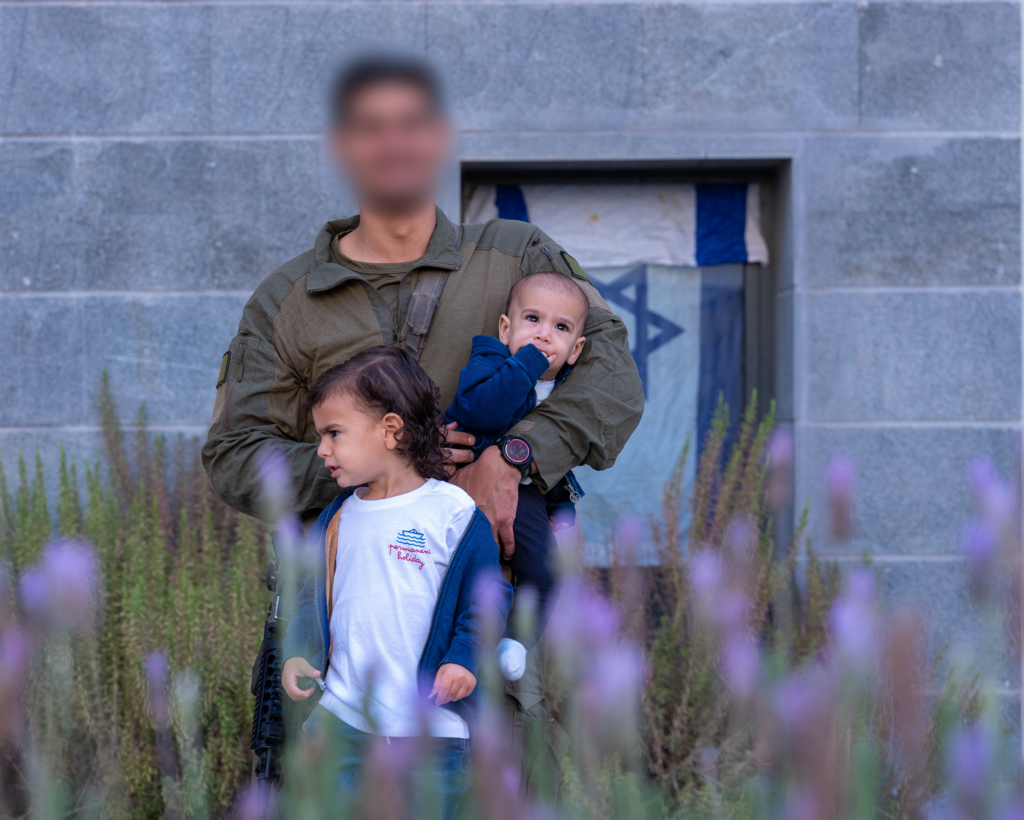
Maj. A. and his sons Elroi Haim and Kfir Zion
(Photo: Yuval Chen)
Ten months after Dvir was killed, A.’s son was given his name: Kfir Zion. “The name Kfir is because right now he is a lion cub, and in the future he will be a lion, king of the animals, like Dvir,” A. explained. “Dvir was always first among his soldiers in battle. Not as a slogan. He led the guys physically and mentally. Like a lion, in control and knowing everything, and no one could overpower him. On the other hand, he also had gentleness, the ability to see the last soldier at the edge, always to understand everyone.”
The second name given to the boy, Zion, is the same as Dvir’s middle name. “For me, it is about preserving Dvir’s essence in life,” A. said. “Kfir will learn about him, and I pray and hope that Dvir’s character traits will be present in him.”