


In a summit held Thursday in Athens with Israel’s Energy Minister Eli Cohen and his counterparts from the United States, Greece and Cyprus, leaders committed to a bold U.S. initiative to replace Russia and become Europe’s central energy supplier.
Cohen, together with co‑chairs of the U.S. National Energy Dominance Council, affirmed a shared commitment to “energy security and cooperation in the Eastern Mediterranean.”
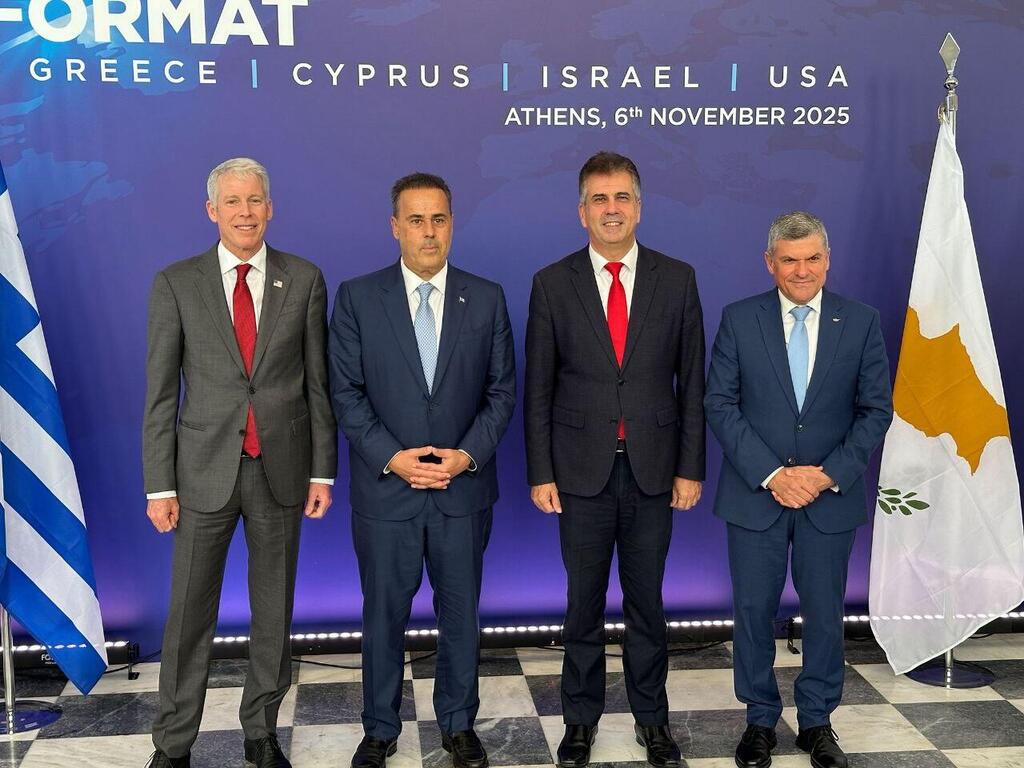
Energy Minister Eli Cohen in Athens alongside his colleagues from Greece, the US and Cyprus
(Photo: Ministry of Energy Spokesperson)
At the close of the summit, ministers issued an unusual joint condemnation of Russia, pledging to advance the goal of “diversifying regional energy sources” by “reducing dependence on hostile actors and deepening connectivity among regional like‑minded partners.” They said they “condemn Russia’s attempts to evade oil sanctions and fund its ongoing war in Ukraine.”
Cohen was photographed at the summit in Athens alongside the U.S., Greek and Cypriot energy ministers.
They also reaffirmed support for broader regional energy connectivity initiatives, including the India-Middle East-Europe Economic Corridor (IMEC), energy development and joint protection of energy infrastructure. They committed to cooperation on energy infrastructure between Europe and Israel.
The forum now plans to convene in Washington in the second quarter of 2026 to “further strengthen energy cooperation among their countries within the 3+1 Eastern Mediterranean energy dialogue.”
The political summit took place amid expectations of an expansion of the Abraham Accords. The ministers discussed creating an infrastructure and energy path that would avoid the Houthi‑controlled southern corridor and the Iranian‑Russian northern axis. They also talked about an Israeli gas export deal to Cyprus via a pipeline, enabling for the first time Israeli gas exports to Europe.
Cohen said, “We are expanding cooperation with our ally the United States and with regional states, strengthening Israel’s status as a regional energy power, turning it into a bridge from east to west, between Europe and Gulf states. I plan to continue using the energy sector as a tool to advance political interests, and I am confident this historic summit will contribute to greater stability and prosperity in the Middle East.”
Also attending the summit were U.S. Energy Secretary Chris Wright, U.S. Interior Secretary Doug Burgum, Greek Energy Minister Stavros Papastavrou and Cypriot Energy Minister George Papanastasiou.
The new trade route is expected to reduce Europe’s reliance on Russian energy sources and allow the United States and Gulf states to become the major energy providers to Europe. Officials said the move will also help lower energy costs. They added that the IMEC corridor, which is a central part of the expansion of the Abraham Accords, “will make Israel a key state between east and west and strengthen Israel’s diplomatic standing in the region.”