

Efforts to end the war in Gaza must be situated within a broader strategic context that transcends immediate battlefield dynamics or domestic political pressures. A report from Israel’s Channel 14 highlights that Prime Minister Benjamin Netanyahu, U.S. President Donald Trump, Indian Prime Minister Narendra Modi, Saudi Crown Prince Mohammed bin Salman and UAE President Mohammed bin Zayed, are advancing an ambitious economic initiative of global proportions: the India-Middle East-Europe Economic Corridor (IMEC).
This multibillion-dollar project represents a critical node in contemporary geoeconomic competition, designed to embed Israel within a transregional infrastructure and trade framework backed by the United States, India, the European Union and Gulf monarchies. Its strategic logic is not confined to commerce; it aspires to serve as a Western-aligned counterweight to China’s Belt and Road Initiative (BRI), particularly its northern land bridge through Central Asia and Russia.
Gallery
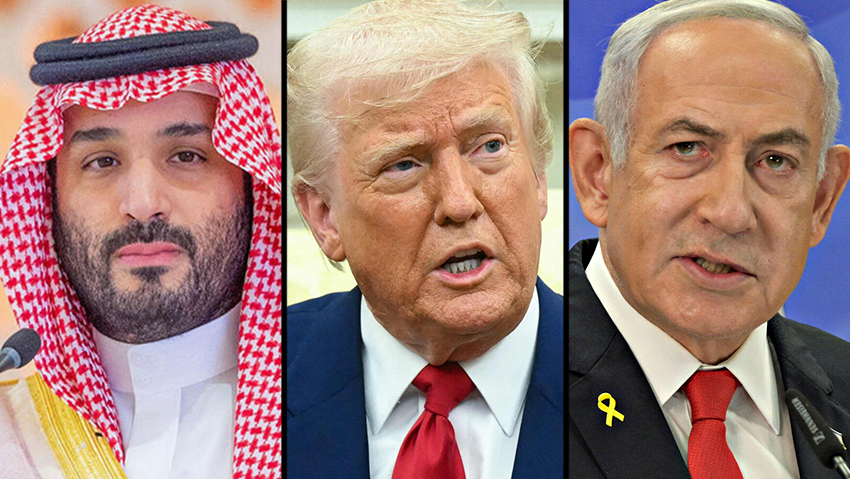
Saudi Crown Prince Mohammed bin Salman, US President Donald Trump, Prime Minister Benjamin Netanyahu
(Photo: SAUL LOEB / AFP, gettyimages, GPO)
Announced at the G20 Summit in New Delhi in September 2023, IMEC proposes an intermodal system of railways, ports, energy pipelines and digital infrastructure stretching from India through the Gulf and Israel to Europe. Israel occupies a central node in this envisioned corridor, with its Mediterranean ports and digital infrastructure poised to serve as the final bridge between Asia and Europe.
However, the outbreak of war in Gaza, combined with escalating regional instability, particularly Iran’s regional proxies, has severely undercut the corridor’s viability. Riyadh and Abu Dhabi, while supportive of IMEC in principle, have signaled that meaningful progress will depend on de-escalation in Gaza and movement toward a two-state solution. For these regimes, normalization with Israel and deeper integration into a Western-aligned economic architecture must be balanced against domestic sensitivities and regional legitimacy.
For Israel, IMEC represents more than an economic opportunity; it is a pathway to redefine its strategic regional status and geopolitical alignments. Prime Minister Netanyahu has framed the corridor as a transformative platform for Israeli integration into Arab economies and global supply chains.
Crucially, this vision is embedded in a broader logic of normalization, particularly with Saudi Arabia, and a recalibration of Middle Eastern alignments that marginalize Iran and solidify Israel’s role as an essential gateway between East and West. From this vantage point, ending the Gaza war is not simply a concession to Western pressure; it is a necessary condition for activating as a pathway to securing Israel’s place in a new regional economic order that marginalizes Iranian influence and boosts Israeli leverage as a trade and energy hub.
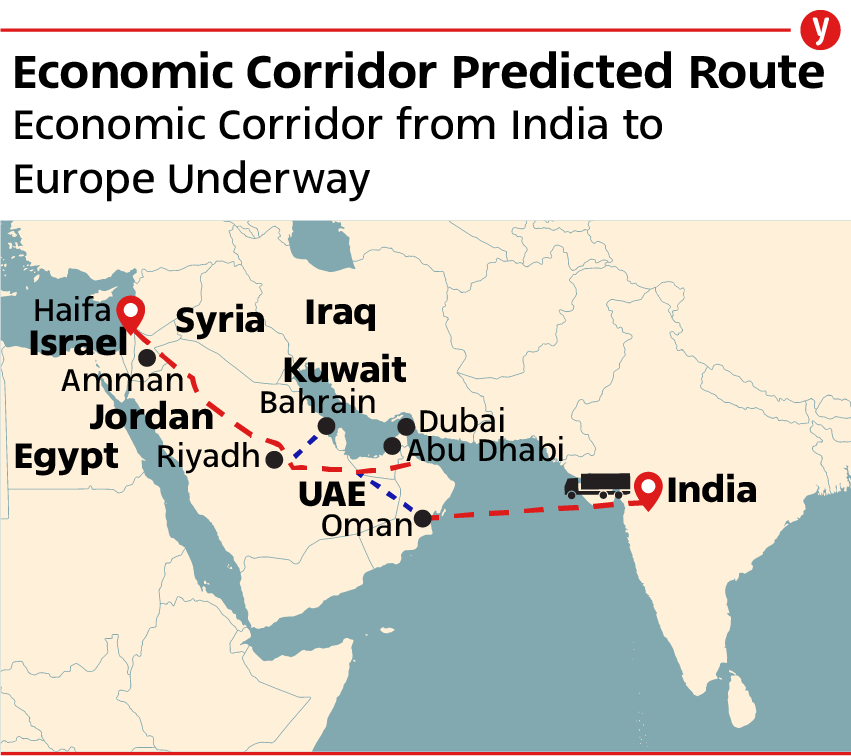
The India-Middle East-Europe Economic Corridor
Nevertheless, the war in Gaza has generated adverse spillovers on the implementation of the IMEC project. It has arrested normalization talks, stalled IMEC’s rollout and exposed the corridor to security risks that threaten investor confidence. Western actors, especially Washington and European states, have recalibrated their diplomatic posture, pressing Israel to agree to a ceasefire and initiate a political framework that could stabilize the region and reanimate dormant projects like IMEC. Absent such a resolution, the corridor risks indefinite suspension despite its strategic and commercial appeal.
While no evidence directly links Hamas’ October 7 assault on Israel to IMEC, interpretations have proliferated suggesting that the attack was aimed at derailing the normalization momentum undergirding the corridor. Then-U.S. president Joe Biden’s assertion that the attack sought to disrupt regional integration, implicitly referencing IMEC, has been echoed by Indian and Western analysts, who argue that destabilizing Israel undermines its candidacy as a reliable infrastructure hub. Whether Hamas intended to block the IMEC project or not, the outcome has been the same: diplomatic paralysis, investor unease and a deferral of plans to operationalize the corridor.
Get the Ynetnews app on your smartphone: Google Play: https://bit.ly/4eJ37pE | Apple App Store: https://bit.ly/3ZL7iNv
From Beijing’s perspective, suspending the IMEC project is strategically beneficial. While not a party to the Gaza war or the corridor, China views IMEC as a rival platform challenging the BRI’s centrality in shaping infrastructure diplomacy in the Global South and beyond. A stabilized Middle East anchored in a Western-aligned infrastructure bloc would constrain China’s diplomatic bandwidth and soften its narrative of providing the Global South’s only viable development alternative. If realized, the IMEC project would signal the emergence of a Washington-led counter-order based on rules-based connectivity, transparent financing, and private-sector engagement, contrasting with China’s often opaque, state-driven BRI model.
In this context, the Gaza war is more than a humanitarian crisis and tragedy that never ends; it is also a pivot in the larger global strategic rivalry over Eurasian connectivity. A ceasefire followed by Israeli-Arab normalization could enable the corridor to materialize, reconfiguring the geopolitical economy of the region. This, in turn, would recalibrate the Middle East’s alignment toward the West, diminish Iran’s regional leverage and curtail China’s influence in regional and global infrastructure governance.
 Dr. Mordechai Chaziza Photo: Yair Harush
However, IMEC should not be misconstrued as a catalyst for ending the Gaza war. The Israeli-Palestinian conflict is rooted in entrenched political, ideological, religious and territorial disputes, particularly the unresolved status of Gaza, Hamas’ governance, Israeli security doctrine and the stalled Palestinian national project. None of these core issues is addressed directly by IMEC, which is a geoeconomic infrastructure initiative focused on trade and connectivity. IMEC is, at best, a post-conflict incentive, an economic dividend that could help consolidate a fragile peace if paired with a viable diplomatic framework.
The corridor’s viability thus hinges on its integration into a broader architecture of political normalization and conflict resolution. For it to function as more than a symbolic gesture, IMEC must be embedded within a diplomatic package that addresses Palestinian grievances, redefines regional security arrangements and aligns multilateral actors toward a shared vision of integration and stability.
IMEC should not be misconstrued as a catalyst for ending the Gaza war; instead, it functions as a strategic inducement, a prospective dividend contingent on the emergence of a viable post-conflict order. Its utility lies not in resolving the core political and territorial disputes that sustain the conflict, but in anchoring a regional architecture that rewards de-escalation and normalization. If a diplomatic framework materializes that facilitates Israeli-Palestinian stabilization and paves the way for Israeli-Saudi normalization, IMEC could operate as a transformative mechanism, reconfiguring patterns of connectivity, trade and influence across the Middle East.
In such a scenario, the corridor would mark a structural inflection point: consolidating a Western-aligned geoeconomic bloc while undercutting the strategic centrality of China’s Belt and Road Initiative. The realization of IMEC, therefore, hinges not on coercive leverage but on the convergence of political will, regional stabilization and the institutionalization of a new order in which infrastructure and alignment reinforce one another.
- Dr. Mordechai Chaziza is a senior lecturer at the Department of Politics and Governance and the Multidisciplinary Studies in Social Science division at Ashkelon Academic College (Israel) and a Research Fellow at the Asian Studies Department, University of Haifa, specializing in Chinese foreign and strategic relations.