

President Donald Trump has renewed threats against Iran’s leadership, saying the United States would respond with overwhelming force if Tehran attempted to assassinate him.
In an interview aired Tuesday on the NewsNation program “Katie Pavlich Tonight,” Trump said that if Iran tried to kill him, the United States would “wipe them off the face of this earth.” The interview was conducted to mark the anniversary of Trump’s second inauguration.
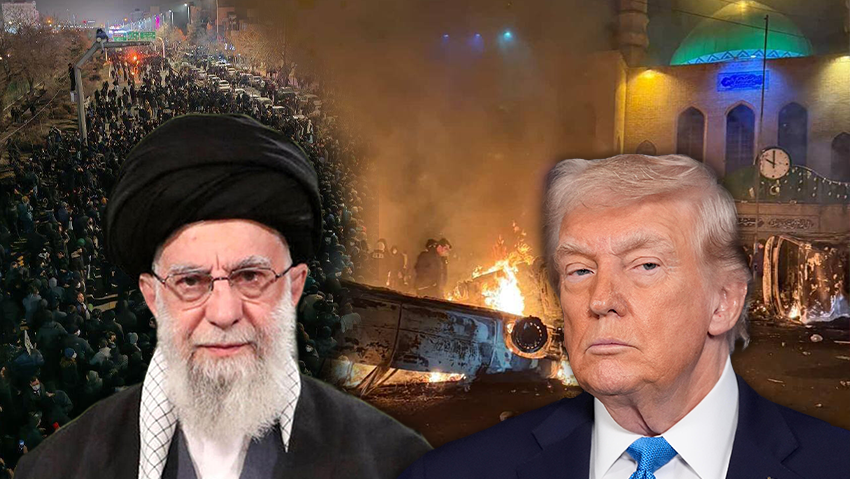
(Photo: AP Photo/Alex Brandon, AFP/HO/KHAMENEI.IR)
Trump said the harsh response would apply not only to an assassination attempt but also if Iran acted to violently suppress protesters. “Anything ever happens, the whole country is going to get blown up." Trump said. “I have very firm instructions," he added.
Trump also sharply criticized his predecessor, former President Joe Biden, accusing him of failing to respond forcefully to Iranian threats. “A president has to protect a president,” Trump said.
Earlier this week, Iranian President Masoud Pezeshkian warned that any attack on Iran’s supreme leader, Ayatollah Ali Khamenei, would be considered a declaration of total war against the Iranian nation. He said the Islamic Republic’s response to any military aggression would be severe and regrettable. Pezeshkian’s remarks followed comments by Dan Shapiro, a former U.S. ambassador to Israel, who said he believed Trump might attempt to kill Khamenei as soon as this week.
In a post on X, formerly known as Twitter, Pezeshkian blamed Iran’s economic hardships on what he described as decades of U.S. hostility and “inhumane sanctions.”
“If there are difficulties and hardships in the lives of the dear people of Iran, one of the main reasons is the long-standing hostility and inhumane sanctions of the U.S. government and its allies,” Pezeshkian wrote. “Any harm to the supreme leadership of our country is tantamount to a declaration of total war against the Iranian nation.”
Trump has recently signaled that he has decided, for now, to delay any military strike against Iran, backing away from a pledge he made during the height of unrest in the country about a week and a half ago, when he said that “help is on the way” and urged Iranians to continue fighting the regime.
Despite that pause, Trump has continued exchanging threats and insults with Iran’s leadership. The United States has been moving an aircraft carrier and other forces toward the Middle East, assets typically associated with preparations for a major military operation against Iran, leading many analysts to assess that the likelihood of a U.S. strike remains high.
Trump's speech last night
(Photo: The White House)


Over the weekend, Khamenei sharply criticized Trump in a series of posts on X, accusing the United States of being responsible for the wave of protests that erupted across Iran amid the country’s worsening economic conditions. “Responsibility must be placed on the United States,” Khamenei wrote. “We find the U.S. president guilty of all the losses, damages and slanders.”
Trump responded in an interview with Politico, calling Khamenei “a sick person” and saying “it is time to look for new leadership in Iran.”
The protests in Iran began December 28 as a spontaneous demonstration by merchants in Tehran’s Grand Bazaar over soaring inflation and the sharp depreciation of the national currency. The economic crisis has made it increasingly difficult for Iranians — already burdened by more than 20 years of Western sanctions tied to Iran’s nuclear program — to afford food and basic goods.
The demonstrations gradually gained momentum and, as in previous protest waves, quickly evolved into broader opposition to the clerical establishment and its widespread repression of civil and human rights under Islamic law. Protesters chanted slogans including “Death to the dictator,” directed at Khamenei, and “This is the final battle — Pahlavi will return,” a reference to exiled crown prince Reza Pahlavi, the son of Iran’s last shah, who was overthrown in the 1979 Islamic Revolution.
The protests escalated significantly on January 8, when hundreds of thousands of people answered Pahlavi’s call to take to the streets at exactly 8 p.m. that evening. The government shut down internet access nationwide that night, and it has not been fully restored, though some easing has been reported in recent days.
Since the beginning of last week, demonstrations have subsided, in what appears to be a temporary success by the authorities in crushing the unrest. Reports indicate that the crackdown was particularly brutal and may have involved militia fighters from other Middle Eastern countries, including Iraq.
While the final death toll is unknown, it is already clear that more protesters were killed during this wave of unrest than in any previous protests against Iran’s clerical rulers, drawing comparisons only to the early years after the 1979 revolution, when the new regime executed thousands of opponents as it consolidated power.
First published: 05:15, 01.21.26