


One week remains until the critical meeting between Prime Minister Benjamin Netanyahu and U.S. President Donald Trump at Mar-a-Lago in Florida, and this time Israeli officials believe Netanyahu faces an especially difficult task. Intense discussions are underway at the top of Israel’s political echelon ahead of the meeting, focused on persuading Trump on the core issues: disarming Hamas and Hezbollah, confronting Iran as it ramps up ballistic missile production, and preserving Israel’s qualitative military edge in the region.
Despite the massive gas deal Netanyahu signed with Egypt, the chances that Egyptian President Abdel Fattah el-Sissi will join the meeting are diminishing, mainly due to public opinion in Cairo. Egypt’s head of public information said over the weekend that “the gas deal has nothing to do with our decision regarding Gaza. Egypt’s position opposing the displacement of Gaza’s residents is non-negotiable. Netanyahu is trying to sell the Israeli public a false image of victory. There are no official talks about a near-term meeting between Sissi and Netanyahu, and there is no direct diplomatic contact between Egypt and Israel.”
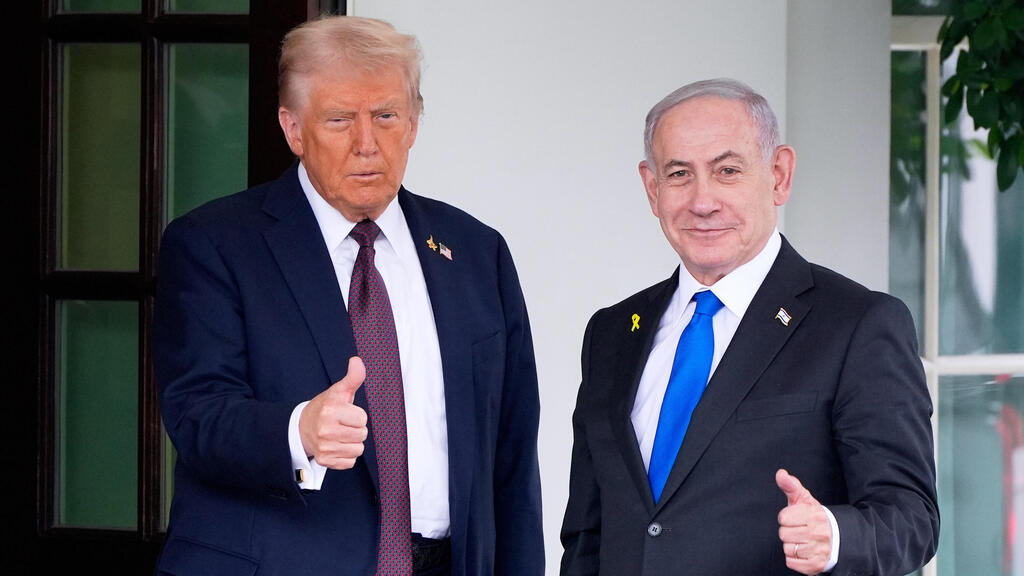
Prime MInister Benjamin Netanyahu with US President Donald Trump at the White House in September
(Photo: Evan Vucci/AP)
The main dispute on the Gaza front concerns how much time Hamas will be given to disarm. As reported by ynet, there are concerns Hamas could stage a “show,” orchestrating a fake disarmament, after which mediators would pressure Israel to move to phase two, which would require Israel to withdraw from the Yellow Line.
For now, Israel is giving the process a chance and is not breaking off talks, but it is conditioning any move forward on genuine disarmament, not “games and theatrics.” Still, officials in Jerusalem believe that, in the end, Israel itself will have to disarm Hamas, not an “international stabilization force,” which has yet to be established.
On Iran, following an NBC report that Netanyahu will present Trump with options for renewed strikes against Iran, Israeli officials recognize that the U.S. president is not eager for military confrontation, and Washington does not like the issue being framed as urgent and immediate. Israel argues that Iran has not learned lessons from the war and has drawn no real conclusions, but it also assumes Trump may be unwilling to join another strike. If Netanyahu succeeds in securing a green light for an Israeli strike, it would be considered a major achievement in Jerusalem.
Sunday's attack in Lebanon


Another hot arena is Lebanon, where there is relatively cautious optimism due to progress by the Lebanese government in disarming Hezbollah of heavy weapons, at least in southern Lebanon. On Saturday, Lebanese Prime Minister Nawaf Salam received the head of Lebanon’s negotiating delegation to the ceasefire monitoring mechanism and said the first phase of the “weapons consolidation plan,” covering areas south of the Litani River, is nearing completion. Lebanon, he said, “is ready to move to the second phase, which includes areas north of the Litani.” Meanwhile, IDF strikes continue, and on Sunday, unusually, two strikes were carried out in quick succession, just 300 meters apart.
To achieve his goals — not moving to phase two before Hamas returns Ran Gvilli and disarms, and obtaining approval for action against Iran — Netanyahu will present Trump with updated intelligence on Iran, Hezbollah and Hamas. In an effort to persuade Trump, Netanyahu also is bringing along Tali Gvilli, the mother of the last fallen hostage. Based on past experience, whenever a security issue was critical to Israel, Trump ultimately sided with it. While he has listened to advisers — mainly Jared Kushner and Steve Witkoff — whose views Israel does not favor, Israeli officials believe they will be able to convince him at the decisive moment.
At Hostages Square on Sunday night, where the eighth Hanukkah candle was lit, Ran’s mother said: “Hamas is deceiving us. Hamas is deceiving the State of Israel, Hamas is also deceiving the United States, and we need you to explain to everyone, to the entire world, one clear thing: we will not give up until Rani comes home. We must not move on. We must not allow anyone to build a life and continue onward at Rani’s expense. We are one people, and we owe this to ourselves. We owe this to Rani, who did everything to protect us all. Rani is my son, but he is also your son.”
Sen. Lindsey Graham in Tel Aviv
(Video: Ido Erez)
Another focus is preserving Israel’s qualitative edge and curbing Turkish influence. At a press conference in Tel Aviv, Republican Sen. Lindsey Graham said: “Giving Turkey F-35s is a mistake, but they are part of NATO.” He stressed, in line with Israel’s position, that there must be no move to phase two without Hamas being disarmed, that Iran must be struck, and that Hezbollah must give up its heavy weapons.
“I came here to try to assess the situation on the ground regarding Hamas’ disarmament,” Graham said. “I met with the prime minister, the foreign minister, the defense minister. I spoke with U.S. military officers. I also met senior IDF officials and Israeli intelligence figures. Based on what I saw and heard, Hamas is rearming and consolidating its power — not the opposite. Phase two will not succeed unless Hamas is disarmed. It is important to put them on a clock and force them to disarm, and if not, I will urge allowing Israel to act against Hamas.”
On Iran, the veteran senator said: “We eliminated the nuclear program, but we did not eliminate Iran’s desire to obtain nuclear weapons. They still want to destroy all the Jews. There is evidence they are building more ballistic missiles that can strike Israel and Europe. There is evidence Iran is returning to enrichment activities. They must be hit before they do so. The only language understood in Islam is force.” Asked about a strike on Iran, he replied: “I’ll leave that to Bibi when he meets Trump, but I suggest hitting them as hard as possible so they cannot develop nuclear weapons. Nothing has changed regarding their ambitions.”
Regarding Lebanon, Graham said: “The situation there is optimistic. The Lebanese government has called on Hezbollah to disarm. If Hezbollah disarms, it’s a good sign for Lebanon and the region. If they refuse to give up heavy weapons, we need to work with Israel against Hezbollah. Once you remove Hamas and Hezbollah, Iran’s two proxies, it increases the chances for normalization with Saudi Arabia. Either Hezbollah gives up heavy weapons, or we need a military campaign. Without that, the region will not move forward.”