

Nearly three weeks after U.S. President Donald Trump unveiled a plan for stabilizing Gaza, Washington is struggling to assemble an international force to secure the enclave, as a wave of Arab countries has rejected American appeals to contribute troops or funding.
The U.S. administration, working through envoys Steve Witkoff and Jared Kushner, has quietly shifted its focus to non-Arab nations after repeated refusals from key regional allies, who fear the risks of direct confrontation with Hamas. Among the countries now approached is Singapore, which was reportedly surprised by the request to send officers to Gaza. The Southeast Asian state has yet to respond and is still evaluating the proposal.
Gallery

IDF Chief of Staff Lt. Gen. Eyal Zamir and US envoys Jared Kushner and Steve Witkoff
(Photo: IDF)
On Monday, Prime Minister Benjamin Netanyahu visited the American-led command post near Kiryat Gat, a facility that coordinates with military and diplomatic representatives from more than a dozen nations, including Germany, France, Denmark, Jordan, Canada, Britain, Spain, the UAE, Italy, Australia, Greece and Cyprus.
The push to build a stabilization force has been complicated by persistent ceasefire violations, including a deadly incident in Rafah in which Master Sgt. (res.) Efi Feldbaum, 37, was killed by anti-tank fire and sniper attacks. On Monday evening, the IDF launched another round of airstrikes in Gaza, citing an "immediate threat" just hours after declaring a renewed ceasefire.
According to the IDF, the strikes targeted dozens of Hamas positions. The renewed truce, ordered by the political echelon, follows pressure from Washington, which warned that recent Hamas violations — including the killing of Feldbaum and delays in the return of 13 Israeli hostages’ bodies — must not trigger a full-scale resumption of the war.
Israeli strikes on Hamas targets in Gaza
(Video: IDF)


President Trump said Israel had a right to respond to Hamas’ actions, calling the attacks “a clear provocation,” but emphasized that the ceasefire should remain in place. Hamas, for its part, denied involvement in the Rafah attack.
Qatari Prime Minister Mohammed Al Thani, speaking at a conference in New York, said Monday that Hamas had violated the ceasefire by opening fire on the Israeli bulldozer that Feldbaum was operating. “What happened in Gaza yesterday was disappointing,” he said. “We acted to contain it. Washington remains committed to the agreement, and both sides must uphold it.”
Al Thani also accused Israel of ceasefire violations and called for a full withdrawal from Gaza once the stabilization force is in place. He claimed Hamas had expressed willingness to relinquish power and said Doha supports a two-state solution. “Israel will not annex or occupy any Palestinian territory,” he said.
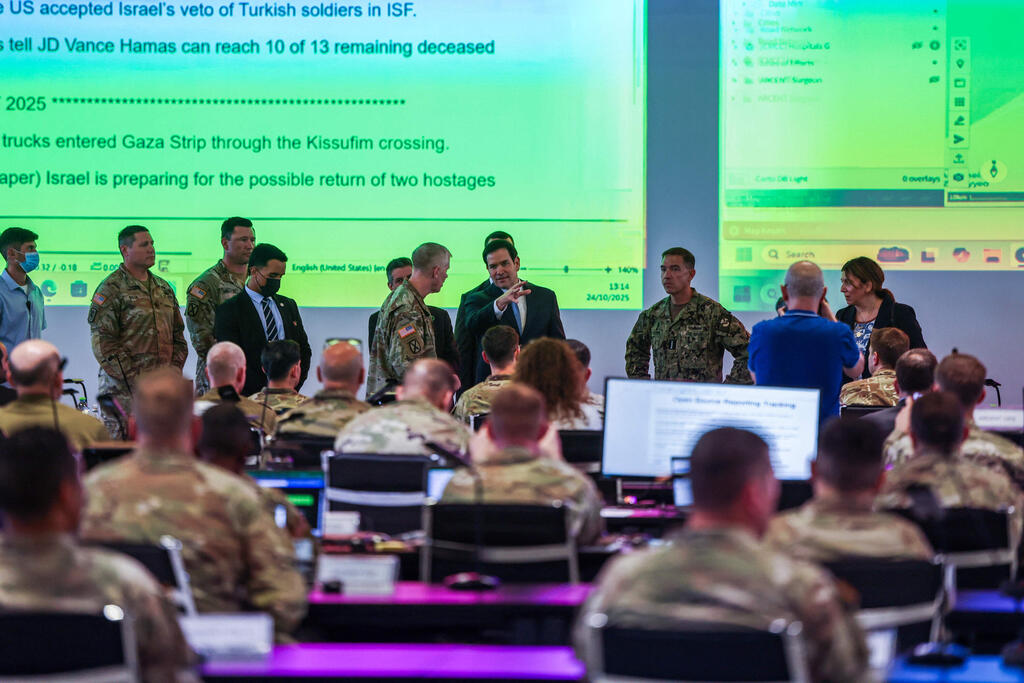
US Secretary of State Marco Rubio visits the international command post near Kiryat Gat
(Photo: Fadel SENNA / POOL / AFP)
He further condemned an Israeli strike on Qatari diplomatic buildings, calling it “a shock to the world” and a violation of Qatar’s role as a mediator. “We felt betrayed,” he said. “That attack proved to the United States that every red line in the region has been crossed.”
Al Thani also criticized National Security Minister Itamar Ben-Gvir for his treatment of Palestinian detainees, calling recently circulated footage “inhumane and barbaric.”
Meanwhile, Hamas has denied responsibility for the Rafah shooting and accused Israel of using the incident as pretext for renewed military action. Qatar confirmed it has pressured Hamas to expedite the return of Israeli remains and that there should be no delay.