

The first part of these interviews was published Thursday. Maj. T. (26), a UAV operator in the Air Force’s Unit 52 at Palmachim Air Base, described how he returned to Israel from Thailand on October 6 and was on duty that night, becoming the only drone operator flying over Gaza in the hours before October 7. “I saw movements at Hamas emergency positions, but the prevailing assessment was that it was just another drill,” he said, explaining how no one translated what was happening on the ground into intelligence about a planned attack — and how he operated once it began.
The second part of the report features harrowing testimony from Maj. A. and Col. A., among the first and few pilots to take off minutes after the assault began. They describe the orders they received after the first rocket launches, how limited their understanding initially was of events on the ground, when the scale of the disaster became clear — and how they functioned in the air while their families were trapped below in safe rooms, hearing gunfire. Like Maj. T., both stress: We failed, but we did not abandon our posts.
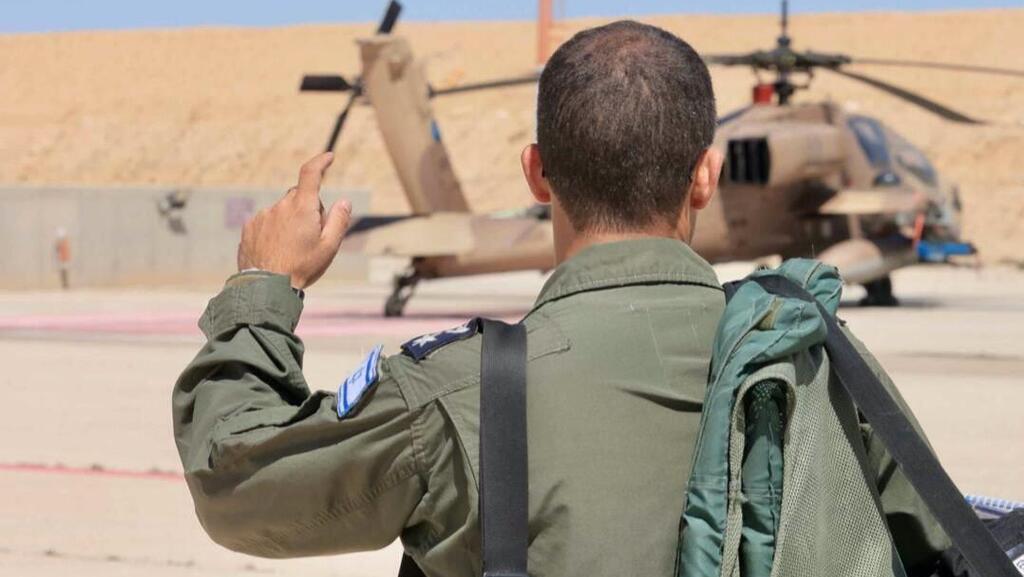
‘I shut off my emotions’
Maj. A., a fighter navigator with Squadron 119 at Ramon Air Base, flying a two-seat F-16, recalled that during the Simchat Torah weekend, he was on routine air defense standby and did not expect anything unusual. At 6:30 a.m., Color Red sirens sounded at the base, and operations staff instructed crews to report to the protected operations room. They quickly put on flight gear as phones rang with initial reports that something was happening in Gaza.
“At 6:40, we decided to get into the aircraft, connect to communications and wait for orders,” he said. During that time, he received a message from his parents, who live in a kibbutz near Gaza, asking what was happening. He replied that he was on a mission. Amid uncertainty, they took off at 6:45, and by 7 a.m. were ordered to scramble toward Gaza. At 7:20, four fighter jets were positioned over the sea — two from Ramon and two from Hatzor — patrolling off the Gaza coast.
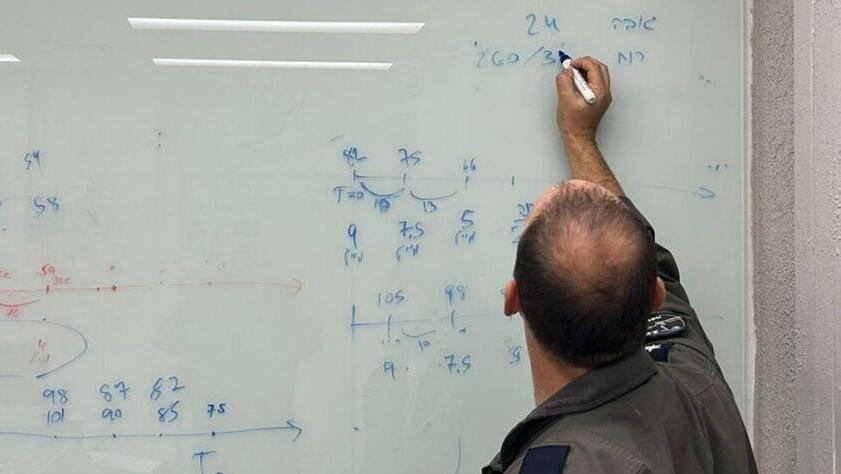
Maj. A.
(Photo: IDF Spokesperson)
“We saw many smoke trails from rocket launches, but we didn’t understand what was happening on the ground,” he said. “The intelligence picture was incomplete, aside from the assumption that another confrontation with Hamas had begun.”
At that stage, they believed the situation was under control. “We didn’t realize there was chaos below,” he said. “We were told we would soon receive targets based on a preexisting plan.” At 7:50, they received their first targets in northern Gaza and bombed them within minutes — border-adjacent tunnels opposite Netiv HaAsara. Another aircraft joined them. After completing the strikes, they returned to land around 8 a.m. to rearm.
Only then did the picture change. “As soon as we landed, we turned our phones back on and saw images of a Hamas pickup truck inside Sderot,” he said. More aircrews rushed in from home, boarding aircraft and taking off immediately. By 9 a.m., the squadron was airborne again, tasked with sealing the breached border. By 11:30 a.m., the entire squadron was in the air.
Maj. A.
(Photo: IDF Spokesperson)
Asked how he felt in the first moments over Gaza, he said the cockpit environment created a false sense of calm. Flying at 20,000 to 30,000 feet, with no cellphone reception and only radio contact with controllers, they had no way to see the border breach. Unlike helicopters or drones, fighter jets lack real-time ground-force tracking displays.
“Only after landing from the first sortie did I realize how different what I experienced in the air was from what was happening on the ground,” he said. He called his wife and children, then his parents and grandparents in the kibbutz, who told him they were locked in their safe room, hearing gunfire outside. “I shut off my emotions, suppressed the worry and went out on the next sortie,” he said.
During that flight, he began to see smoke rising from homes in kibbutzim. From above, he suddenly spotted his own kibbutz, where his parents live, also burning. “It was a very quiet moment in the cockpit,” he said.
Looking back, he said that had they known more during the first sortie, they might have flown lower, louder passes that could have deterred attackers and allowed them to report more clearly what was happening. Responding to criticism of the Air Force, he said, “The Air Force did not abandon its mission on October 7. We failed, and I do not absolve us of responsibility. We were there, but we were not good enough. That will stay with me for life.”
‘Eliminate anyone between the border fence and the communities’
Col. A., a former commander of Apache helicopter Squadron 190 at Ramon, said the first sirens at 6:30 a.m. caught him at home on base with his family. After repeated alerts, he headed to the squadron and decided to activate all available helicopters, beyond those on routine standby.
Ramon is a distant base, and many personnel needed time to arrive, so he called a reservist pilot who lived nearby and ordered him to report immediately. Technical crews were already arming helicopters as rocket impacts were heard near the base. The first helicopters took off, and Col. A. himself launched at 8:10 a.m.
Minutes later, while airborne, they were directed to Kibbutz Be’eri amid reports of an infiltration. They were told they were authorized to open fire in Israeli territory and were given radio contact with a ground unit from Gaza Division’s northern brigade. They were also asked to cover a Shayetet 13 team landing in the area.
Within 20 minutes, they were firing cannon rounds near Be’eri after identifying, though not with certainty, several terrorists. Dense vegetation made it difficult to distinguish between attackers, Israeli forces and armed civilian responders. Missiles were also fired, driving some terrorists out of the kibbutz. Additional attackers were spotted crossing through a breach in the fence and were struck.
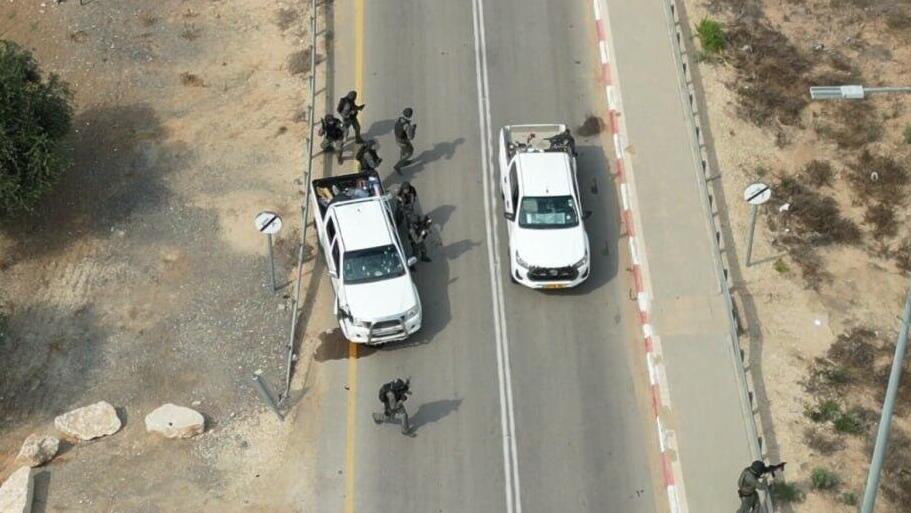
Security forces on October 7
(Photo: IDF Spokesperson)
At 8:45 a.m., they were redirected to the border fence near the Black Arrow memorial, where more terrorists were seen crossing and were attacked. They were then informed of a massacre at Erez base. Over the base, they saw armed individuals but could not determine whether they were terrorists or soldiers. Requests for authorization to fire were met with uncertainty.
Later, over Nahal Oz, they received a clear order: eliminate anyone between the border fence and the communities, as no Israeli forces were believed to be in that zone. “Anyone identified there was to be fired upon immediately, especially those moving back toward Gaza,” Col. A. said.
All squadron helicopters were now airborne. Col. A. exhausted all six missiles and 500 rounds of ammunition within an hour, handing off the mission to another helicopter before returning to rearm. After ensuring the squadron was fully mobilized, he took off again at 10:40 a.m., later operating over Nir Oz, where he saw terrorists moving along roads and climbing onto a burned-out tank whose crew he later learned had been abducted.
Throughout the day, helicopters supported ground forces across multiple communities, eliminating dozens of terrorists. By midafternoon, they returned to base to rearm once more.
“At around 8 a.m., we understood for the first time that there was a ground invasion,” he said. “Over Be’eri, it became clear to me that this was larger than the most extreme scenario we had prepared for.” He noted that one helicopter replacing him was badly damaged by terrorist fire and forced out of action.
Despite flying lower to improve visibility, he said it was often impossible to determine whether armed figures below were Israeli soldiers or attackers. “You see an armed person moving tactically, and you have to decide for yourself,” he said. “There was no one on the ground telling us who was who.”
First published: 19:14, 01.02.26