

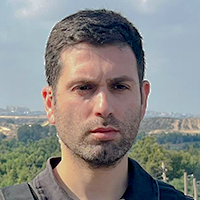
Maj. T., 26, is an operator of a Zik UAV in Unit 52 of the Israeli Air Force at the Palmachim base. On October 6 he returned to Israel from Thailand, and that night went straight into a shift that made him the only UAV operator flying over the Gaza Strip on the night before October 7.
An investigation by “7 Days” revealed that when Mohammed Deif learned there was only a single UAV in the air, conducting what appeared to be a routine patrol, and that no significant Israeli preparations were visible, he suspected the IDF was setting a trap and even considered calling off the attack altogether. The IDF chief of staff, Lt. Gen. Herzi Halevi, did instruct that night to launch an additional UAV for higher-quality visual intelligence, but the order was ultimately not carried out. Although Maj. T. observed unusual activity from the air, his reports were interpreted as no more than a Hamas exercise.
Gallery
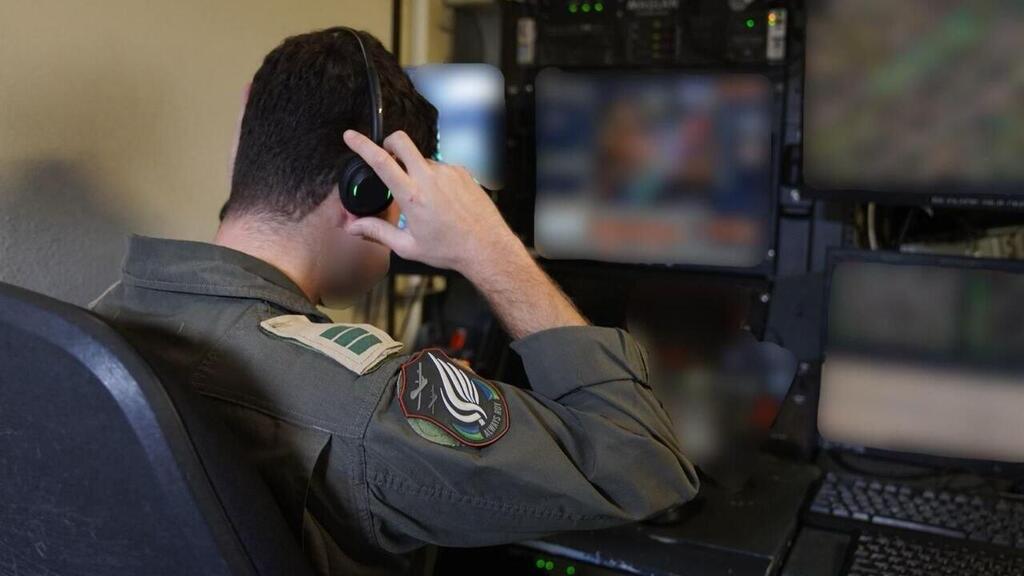
Major T: 'I saw movement at Hamas emergency positions, but we didn’t know how to connect it to a broader picture of imminent major attack'
(Photo: IDF Spokesperson's Unit)
In a special interview, Maj. T., alongside an F-16 pilot and an attack helicopter pilot who were among the first to take off into the smoke-filled skies of the western Negev as the war erupted, describes how they tried, together with their comrades, to do everything possible to repel the attack and assist ground forces amid the chaos. The three pushed back against conspiracy theories alleging an “inside betrayal” in the Air Force, claims that were also debunked when Brig. Gen. Omer Tischler was appointed the next Air Force commander at the start of the war. Still, the immense failure of those horrific hours remains seared into Maj. T.’s memory, especially the night that preceded them.
The night before
How did you experience the night before the war and the dramatic change in the morning?
“In fact, the strike I carried out that morning after the invasion began was the first of my life, since I had completed my certification only a few months earlier. After a mission commanders’ course, I flew to a vacation in Thailand and returned to Israel on October 6 straight into a routine, quiet shift in the squadron’s control trailer at Palmachim. I started the shift as a routine security mission and ended it in a war.”
He said: “It was a standard shift, from 2 a.m. to 6 a.m., in the Lebanon sector. At 4 a.m. it became clear that something was happening in Gaza, and I was redirected south. Around 5 a.m. we saw things moving and unfolding, but only in the specific area the UAV was scanning in Gaza City. In the end, it’s a narrow field of view. You see tens of meters by tens of meters for a specific intelligence task you’ve been given. You can’t build a full picture that way. I saw movement at Hamas emergency positions, but we didn’t know how to connect it to a broader picture of an imminent major attack, the largest in the history of a terrorist organization.”
Maj. T. said he informed his superiors about the movements. “I reported this up the chain, even when I saw a lot of movement. But systemically, no one understood that something major was happening in the Strip. We jumped with the UAV over several Hamas emergency assets, not routine ones like headquarters. I saw intense activity there, people carrying equipment on the ground and vehicles moving. But the prevailing assessment was that this was just another exercise, and that they were still deep inside the Strip, not approaching the border.

Major T. was the only UAV operator flying in the skies over the Gaza Strip on the night before October 7
(Photo: IDF Spokesperson's Unit)
“This was in the heart of Gaza City,” he emphasized. “I had a camera that obviously didn’t cover the entire area. We were working with the Shin Bet, and I was effectively the only IDF UAV over Gaza that night. Toward 6 a.m., another UAV was brought over to Gaza, but I was the more effective one.”
In hindsight, should I have sounded louder alarms that night?
“The Operations Directorate moved us in the middle of the night from Lebanon to Gaza, and at 4 a.m., when I saw the movements, I said it was relatively unusual. But to all the experienced bodies who saw and were updated, including the Shin Bet, it didn’t look exceptional. The talk was that it was a Hamas drill. By around 6 a.m., there was no more movement below, and then we were also caught by surprise in the trailer, because at 6:29 a.m. there was a massive rocket barrage aimed at us as well. Rockets fell near our trailer and it literally shook. It was a situational surprise.”
The massacre
“Our team was an intelligence-gathering team, not a full strike team, so a strike team immediately arrived to replace us in the trailer,” T. said. “We quickly went to the squadron operations room and saw people there in shock around 6:45 a.m. They told us to run to another trailer to take control of another aircraft that had been diverted from the Hebron area. The strike team that replaced us had already carried out a first strike near Netiv HaAsara, spoke with the commander of Battalion 77 shortly before 7 a.m., and we heard over the radio how many infiltrations there were.”
documentation of the multi-dimensional unit's fighting on October 7th in Kibbutz Re'im
(Video: IDF Spokesperson's Unit)


He continued: “We had no briefing for this, but we quickly understood what was happening, although at first we thought it was only one or two infiltrations. We tried to build a situation picture together with the division. Meanwhile, the skies filled with black smoke in several places, and in such conditions UAVs have to operate in formations, not alone. We reached the Erez base with our UAV and suddenly I saw armed figures walking nonchalantly from above. The division shouted over the radio to strike them, and at 7:22 a.m. I carried out the first strike of my life.”
What were the feelings during those first hours?
“We built our own situation picture and constantly tried to understand who among the armed figures were our forces and who were the enemy, because they were walking slowly down there near military jeeps. We were literally arguing among ourselves about who was a terrorist and who was a soldier. That’s why we also decided to fire nearby, just a few meters from those armed men. Those strikes disrupted, for example, the infiltration into Kibbutz Erez. Our missile is small, and at those hours we were still in the regular operational mode that forbids bringing phones into the trailer, so we didn’t know the scope of events. Around 9 a.m., we were instructed to strike pickup trucks on the roads carrying armed men returning to Gaza. More teams arrived and we briefed them on the fly. We had tears in our eyes because we still didn’t know for sure whether we had struck or killed our own soldiers or terrorists. Only a day later, after various checks, did we understand that we had killed only terrorists that day.”
And personally, how did you feel by midday?
“One of the unit commanders grabbed me at midday on October 7, after I had been awake on a continuous shift since the night before, and shook me. He told me, ‘Go wash your face, you’ve been through a hard event, rest for a few hours and come back to the trailer.’ That’s what I did from that evening onward, four-on, four-off, for about two years, in all theaters. Later, when things calmed down, the unit commander watched all four hours of my shift from that night and told me that even in hindsight, he wouldn’t have been able to extract abnormal details that justified raising a red flag and waking everyone, beyond all the reports I had filed.”
‘We were surprised and we failed’
How do you feel when you hear claims of betrayal from within, including in the Air Force?
“It sends shivers through me. I say, I was there. We were surprised and we failed, and there’s no way to spin that differently. But from the opening whistle of the war, everyone flew to the unit, and within an hour everyone was operating in the trailers and aircraft were in the air. Since then, we haven’t stopped fighting.”
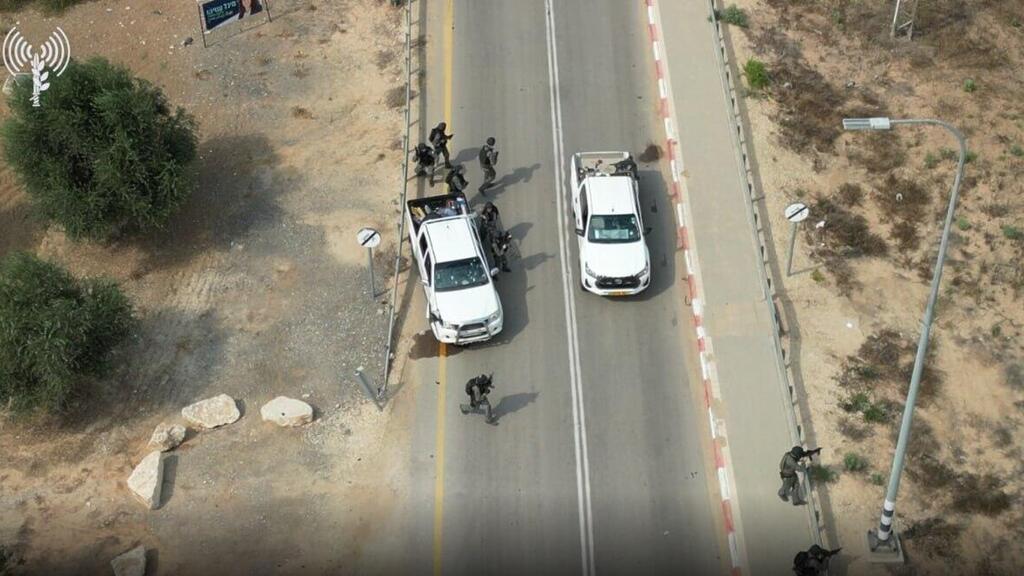
IDF security forces on October 7
(Photo: IDF Spokesperson's Unit)
He added: “We were surprised because the enemy was smart and knew how to conceal its plan well. In the end, real-time intelligence has to connect to an analytical concept. It’s important to remember that the first munition dropped on the Strip, at 7:14 near Netiv HaAsara, was from one of our UAVs. As the morning went on, we operated like mad, and because of the sheer number of terrorists, we conserved munitions.
“For example, if we saw two terrorists who were not near civilians or soldiers, we didn’t strike them. We waited to identify a group of terrorists and struck those. The team that replaced us even brought a phone into the trailer, against regulations, to connect to what was happening on the ground and work from the trailer via WhatsApp groups in the Gaza border communities.”