

The low rumble of engines turned into a roar as the Hercules emerged from the darkness. It landed without lights on the flat desert ground, kicking up a cloud of dust. Two soldiers, equipped with a radio and night-vision gear, tracked it until it came to a complete stop. There was no applause. Maybe just a brief moment of relief.
It was 9 p.m. The final landing of the evening. The first aircraft, painted in camouflage colors, had landed at 5:20 p.m. It came to a stop on the makeshift parking apron under a merciless sun and lowered its rear ramp. Two pickup trucks with yellow license plates rolled out of the cargo hold.
“Where are you from?” I asked the passengers, who were dressed in civilian clothes.
“Wherever we need to be from,” replied a broad, square-jawed man. A brief check revealed that they were Shayetet 13 naval commandos.
Gallery
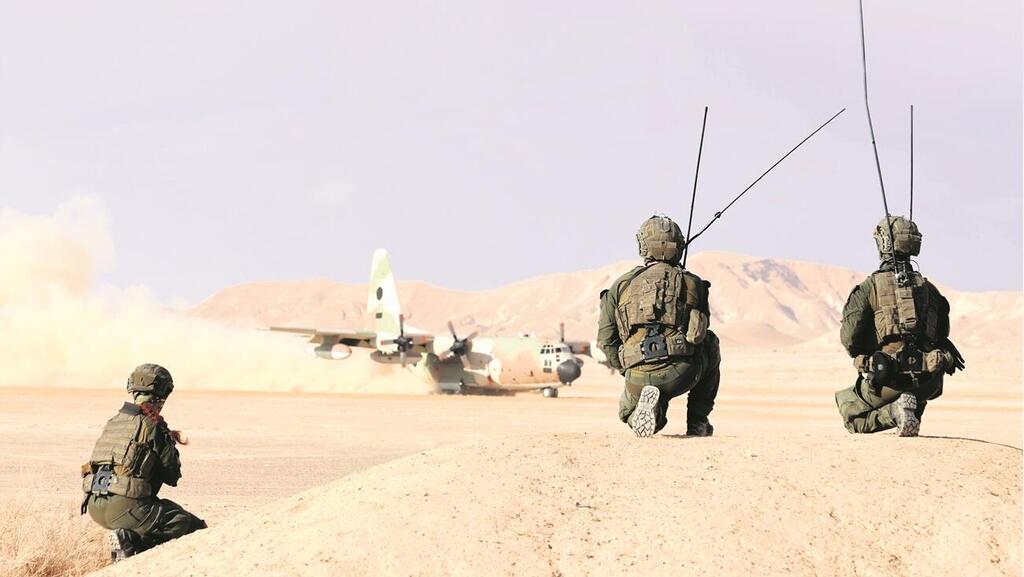
Forward Landing Unit fighters help land Hercules during training in the south
(Photo: Gadi Kabelo)
This happened several weeks ago during an exercise by one of the Israeli Air Force’s most secretive units: the Forward Landing Unit. Its members prefer another name — Unit 5700. Like its larger and better-known sister units, Shaldag and 669, the Forward Landing Unit is part of the Air Force’s Special Forces Wing, Wing 7.
Broadly speaking, the Forward Landing Unit creates landing fields for the Air Force, in many cases far beyond Israel’s borders and inside hostile territory. That is how “the long arm of the State of Israel” becomes truly long.
“Our job is to locate, inspect, mark and control temporary landing strips and airfields so that the Air Force’s transport aircraft can operate wherever they are needed,” Maj. G., the unit commander, explains in a rare interview. “We are the body that enables the connection between ground and air — almost anywhere and for any mission.”
Why 'almost'?
“The unit has no range limitations. We can reach anywhere. The only limitation is the nature of the terrain. And the terrain is a central part of what we do.
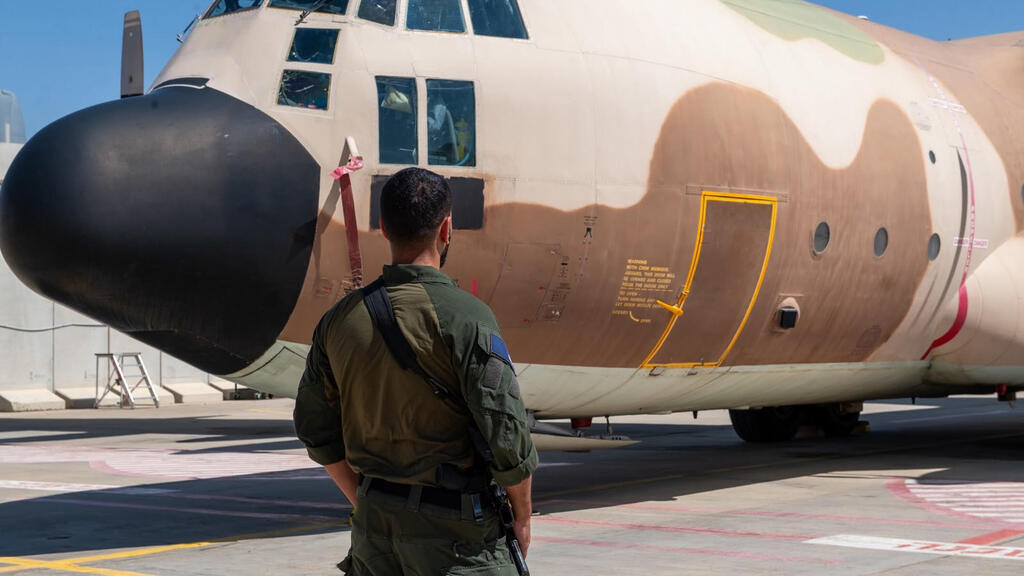
Major G., commander of the Forward Landing Unit(
(Photo: IDF Spokesperson's Unit)
The exercise we visited took place in the southern Negev, alongside the road from Mitzpe Ramon to Eilat. But standing there, in the middle of the flat valley, watching transport planes land and take off from the strip marked out for them by Forward Landing Unit soldiers, it was easy to imagine that we were on Iranian, Iraqi or Syrian soil.
Last May, in the midst of Operation Roaring Lion, The Wall Street Journal reported that Israel had established a secret military base in the heart of the Iraqi desert to support its air campaign against Iran. According to the report, the facility housed special forces and served as a logistics hub for the Air Force. Search-and-rescue teams also were stationed there in case Israeli aircraft were shot down and their pilots were forced to eject over enemy territory.
The New York Times added that there were two such bases and that planning for both had begun as early as 2024. According to the Times report, local residents said an Iraqi shepherd discovered one of the bases and that a helicopter chased his vehicle and killed him from the air.
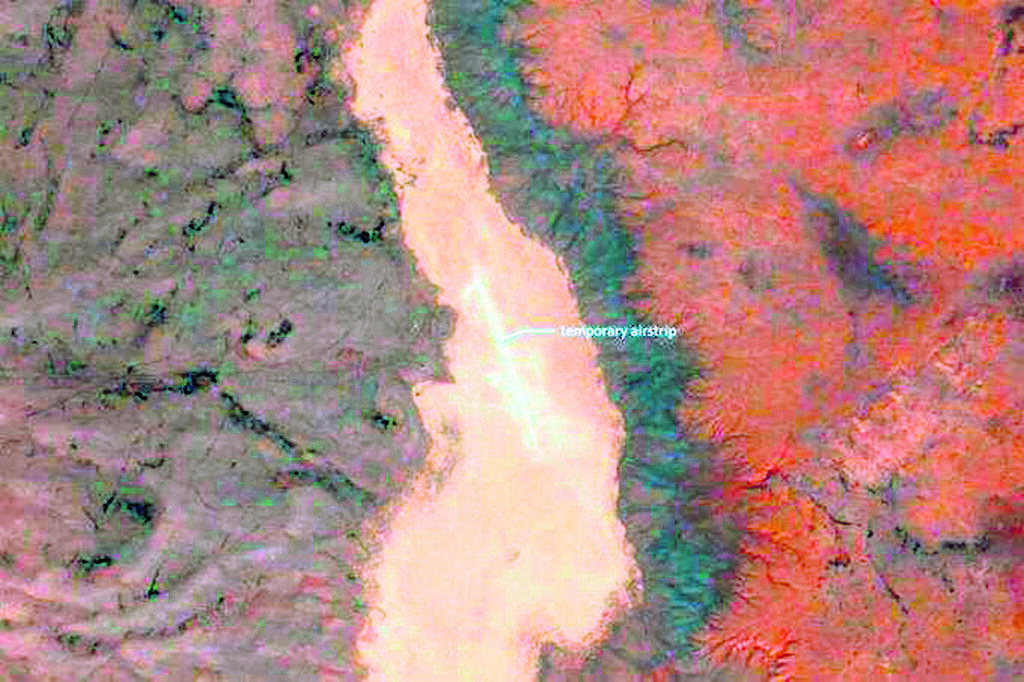
Aerial photograph of the area where, according to foreign publications, the Israeli airfield was established in the Iraqi desert
(Photo: X social media platform)
If bases like these were indeed established in the heart of Iraq, it is reasonable to assume that the Forward Landing Unit also took part in setting them up and operating them. Because of information-security restrictions, the soldiers are forbidden from saying exactly where they operated during the war. But from what they are permitted to say, one can infer that they were in places no Israeli had previously set foot.
Take Lt. A., for example, a landing officer currently responsible for training in the unit.
“At the time I was a team commander, and I took part in the operation with several reserve soldiers,” he says. “Our mission, together with other Wing 7 units, was to locate, prepare and mark a landing strip at a remote location outside Israel’s borders, and to land several aircraft on desert terrain where no plane had ever landed before.”
Preparations for the operation, Lt. A. says, lasted about two weeks and included precise planning and drills simulating field conditions.
“It was a very complex operation, with a very narrow time window for landing, under complete secrecy and on a night with zero percent illumination,” Lt. A. recalls. “The squad commander, whose deputy I was, stood three meters away from me and I could not see him until I put night-vision equipment over my eyes. I remember the moment we told the first aircraft over the encrypted radio: ‘Cleared to land.’ After that, we landed several more aircraft, which brought forces and equipment with them. Despite the challenging conditions, everything went smoothly. We accomplished the mission.”
Describe what it felt like in real time.
“Because we had done so many drills beforehand and practiced different scenarios and responses, I worked like a robot. You feel as if it’s just another exercise, except this time it’s real.”
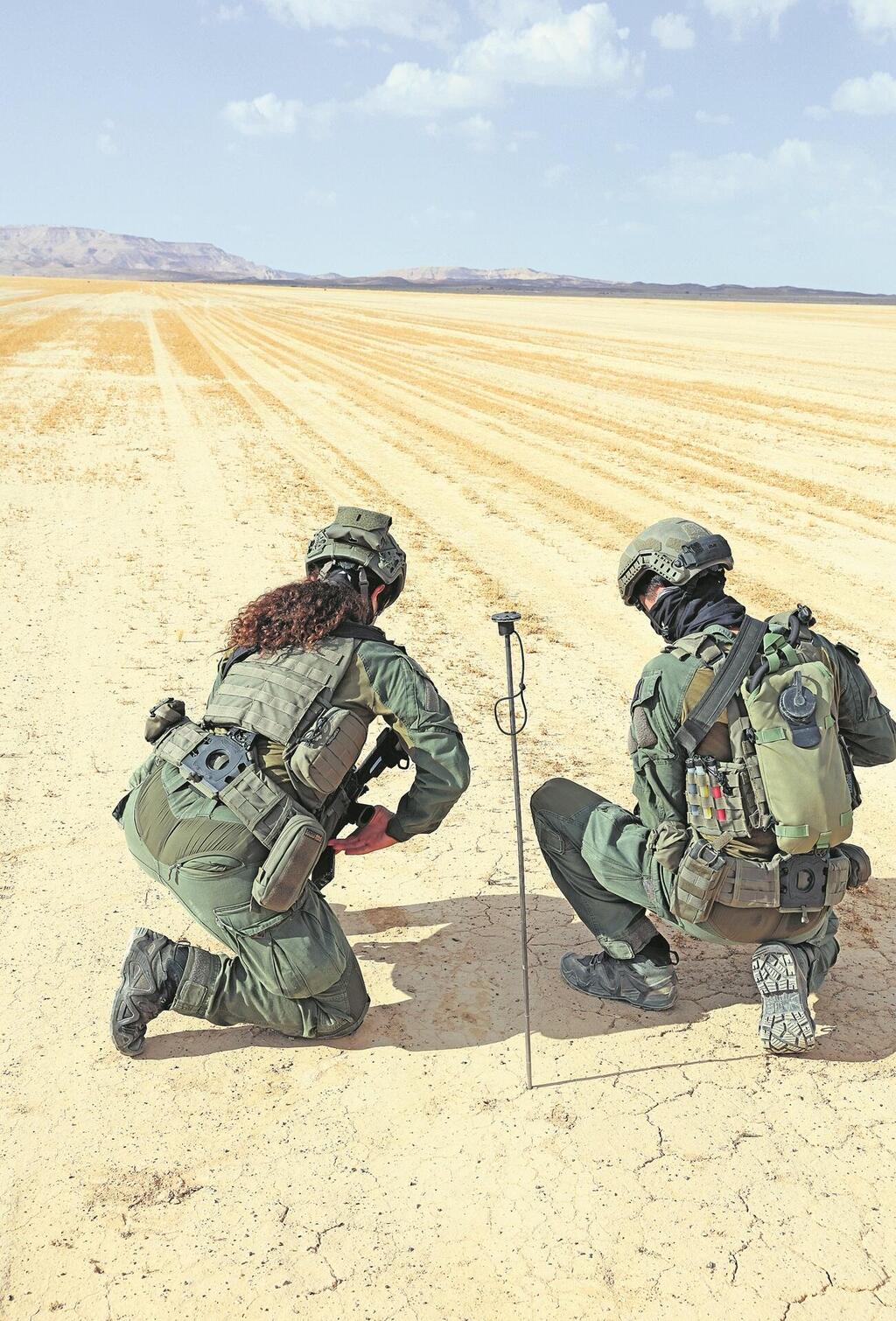
Front Landing Unit training
(Photo: Gadi Kabelo)
At the end of the operation, Lt. A. brought back several stones from the site as souvenirs. That has already become a custom in the Forward Landing Unit, as it has in other special units that operate far beyond Israel’s borders.
At the entrance to the unit’s headquarters at Nevatim Air Base, there is a display of stones brought back from different places, with the names and dates of operations written on them in permanent marker. One especially large stone had stood in the middle of a runway somewhere and was removed by the soldiers, one of whose jobs is to clear any obstacle that could endanger an aircraft.
“We hauled it back here in a wheelbarrow,” Lt. A. says.
“The stones speak,” says the unit commander, Maj. G. “They speak if you know how to listen.”
What do they say?
“They tell stories of experiences. They tell stories of creativity, of variety. They tell the story of a close-knit unit that combines regular soldiers with reservists who served hundreds of days during the war. It is a small unit, but it enables the Air Force to do a great many things.”
*****
This is a rare glimpse into a unit the public has barely heard of. Even the interviewees themselves admit they did not know it existed before they enlisted. Nevertheless, it has been around for many years.
The Forward Landing Unit was established in December 1973, shortly after the Yom Kippur War. In the 1980s, during Operation Moses to bring Ethiopian Jews to Israel, the unit prepared a landing strip for Hercules aircraft in the Sudanese desert. During the First Lebanon War, it operated Beirut International Airport for the Air Force.
Nor does it operate only beyond Israel’s borders. After October 7, the unit enabled Air Force transport aircraft to land reinforcement troops near the Gaza border communities. During the war with Iran, it established temporary landing strips away from Air Force bases that were under missile attack.
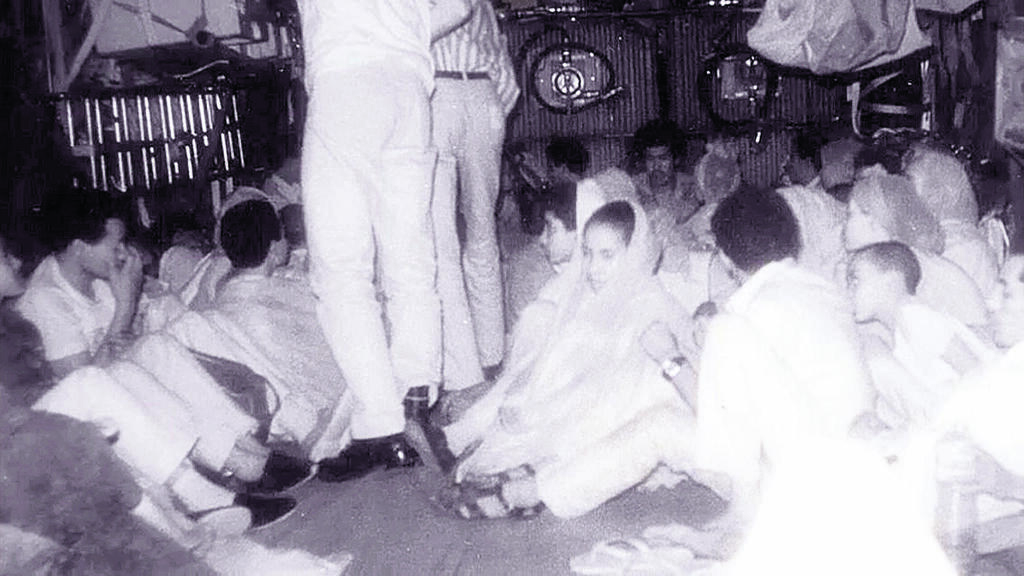
Operation Moshe to bring back Ethiopian Jews, in which the Forward Landing Unit trained a landing force
(Photo: IDF Spokesperson's Unit)
Recruitment to the unit opens once a year. In November 2023, it opened its doors to women for the first time. Women now make up about a quarter of the unit’s combat force.
“There is absolutely no difference here between men and women,” says Lt. L., a team commander in the unit. “From the first day of training, we are treated exactly the same and no allowances are made for us. I was an air traffic controller and now I’m a team commander, and I do exactly the same work as the male combat soldiers.”
“I’m a combat soldier just like every guy here is a combat soldier,” adds Sgt. N., an air traffic controller. “It’s not an issue at all.”
Maj. G.: “Integrating female combat soldiers into YAHK has, in my view, been a resounding success. I have both male and female officers in the unit’s command group, and it’s an incredible experience.”
The road to earning the unit’s combat pin is long and grueling. Male and female soldiers undergo Level 05 infantry basic training at BISLACH 314 in Hatzerim together with Shaldag and 669. Afterward, they begin professional training within the unit itself.
“In the basic stage of training, which lasts several months, they learn the principles on a theoretical level: what a landing strip looks like, what criteria are required to land an aircraft there, the relevant aviation regulations and so on,” Lt. A. explains. “In the next, advanced stage, they learn in practice how to locate, prepare and mark a landing strip in the field — and how to land aircraft on it.”
Naturally, special emphasis is placed on navigation.
At the end of the training course, which lasts about eight months, they acquire the basic profession shared by everyone in the unit: landing operator. And it should be stressed that the Forward Landing Unit is responsible not only for landings but also for takeoffs.
But the training does not end there. Immediately afterward, they join the combat platoon and begin specialization in one of four professions in the unit: soil examiner, air traffic controller, operational driver or medic. The specialization takes several months and can last as long as six months.
“There are also two secondary roles, performed in addition to the main job: observer and drone operator,” says Lt. L. The drones are used mainly to secure the landing strip, another task assigned to the unit.
“One of the things we do during professional certification is join an ‘observation flight,’” says Sgt. N. “That means experiencing a landing from the cockpit, so you can feel what it looks like from the other side. I was on one such flight when two friends of mine were taking their certification test as air traffic controllers, and we heard them talking to the pilot over the radio. When you see from above the markings the unit placed on the ground, it looks different than it does from ground level. Suddenly it looks like a runway. It helps you help the other side.”
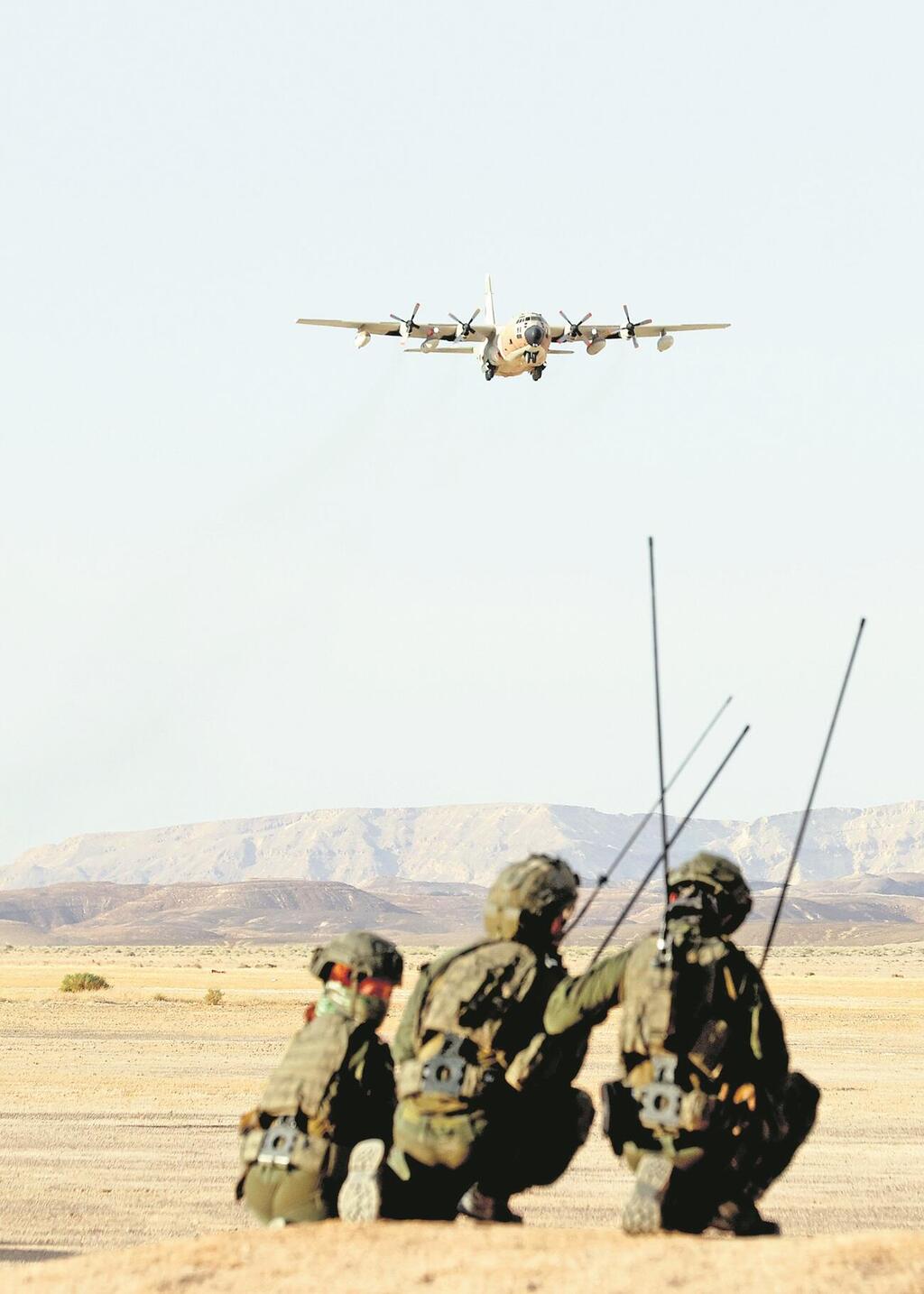
Hercules takes off during unit training
(Photo: Gadi Kabelo)
Despite the less-than-glamorous title, soil examiner is a key role in the unit and carries heavy responsibility. The soil examiner is the one who decides whether the ground can or cannot support the landing of the Air Force’s main transport aircraft, the Hercules, which is large and heavy. In this respect, there is little difference between the veteran Karnaf and the newer Shimshon variants.
If the soil examiner makes a mistake, in the best case the aircraft could become bogged down in the ground or suffer a punctured tire — both complicated situations in hostile territory. In the worst case, the aircraft could crash.
The soil examiner relies mainly on professional knowledge acquired during training and simple tools such as a metal probe.
“It’s a long rod with a cap on the end that you stab into the ground to test how hard it is,” says Staff Sgt. A., a soil examiner in the unit. “It also has markings every 10 centimeters, which allow you to measure obstacles on the runway such as vegetation.”
And what do you do if there are obstacles like that? Do you have special engineering equipment?
Sgt. A.: “We have shovels and hoes. And if it’s a small bush, you can also pull it out with your hands.”
A slightly more advanced tool is a GPS device worn by the soil examiner on the wrist like a watch.
“You use it to mark coordinates so you know the length and width of the runway and can pass that on to the pilot, so he knows exactly where to land,” Staff Sgt. A. explains.
Alongside the regular soldiers, the unit has senior reserve soil examiners. Some are geologists in civilian life, but most are people who work the land.
“We have farmers here whose connection to the soil is difficult to quantify,” says the unit commander. “People of the land who know what rain does to soil, how vegetation holds the ground together and other things that are essential to determining whether a particular area can support an aircraft landing.”
Incidentally, one way to test soil is to taste it — literally — to estimate its salinity and mineral composition. That, too, is something the soil examiners know how to do.
Weather has a critical impact. Wind, of course, as well as fog or haze that reduce visibility, but also rain, which can turn relatively hard ground suitable for landing into dangerous mud within minutes.
Staff Sgt. A. recounts one such incident.
“I was taking part in a unit operation as the No. 2 soil examiner,” he recalls. “Above me was a senior examiner, a reservist with a lot of experience. We knew it was going to be cold, but there was no rain in the forecast. Shortly after we prepared the runway, rain began to fall and the ground became wet and unstable. The aircraft arrived in pairs, and every time one plane landed, it had to clear the runway for the next one.
“Despite the rain, it was possible to land on the runway. But to clear it, the aircraft had to make a 180-degree turn on the dirt apron, and we knew that during the turn it could dig itself in and sink. There were people aboard the aircraft, from our unit and other units, including our unit commander, and it was very stressful. But in the end, we improvised a creative solution in the field that allowed the aircraft to clear the runway without sinking.”
What do you do if a plane does sink or get bogged down?
“A soil examiner with a shovel and an experienced loadmaster who knows how to guide the pilot,” Lt. A. explains.
And if there’s a flat tire?
“The aircrew knows how to change a wheel.”
“When you arrive at a landing strip, there are quite a few unexpected ground conditions we may encounter,” says Maj. G. “To decide whether it is serviceable or not requires a set of considerations that are mostly professional. Ultimately, our mission is not to tell the pilot why he cannot land — but to do everything necessary so that he can land safely.
“Sometimes there are simple solutions. If there is a tarp stuck in the middle of the strip, we’ll pull it out with our hands. But many times the landing-strip commander and his team have to think outside the box, and in that respect creativity runs wild.
“Our unit enables the Air Force’s transport fleet to operate wherever it is needed. With advance preparation, it knows how to reach almost anywhere and set up a landing strip. The landing-strip commander carries an extremely heavy responsibility and, together with his team, can cause an aircraft to land safely or, God forbid, to crash. We operate in that space between a successful landing and a crash or serious damage to the aircraft. That is our business.
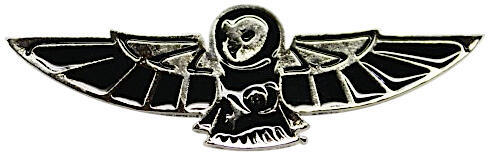
The unit pin
(Photo: IDF Spokesperson's Unit)
“If it were simple, there would be no need for a professional unit. But because there are ground problems, obstacles, difficult weather conditions, rain and mud, and because you have to work in extreme cold or heat, you need a very high-quality and professional team.
“As you have already understood, there are different professions in the unit — soil examiner, air traffic controller, medic, operational driver. But there is one title that is common to all of them, and that is landing operator. When you scan the strip and look for obstacles, everyone’s eyes have to be working all the time so you don’t miss even the smallest thing. That is why teamwork is so important and strong discipline is essential.”
*****
If the soil examiner is responsible for the ground and gives the final approval that the landing strip is fit for use, the air traffic controller is responsible for the air traffic itself and is the one who gives the pilot the green light to land or take off.
Here, too, regular soldiers serve alongside experienced reservists, some of whom work in control towers at civilian airports.
Every landing strip the unit establishes has a control tower. Except in their case, it is a “walking tower,” as Lt. A. puts it. He himself served as an air traffic controller in the unit before attending infantry officers’ course.
“The control tower is one person, or several people, with a vest, a radio, binoculars and night-vision equipment,” he explains.
“My teammates and I — we are the control tower,” says air traffic controller N. “In addition to the radio and observation equipment, we also have a Kestrel, a device that measures wind direction and speed. With time and experience, you learn to feel the wind without it. I’m not there yet.”
In the exercise we joined, the “control tower” consisted of two soldiers standing on a small hill about a meter and a half high. When darkness fell, they put on night-vision goggles that allowed them to see the aircraft approaching to land.
At the foot of the hill stood the commander of the unit’s combat platoon, equipped with a thermal night-vision device mounted on a tripod. The device, which detects objects according to the heat they emit, is used for a final sweep of the runway before landing or takeoff to make sure no animal or person has entered it.
During the preliminary briefing, the platoon commander, a former Nahal Reconnaissance Unit officer who did not grow up in the Forward Landing Unit, said: “Pay attention, we saw a lot of animal shit here. That means they are definitely going to enter the landing strip, if not during the day then at night. The answer to that is infrared night vision and thermal imaging. I’ll be the observer.”
A wild boar or hyena entering the runway during a landing could cause a major disaster.
Even if the air traffic controller is standing exposed in the field rather than sitting with a cup of coffee in an air-conditioned control tower, the essence of the job is similar.
“There are several levels of air traffic controllers in the unit,” Lt. A. explains. “As a junior controller, you are certified only to coordinate taxiing, meaning aircraft movement between the runway and the parking apron, or to coordinate departures and arrivals with the air control unit. Over time, you advance.”
A brief explanation: Israel’s airspace and the Air Force’s operational arena are controlled by the air control unit, which has two main bases — the southern air control unit near Mitzpe Ramon and the northern air control unit on Mount Meron.
Each Air Force base and civilian airport, foremost among them Ben Gurion Airport, has its own CTR, or Control Zone, an area of airspace controlled by the local control tower rather than the air control unit for takeoffs, landings and flights up to a specified altitude.
Once the Forward Landing Unit prepares a landing strip in the field, which for all intents and purposes becomes an airfield, the unit is responsible for the CTR designated for it. That responsibility falls on the air traffic controller, the professional authority, and the landing-strip commander, who is effectively the “base commander,” even if he is only a lieutenant or captain.
To illustrate the weight of that responsibility, Sgt. N. recounts an especially complex landing in which she took part as an air traffic controller.
“It was my first operational experience, the first time I had to run a tower without a senior controller above me,” she recalls. “Lt. L., who was the landing-strip commander, and I were supposed to land an aircraft full of people. We reached the site, set up everything we needed, and then an unexpected sandstorm began, causing severe visibility restrictions.
“We could barely see 100 meters ahead and understood that if it continued like that, the aircraft would not be able to land. Shortly before the first aircraft arrived, the sandstorm intensified and we reached zero visibility. It was approaching, the pilot was calling us on the radio, and we could not see anything. Not even the runway. And in order to allow a landing, I have to be able to see the entire length of the runway.
“We told the pilot to make a pass and another circuit in the air in the hope that conditions would improve enough to permit a landing. If not, he would have to enter a holding pattern that could last a long time.”
Eventually, after receiving approval from the unit commander, Lt. L. and Sgt. N. cleared the pilot to descend for landing.
“And then, five seconds before touchdown, the runway suddenly cleared and he managed to land safely.”
“We debated a lot about what to do,” Lt. L. says. “Because of the operational situation, the landing had to happen, so we allowed it despite the difficult conditions. It really was an insane situation.”
*****
Forward Landing Unit commander Maj. G. has been in the role for only two months and came from outside the unit, but having spent years on the other side of the operation, he knows its work well.
He is 34, a graduate of the Kadoorie Agricultural High School, married to A., a physiotherapist, and a father of three. His youngest was born several weeks ago.
“I enlisted in July 2010 for pilot training and dropped out after five months,” G. says. “From there I went to the loadmaster course, which is part of the Air Force transport system, and that has been my profession ever since.”
A loadmaster is effectively the commander of the Hercules cargo compartment and is responsible for everything that goes onto, comes off or is dropped from the aircraft — equipment, vehicles and people.
The Air Force operates two C-130 Hercules transport squadrons: Squadron 131, the “Yellow Bird Knights,” which flies the veteran Karnaf aircraft, and Squadron 103, the “Elephants,” which operates the upgraded Shimshon aircraft.
Both are based at Nevatim in the Negev, as is the Air Force’s loadmaster unit, where G. held several command positions. Apart from his first months in pilot training, he has spent his entire service at the same base and also lives there with his family.
As a loadmaster, G. went wherever Air Force transport planes went — across the Middle East and across the ocean as well, including joint exercises with the U.S. Air Force on American soil.
“I had the chance to train in all kinds of places around the world. I remember we landed in Romania and saw fields of grass on both sides of the landing strip. And I don’t mean grass as in the English word for a lawn. I mean cannabis.”
I assume a lot of people wanted to be on the landing team there.
“There were very clear instructions, and discipline was very strict,” G. says with a smile. “But in the United States we also had the opportunity to land on actual grass surfaces.”
Loadmasters are the first people to meet Forward Landing Unit soldiers on the ground.
“The ramp opens, you step out into total darkness, and suddenly some figure approaches you out of the darkness wearing tactical gear, combat equipment and night-vision gear. And there is always a high-five and a hug, and then you hand over responsibility to the force unloading from the aircraft or, the other way around, to the force that has just linked up with you.
“That is the memory engraved in me as a loadmaster, the encounter with Forward Landing Unit. And it is also based on personal familiarity, because we serve on the same base and are together during battle procedure and preliminary training.”
Now, alongside his loadmaster wings, he also wears Forward Landing Unit’s insignia, centered on a desert owl, a nocturnal bird of prey whose face resembles a human face.
No one can say for certain why that particular bird was chosen as the unit’s symbol, but one of the first things people learn in the unit is how to imitate its distinctive call.
At the end of the interview, Maj. G. takes me to the briefing room, where about 20 male and female soldiers are sitting. He asks them to demonstrate the sound of the desert owl, and as one they launch into cries of “Prrrr, prrrr.”
Everyone except the commander himself.
And what about you? Where’s the personal example?
“I’m still learning. Until I get to their level, I’m keeping it to myself.”
*****
On the wall of Maj. G.’s office hangs an organizational chart of the unit with the photos and names of all the regular soldiers, NCOs and officers. Their exact number cannot be disclosed. It can only be said that this is a very small unit.
Outside are the operational vehicles, some standard and others classified.
“Most movement is by vehicle. But we have the ability to fly by helicopter,” G. says.
And not only to reach distant places.
“I can now scramble a team by helicopter to the north to open one landing strip or another.”
When the landing strip is being established inside Israel, helicopters can serve a much more mundane purpose as well: bypassing traffic jams.
Lt. L. experienced that firsthand.
“Every team commander in the unit has to take a certification test to become a team commander,” she says. “It’s 24 hours without sleep, and you prepare for it for a very, very long time. I was supposed to take my certification test and then suddenly, in the middle of the night, we were scrambled to one of our landing strips to fly forces there as part of an operational mission.
“Within 15 minutes we were already outside the base, but there was a lot of roadwork along the way and even though it was nighttime, we got stuck in traffic. We reached the landing strip after a four-hour drive, just before the first aircraft was supposed to land. Within 10 minutes we had prepared the strip and marked it with lights. When we understood the purpose of the operation, we felt an enormous sense of meaning.”
Marking the landing strip for the pilot is a central part of the process. During the day it is marked using colored panels and small flags, and at night with dual-purpose lights that can emit either visible light or infrared illumination detectable only with special equipment.
When establishing a runway in enemy territory, that is particularly important.
Finding an area suitable for such a landing strip is a mission in itself, requiring intelligence capabilities and cooperation with other units, and Forward Landing Unit personnel cannot elaborate on it.
Over the years, a “bank of landing strips” has been built with precise coordinates, but it is entirely possible that they could be required to land an aircraft at a location not listed in that classified Excel spreadsheet.
“We know how to do that too,” says Maj. G.
The relationship between unit officers and the aircrews of the Hercules squadrons is almost daily.
“Even in the most basic landing exercise, there is a procedure between the captain and the landing-strip commander,” Lt. A. says. “Before he takes off, he calls me and we plan the landing together and give each other points to pay attention to. When it comes to an operational mission, we are together at every stage of planning and battle procedure, and of course afterward as well, during the debrief.”
Staff Sgt. A.: “Sometimes the pilots give us feedback in real time. There was a case when the first pilot told us, ‘Listen, it was really hard for me to take off. Check the runway.’ And then we discovered it actually wasn’t fit for takeoff.”
Are there cases where the pilot tells you, 'Guys, with all due respect, I can’t land here'?
Lt. A.: “Usually the pilots trust us 100%.”
Wing 7, of which Forward Landing Unit is a part, together with Shaldag, 669 and the relatively new Arad unit, which is composed entirely of female soldiers, was established in 2020. Until then, each of the Air Force’s special units operated independently.
“Wing 7 is proof that the whole is greater than the sum of its parts,” says Maj. G. “The wing commander receives a mission and employs his units in whatever way he sees fit. It is a force multiplier for the Air Force and for the IDF as a whole.”
Is there a scenario in which a Shaldag force, which is a commando unit, would arrive before you at the place where you are supposed to prepare a landing strip in order to seize control of it operationally?
Maj. G.: “I’m not going to address that, but you can imagine whatever you want.”
What is your working interface with 669?
“There is a readiness posture for rescuing an ejected pilot, and that is part of our strength as an Air Force. Ultimately, every fighter pilot who goes out to bomb Iran knows that someone will come and rescue him. That is one of Wing 7’s missions.”
Could your unit be asked to prepare a forward landing strip for forces on standby to rescue an ejected pilot?
“If we are asked to prepare such a place, we absolutely have the capability to do it.”
As for foreign reports that the Air Force established two such landing strips on Iraqi soil, he cannot say a word.
So all that remains is to imagine.