

Egyptian media outlets reacted with pride and triumph after an Israeli investigation suggested that Ashraf Marwan, long believed to be one of Israel’s most valuable spies, was in fact working for Egypt as part of a deception campaign ahead of the 1973 Yom Kippur War.
Marwan, an Egyptian businessman and senior official who was married to the daughter of President Gamal Abdel Nasser, was known in Israel by the codename “The Angel.” For decades, he was thought to have provided critical intelligence that warned of war. But a report published in Yedioth Ahronoth and its sister website Ynet last week argued that Marwan was “the spearhead of a sophisticated Egyptian deception operation” that left Israel’s intelligence community confused and blind in the lead-up to the October 1973 conflict.
One Egyptian commentator hailed the revelations as “further proof of the genius of Egyptian intelligence.”
The Cairo-based daily Al-Youm al-Sabea reported that “the Israeli newspaper Yedioth Ahronoth determined that Ashraf Marwan was not ‘The Angel’ who tricked the Arab states in the 1973 war, but the spearhead of Egypt’s strategic deception plan before its October victory.” The paper said Israeli media had “confirmed the existence of contradictory testimonies within Israel about the true story of the most significant espionage case of the 20th century.”
It added that Marwan’s life “has become a fertile subject in Israeli media over the past 50 years, with conflicting accounts about him, while Israel refuses to admit that he worked for Egyptian intelligence and assisted in the deception plan that preceded the October 1973 war.”
The Egyptian network Sada El-Balad called Marwan “Egypt’s most skilled player in the war of minds,” while the newspaper Al-Masry Al-Youm quoted Ahmed Anwar, a member of Egypt’s Council for Foreign Affairs, who said the Israeli exposé “did justice” to Marwan. Anwar argued that Israeli claims portraying Marwan as a double agent were part of “a smear campaign aimed at undermining the symbolism of the family of President Gamal Abdel Nasser and obscuring the true role Marwan played for Egypt.”
Mohamed Aboud, a professor in the Hebrew department at Cairo’s Ain Shams University, wrote on Facebook: “After 50 years of controversy, the truth emerges from the heart of Tel Aviv. A headline in Yedioth Ahronoth reveals that Ashraf Marwan was not ‘The Angel’ who tricked the Arabs, but the spearhead of Egypt’s strategic deception plan ahead of the October war.”
In the 7 Days weekend supplement of Yedioth Ahronoth, journalist and intelligence expert Ronen Bergman concluded that Marwan deceived Israel and was part of a carefully designed Egyptian plan that paved the way for the early success of the October 1973 offensive. “History does justice to its people,” Aboud wrote, “and the legend of ‘Israel’s best spy’ becomes yet another testament to the brilliance of Egyptian intelligence and the architects of the great October victory.”
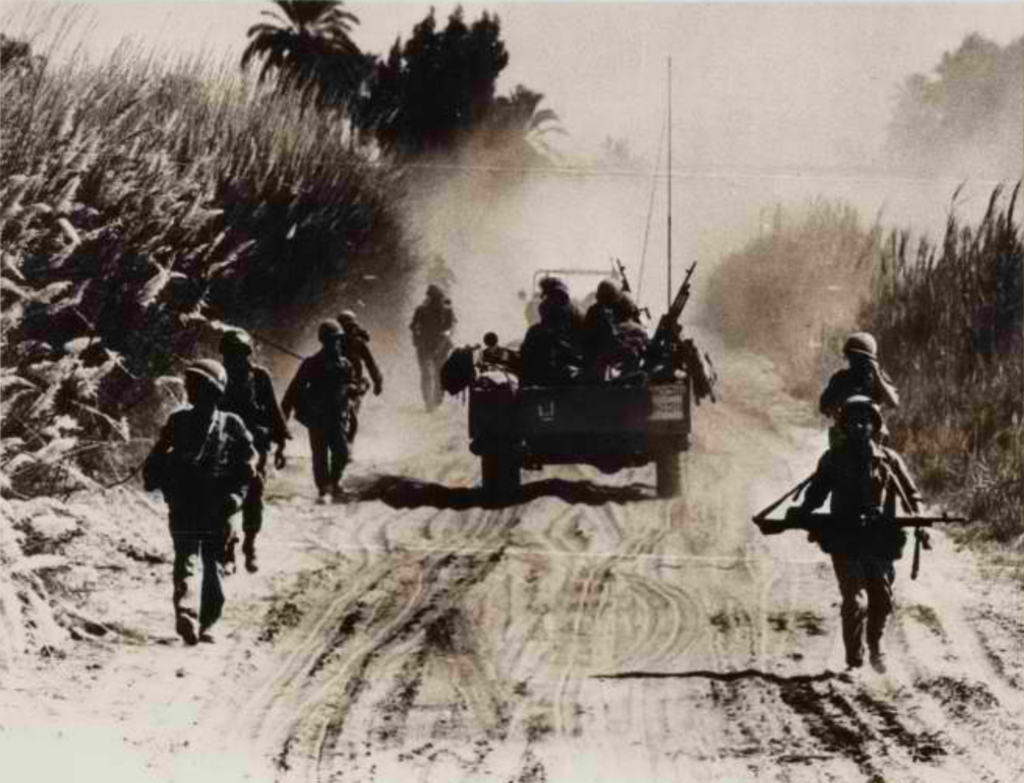
Israeli forces on the Egyptian front during the 1973 Yom Kippur war
(Photo: State Archives)
The Egyptian channel Extra News released a video under the headline: “Israeli confession: Ashraf Marwan is a dagger of Egypt in the heart of Tel Aviv.” The newspaper Al-Dostour also covered the story, and images from the 7 Days supplement spread across Arab social media.
In Egypt, the Yom Kippur War—known as the October War—is commemorated as a victory, despite Israel eventually reversing Egypt’s early gains. Every October, Egypt observes “Victory Day.” On Oct. 6, 2023, one day before Hamas’ attack on Israel, Egypt marked the 50th anniversary of the war.
Marking the 51st anniversary last year, President Abdel Fattah el-Sissi said: “On this day, Egypt achieved a victory that will remain eternal in the memory of the nation and in the pages of its glorious history. A victory that will always remind everyone that this nation, through the unity of its people, its leadership and its army, is capable of achieving the impossible, no matter how great.”
The Israeli Investigation
The Yedioth Ahronoth investigation, based on previously unpublished intelligence material, concluded that Marwan was working for Egypt all along.
The findings revealed that starting in late August 1973, Marwan took part in meetings where Egyptian President Anwar Sadat and Syrian President Hafez Assad decided how the war would be fought and set Oct. 6 as the date of attack. Instead of passing this crucial information to his Israeli handlers, Marwan supplied false reports suggesting different dates and assessments that war would not break out.

Maj. Gen. Shlomo Gazit
(Photo: IDF)
Even the warning he gave on the eve of the war was vague and arrived too late, according to the report.
The investigation quoted Maj. Gen. Shlomo Gazit, one of Israel’s most respected military intelligence chiefs, who rebuilt the unit after the war. In remarks released only after his death, Gazit said: “Marwan was planted deep within Israeli intelligence, recruited Mossad chief Zvi Zamir as if he were a pawn, misled him at will, and was in fact the central cog in Egypt’s deception plan.”
In response, the Mossad dismissed the findings, calling them “baseless and a distortion of historical reality.”