


About 100 kilometers off Israel's coast, a complex engineering operation is nearing a critical milestone. Amid persistent GPS disruptions and challenging security conditions, energy company Energean is completing the first stage of connecting the new Katlan natural gas field to the existing Karish production platform, while the floating facility continues supplying gas to Israel's domestic market.
The latest phase involved lifting massive operational modules weighing approximately 350 tons and standing as tall as a three-story building onto the Karish platform. The equipment was transported aboard a specialized cargo vessel and positioned with a crane, requiring exceptional precision. The operation is particularly challenging because the modules are being installed directly onto an active floating production facility, without interrupting its regular operations.
Gallery
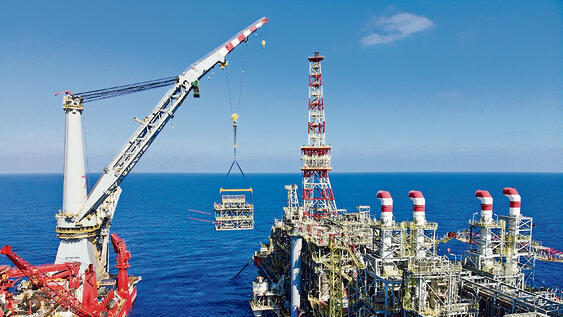
Modules weighing hundreds of tons are lifted from cargo ships onto the Karish gas platform
(Photo: Energean)
Beneath the surface, the project has involved drilling gas wells and laying approximately 30 kilometers of pipeline along the seabed, with positioning accuracy measured in centimeters. At the height of construction, around 10 vessels operated simultaneously in the area, including advanced drilling ships and support vessels carrying equipment and supplies. Workers were transported to and from the platform by helicopters and service boats.
The investment in Katlan is estimated at approximately $1.5 billion. By comparison, developing the entire Karish field previously cost around $2.5 billion. The scale of the operation is also reflected in its daily expenses: running the drilling vessel alone cost approximately $1 million a day over roughly six months.
Katlan is expected to begin supplying natural gas during the first half of 2027, with most of its output already sold in advance to the domestic energy market. Energean's next planned step is to connect the neighboring Tanin gas field to the Karish platform.
Israel's natural gas industry has historically been dominated by American energy giant Chevron, which operates the Leviathan and Tamar fields alongside Israeli partners, including NewMed Energy, whose role is primarily commercial rather than operational. The Karish and Tanin fields were sold to British-Greek company Energean about a decade ago to introduce greater competition into the market. Energean is now Israel's only other major offshore gas operator alongside Chevron.
Since production began at Karish in October 2022, Energean has become a significant supplier, currently accounting for approximately 35% to 45% of Israel's natural gas consumption. Katlan, discovered in 2023 between Karish and Tanin, represents the next stage in the company's development of its offshore assets.
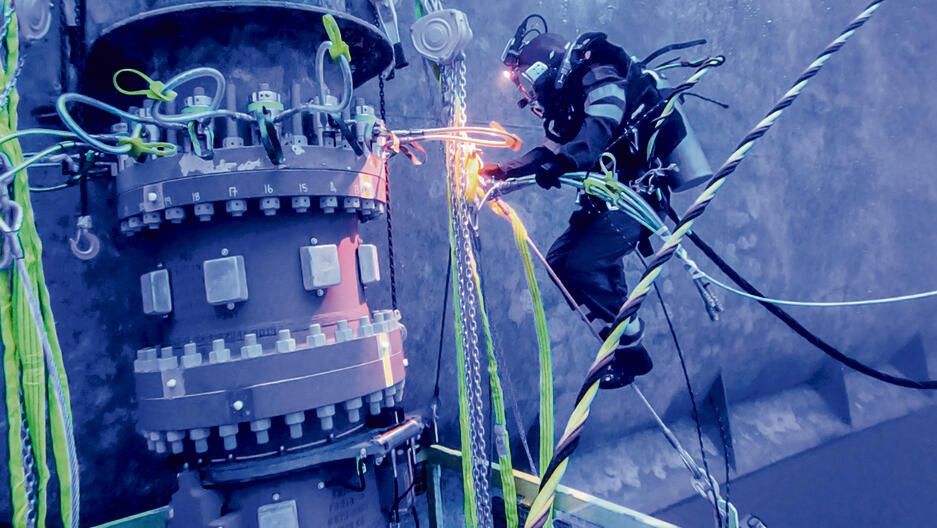
A diver works to connect the Katlan gas field to the Karish platform
(Photo: Energean)
Shaul Zemach, CEO of Energean Israel, described the extraordinary challenges of carrying out such a project under current conditions. "In the global energy industry, projects like these are undertaken only by operators with unique capabilities," he said. "In Israel, there are only two such companies: the American giant Chevron and our company, Energean, which is significantly smaller."
"It's quite remarkable that we're undertaking an offshore project of this magnitude from scratch under the present circumstances," Zemach added. "These projects are extremely complex even on land, but certainly at sea, with changing weather conditions, GPS disruptions, security incidents and similar challenges. All of these make an already complex project even more complicated."
The fear: a future gap in Israel's gas reserves
Beyond the engineering achievement, the Katlan project comes amid growing concern over Israel's long-term natural gas reserves. The Energy Ministry recently published the conclusions of the Dayan Committee, which examined the country's natural gas policy. According to Zemach, the government is not doing enough to encourage exploration and development that would expand available reserves.
"Developing a project like Katlan is the answer," he said. "That's how you increase reserves. Reserves cannot grow on their own. They grow when a company comes along, invests $1.5 billion and puts in the operational effort to build a project like this from scratch. The country needs projects like these to happen continuously so that reserves are constantly being developed."
Zemach said Energean's drilling activities have been the only such operations carried out in Israel's exclusive economic waters over the past decade. He warned that the absence of new exploration drilling could create a significant gap in the country's energy reserves roughly a decade from now.
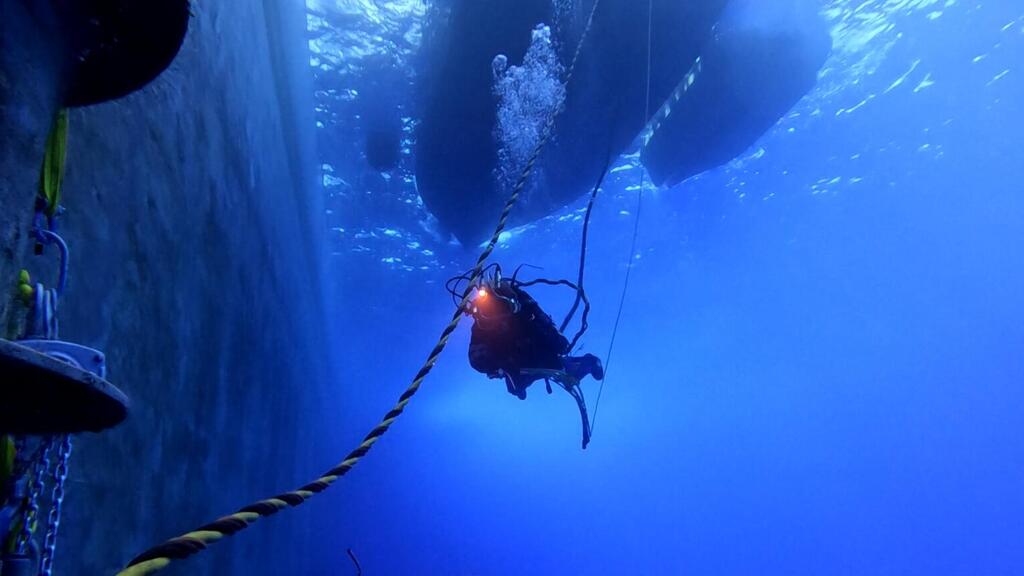
Work to connect the Katlan gas field to the Karish platform
(Photo: Energean)
"Developing new fields, from exploration drilling and discovery to the production of the first gas, takes between five and seven years, and sometimes even longer," he explained. "That means the first gas from licenses issued in 2027, under the current tender, will arrive between 2032 and 2037. Those are the time frames. This is an industry that requires long-term planning."
He added that while Energean has its own development plans, their implementation also depends on the pace at which the state allows new projects to proceed.
Zemach stressed that Israel's offshore gas potential remains far from exhausted. Although future discoveries are likely to be smaller than the giant fields found in 2009 and 2010, he believes many could still be commercially viable and important to the country's energy security.
"The potential still available in Israel's economic waters has not been fully realized," he said. "We must not neglect it, and we are responding to that challenge."
From a strategic standpoint, Zemach argued, Israel should focus less on repeatedly debating how much existing gas must be reserved for domestic use and more on expanding the total amount available.
"Both for energy security and for Israel's geopolitical influence, it would be better to make increasing reserves the objective," he said. "The biggest challenge is maintaining a degree of certainty about the future. The more exploration and development there is, the greater that certainty becomes. We need a clear long-term horizon."