

The ceasefire in the Gaza Strip after nearly two years of war has produced a reality in which the IDF is deployed over more than 50% of its territory, and in large parts access to infrastructure, property and agricultural lands is limited or prohibited. At the same time, most of the population has been pushed into a narrow coastal strip where Hamas maintains influence networks, enforcement mechanisms and a shadow economy.
Therefore, anyone walking through the traditional commercial hubs of Gaza — areas under Hamas influence — will struggle to determine what they are actually seeing: the beginnings of a remarkable recovery, or merely survival spasms by a population that has learned to adapt to harsh living conditions.
It seems the answer is that Gaza’s economy is now in an unusual interim stage. On the one hand, there has been an almost total structural collapse of employment and production bases over two years of war; on the other, there are isolated signs of life driven by a combination of significant humanitarian aid, small‑scale street entrepreneurship and sparse cash flows. Contrary to expectations that Gazans might experience a rapid, comprehensive reconstruction program immediately after the ceasefire, the reality on the ground suggests a prolonged early recovery phase.
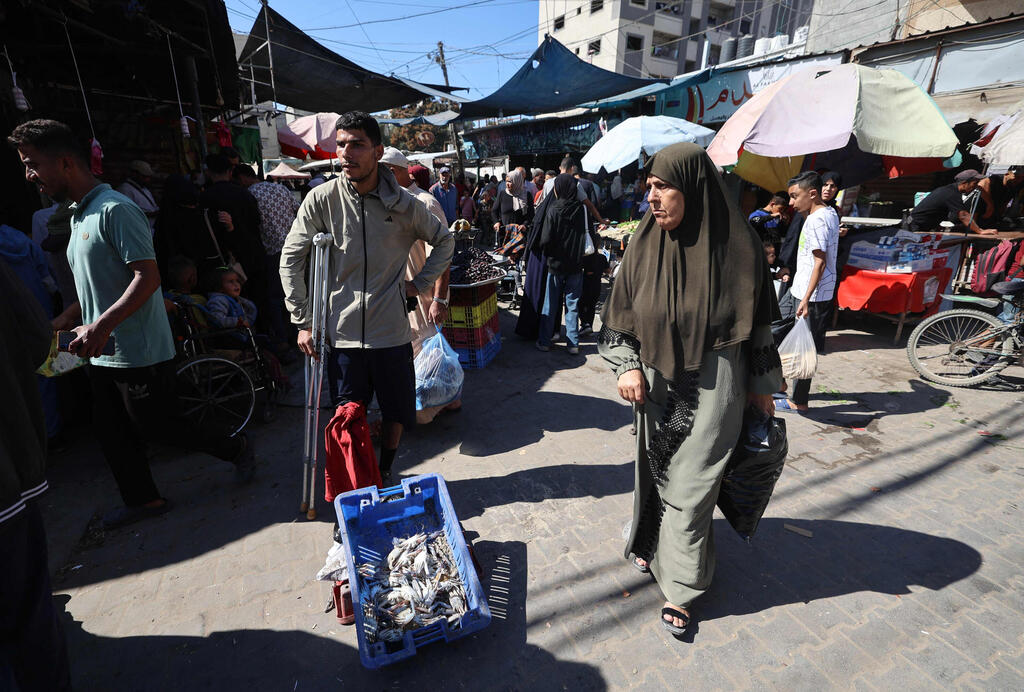
This is a stage where economic activity is not the result of capital investment — since the international community remains hesitant to channel reconstruction funds as long as a stable government presence isn’t visible — but the ability of the retail market to adapt to shifting inventories.
Nothing illustrates this paradox better than the food and bakery sector in central Gaza City. Arab media recently highlighted the case of the Abu Zuhair bakery in Gaza’s Old City, which exemplifies the Strip’s new operational model. The business, once strategically located and relatively well‑equipped, was forced to reinvent itself after the ceasefire amid near‑total lack of infrastructure. Switching to manual production and using improvised fuels such as “khatab” (wood) and discarded furniture has become the operational norm.
Economically, this represents a regression of decades in labor productivity. While baking in a gas oven once took about half an hour, it now requires six hours of work due to the need for manual heating and fire tending. Operational costs are far higher, yet within the vacuum of local production, these businesses serve as focal points of activity. The use of makeshift fuels is not just a survival necessity but the backbone of new “street kitchens,” producing low output at high real cost despite strong demand for basic food.
The return of restaurants and street stalls is part of a broader trend visible in commercial centers like the al‑Zawiya market. According to the United Nations Office for the Coordination of Humanitarian Affairs (OCHA), most markets in Gaza are open today, and some have seen dramatic price drops of about 11.5% in the past month. That decline is mainly due to increased flows of humanitarian goods, but it can also be misleading. The purchasing power of most locals remains at rock bottom, and restaurants in 2026 operate on an “instant economy” model: they do not cook according to a fixed menu, but rather based on what was delivered that morning — flour, oil and legumes acquired in informal markets and turned into hot meals. The reality is of partial services operating only a few hours a day and fully dependent on the logistics chain at the crossings. Nonetheless, it is still a significant shift from the wartime situation.
“The smell of shawarma has returned to the street, but the meat comes partly from cans or from very limited local slaughter,” a local merchant told Al‑Jazeera in a report on returning street stalls.
Banking collapse and forced digitalization
The banking system presents one of the most complex challenges for Gaza’s economy. Despite directives from the Palestinian Monetary Authority, the central bank, to open bank branches, the Strip is suffering from a severe shortage of physical shekel bills. This shortfall has spawned a black market for exchange fees, where street money changers charge between 15% and 30% for converting digital balances into cash.
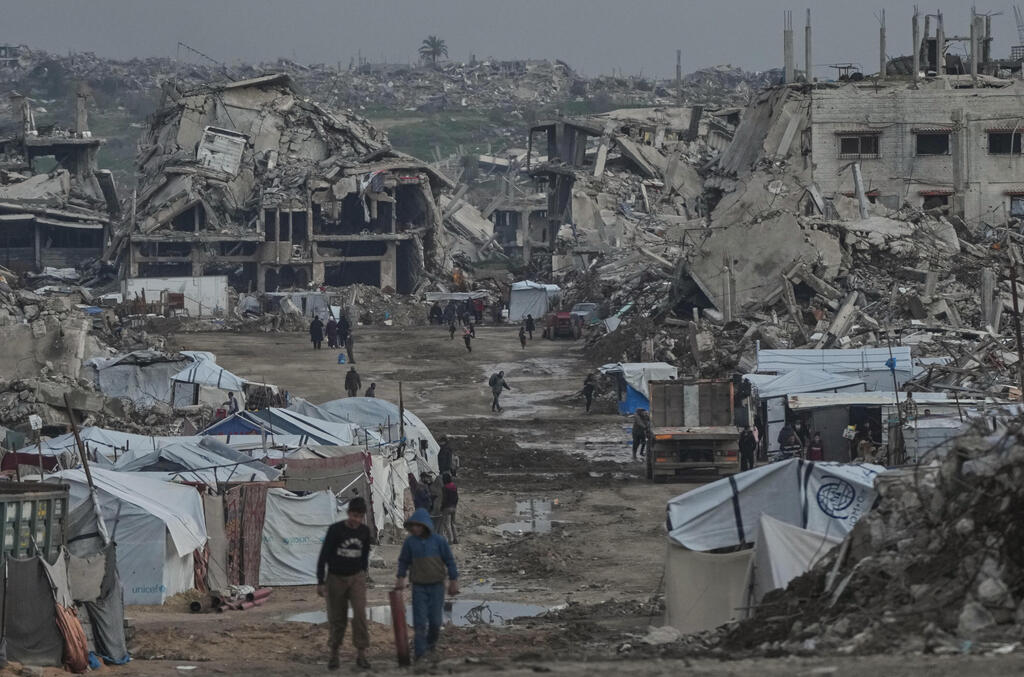
Gaza's Zitoun neighorhood
(Photo: Jehad Alshrafi/AP)
Although Gazans protest this “tax” outside bank branches, in practice it is pushing the economy toward forced digitization. Mobile wallets like Jawal Pay and phone payments have become commonplace even at vegetable stalls, a survival necessity in the face of empty ATMs. In a December survey, an overwhelming majority (95%) of business owners in Gaza reported accepting cash payments, while 80% also reported taking payments via mobile wallet. Business owners identified a major barrier to wider digital wallet use: their continued reliance on cash payments to wholesalers, most of whom do not accept digital payments.
The fragile economic system that exists today in Gaza is fueled by the flow of aid trucks through the crossings. The opening of the Rafah crossing to limited Gazan movement has not yet contributed significantly. In a joint statement by Western foreign ministers in late December 2025, the goal was set at 4,200 trucks per week, with 250 trucks per day allocated to the UN. The statement said this figure should be “a floor, not a ceiling.”
An analysis by the AP news agency found that in the period after the ceasefire up to early December, an average of 459 trucks entered per day — about 3,200 per week, below the 4,200 target, though the weekly total may have since risen. According to reports, the main current bottleneck is logistical within the Strip itself: the ability to collect, store and distribute goods, which was severely damaged because warehouses and access routes were hit during the war. The result is an economy that lives in waves: in weeks of high flow, prices fall and commerce revives, but as with any logistics slowdown, prices spike.
Reconstruction stagnates; “Gray recovery” emerges
On the reconstruction front, significant and large‑scale activity has yet to truly begin, despite the existence of plans — largely because of uncertainty over implementation of Phase II of U.S. President Donald Trump’s program. Current efforts focus on what is defined as “gray reconstruction”: basic operations intended to enable movement and commerce, such as clearing debris and repairing main roads. In the absence of new building materials, a broad recycling industry has developed in the Strip, including concrete collected from destroyed buildings, crushed into gravel and used to fill potholes and rehabilitate water and sewage lines.
Thousands of Gazans are now employed in manual extraction of iron and concrete from piles of rubble — one of the few employment engines on the ground. Three main actors drive this labor market: private demolition contractors who see rubble as available raw material and hire workers at low daily wages (around 30 shekels) to extract iron that is then sold for minor building repairs; the United Nations; and independent Gazans mining iron from the ruins of their own homes to sell to traders for livelihood.
Hamas and the shadow economy
Despite losing control of about half the Strip, Hamas remains a significant economic actor operating within the shadow economy, exploiting the fact that most of the population remains under its influence. The terror organization functions parasitically within the supply chain, using armed men to collect “security fees” from private aid trucks in areas where the IDF is not present, and seizing parts of the goods to sell on the black market or distribute to its loyalists.
In addition, Hamas controls a large portion of the cash reserves it managed to preserve before the war, allowing it to remotely run the network of money changers and extract a cut of the high withdrawal fees. This involvement distorts the market, pushing consumer prices higher in central and southern parts of the Strip where Hamas is dominant due to the levies the jihadist group imposes.