

Israeli food technology startup Plantopia said Wednesday it has raised $9 million to build its first commercial manufacturing facility for plant-based dairy proteins, as rising global demand for protein and supply constraints drive up dairy prices.
The funding round was led by Schreiber Foods, one of the world's largest dairy producers, together with venture capital firm Siddhi Capital. Israeli investors including Yotvata Dairy, Arkin Capital, and the Fresh Start FoodTech Incubator.

The latest investment brings the company's total funding to more than $16 million.
Plantopia said the financing will allow it to transition from research and development to commercial production at a new facility under construction in Kibbutz Sdot Yam on Israel's Mediterranean coast. The plant is expected to begin operating during the third quarter of this year.
Founded in 2018 by Prof. Alexander Vainstein, Tal Lutzky and Amir Tiroler, the company is based on biotechnology developed at the Hebrew University of Jerusalem's Faculty of Agriculture. Its platform uses molecular farming to produce animal-identical dairy proteins in plants rather than through livestock or precision fermentation.
The company says its technology is the first to produce casein — the primary protein responsible for cheese's texture and melting properties — in all four naturally occurring forms found in cow's milk: αs1, αs2, β and κ.
Plantopia says the proteins are chemically identical to those found in cow's milk while being lactose-free, animal-free and produced at costs competitive with conventional dairy production.
The company said its first commercial product will be casein, which it believes could enable manufacturers to produce plant-based mozzarella that matches traditional mozzarella in taste, texture and performance while eliminating the need for dairy cattle.
Unlike many alternative protein companies that rely on precision fermentation using microorganisms, Plantopia's production process uses vertically grown indoor sprouts. The company says the method does not require sunlight, livestock or extensive farmland, generates oxygen instead of greenhouse gases and can be expanded relatively easily wherever demand exists.
Plantopia argues the approach offers lower capital and production costs than fermentation-based technologies while reducing carbon emissions associated with dairy farming.
The company said growing demand for dairy proteins is creating significant supply pressures worldwide.
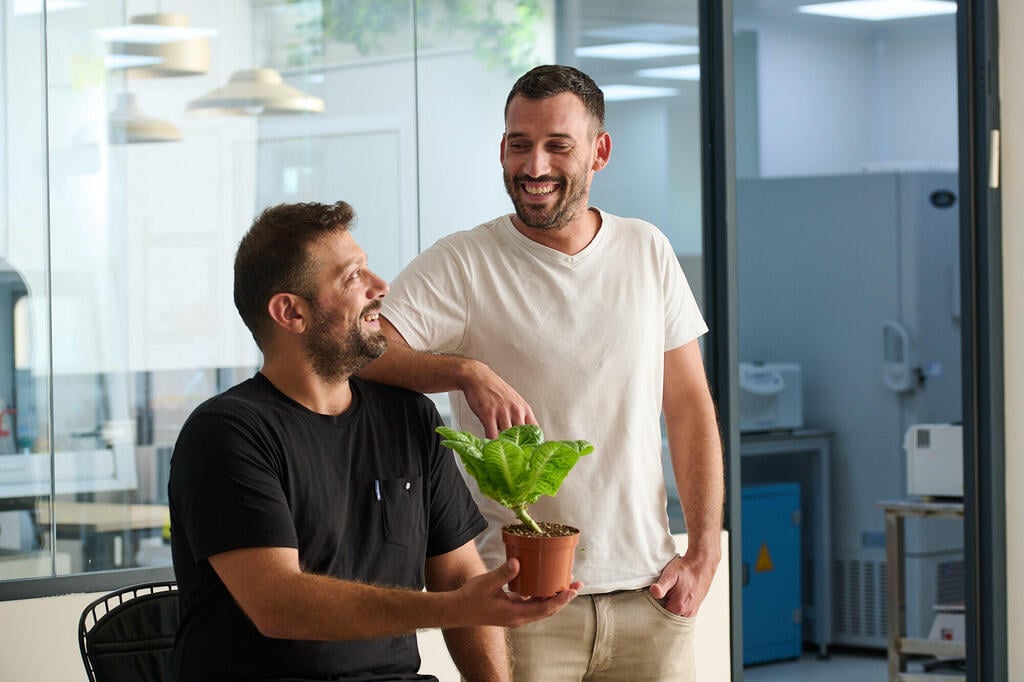
Tal Lutzky and Amir Tiroler
(Photo: Plantopia)
It cited changing eating habits in the United States, driven in part by the widespread adoption of GLP-1 weight-loss medications such as Ozempic and Wegovy. Because patients taking those drugs often lose muscle mass along with body fat, physicians increasingly recommend higher protein intake.
According to Plantopia, dairy protein consumption in the United States has risen 83% over the past two years, while prices have increased by about 250%.
The company also cited U.S. Department of Agriculture data showing sharp increases in whey protein concentrate prices, as food manufacturers increasingly incorporate dairy proteins into products ranging from breakfast cereals to ready-to-drink beverages.
Plantopia estimates that roughly 12% of the U.S. population now uses weight-loss medications.
The company also pointed to broader structural challenges facing the dairy industry, saying global demand for dairy proteins is outpacing supply while conventional dairy farming faces environmental constraints.
It noted that about 70% of the world's population is lactose intolerant to some degree, with rates reaching as high as 90% in parts of Asia, increasing demand for alternative sources of dairy proteins.
The North American market for casein alone is estimated at about $50 billion, according to the company.
"Plantopia's technological achievement is the holy grail of dairy proteins – proteins that are identical in composition to those found in cow's milk," CEO and co-founder Tal Lutzky said in a statement.
"They will help meet the growing demand for dairy proteins while enabling us to produce products that are as good as the original, providing a commercially viable alternative to one of the world's largest sources of pollution. Having completed the development stages that have been our focus in recent years, we are now moving into commercial production," he said.
First published: 10:40, 07.22.26