

The recent sharp decline in the dollar’s value has wide‑ranging implications for Israel’s economy, households, investors, borrowers with dollar‑linked debt, savers and, naturally, consumer prices. On April 9, 2025, the dollar traded in Israel at 3.81 shekels. On Tuesday, in continuous trading, the dollar was around 3.14 shekels, about 17 % lower than last year’s rate, with the indicative rate set at 3.15 shekels. The euro’s indicative rate was fixed at 3.67 shekels.
The steep fall in the value of the dollar and the euro is good news for Israelis traveling abroad, who could save hundreds or even thousands of shekels on flights, hotels, car rentals, tours and shopping. But some suffer from the dollar’s weakening and are calling on Bank of Israel Governor Amir Yaron to intervene in the foreign exchange market for the first time in some time and buy dollars amid the flood of supply.
Gallery
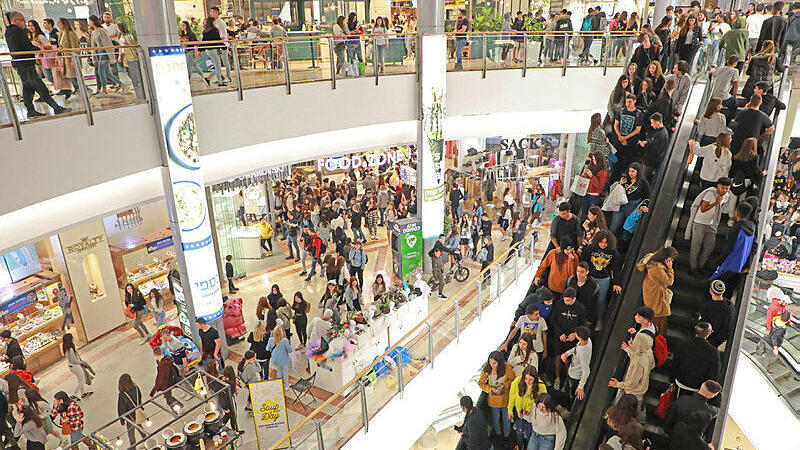
The Israeli consumer is not expected to see an immediate change in prices as a result of the strengthening of the shekel. Azrieli Mall
(Photo: Dana Koppel)
Dr. Ron Tomer, president of the Manufacturers’ Association of Israel, urgently appealed to Economy Minister Nir Barkat and Finance Minister Bezalel Smotrich to help exporters and manufacturers, warning that “the appreciation of the shekel threatens exports and the future of Israel’s high‑tech sector.”
Tomer told ynet in an interview that: “We demand an immediate emergency government meeting with industry and manufacturers to stop this serious situation, due to the sharp drop in the dollar and euro.”
Will prices in Israel fall?
Consumers expecting imported goods and local products that rely on imported raw materials to fall in price because of the stronger shekel may be prematurely optimistic.
Israeli consumers are not likely to see immediate price reductions because importers and retail chains, such as in fashion, do not buy inventory day‑to‑day. They place orders with suppliers about six months in advance and usually lock in, or in industry terms “hedge,” the dollar exchange rate at the time of ordering.
In addition, inventories held in warehouses were purchased at a higher, older dollar rate. For example, financial reports from major appliance importers such as Electra and Tadiran show they hold about four months’ worth of stock. That means prices are unlikely to fall until current inventory is sold.
A spokesperson for a major fashion chain told ynet that if the dollar remains at its current level in the coming months, it is likely that summer fashion prices will drop when new orders are placed with suppliers abroad at the lower dollar rate.
Optical retailer Opticana, which imports eyeglasses frames, said its inventory was also purchased at the old dollar rate.

Travelers are getting more value for their shekels
(Photo: Nitsan Dror)
Zvika Gior of NewPan, a leading importer of appliances and electronics, said the lower dollar will have an effect but not immediately, and only if the rate remains stable. “It will take several months before the price effect is felt,” he said.
A food importer from the Far East said that while trade with suppliers in China or Asia is conducted in dollars, suppliers who receive lower value dollars raise their prices to compensate.
Those hit hardest by the dollar’s decline are exporters, who now receive lower returns for goods sold abroad. This hurts profitability in highly competitive markets that are not always friendly to Israel, making it difficult for exporters to raise prices to offset lower revenue.
From Kiryat Gat to Minnesota
Yoav Zeif, CEO of Stratasys — the world’s largest industrial 3D printer manufacturer — described the impact. “We have headquarters in Minnesota, three production facilities in Kiryat Gat and one in Minnesota," he explains. "We sell in dollars that have fallen in value and pay our expenses in shekels. Our dollar costs in Israel have risen by almost 20 %. In addition, we face a 15 % tariff in the U.S., so together that adds up to 35 % in costs. Bottom line, when we manufacture in Israel we are now losing money.”
Zeif, said the company has invested in technology and believes in manufacturing in Israel, but now must move one of its loss‑making plants to Minnesota, where production costs are lower. “The cost of hiring a development engineer is dramatically higher in Israel,” he said. “Production costs have risen significantly and hurt our ability to compete. We are a public company that must do what’s best for shareholders.”
Zeif suggested policy responses. “For example, intervention by the Bank of Israel. There is no problem lowering interest rates now given the inflation rate — demand for shekels would decline and the exchange rate would balance. We have huge foreign reserves and can manage the rate and establish a floor that we can live with. At the government level, support could be created that more meaningfully encourages manufacturing and R&D employment in Israel," he says.
The good and bad behind the dollar’s fall
There are many reasons for the dollar’s collapse against the shekel, some positive and some negative:
• Interest rate differentials with the U.S. have widened, prompting the Bank of Israel to cut its base rate to 4 % last week in an effort to narrow the gap, but rate cuts have not kept pace with reductions in the U.S. and Europe.
• A large surplus in the balance of payments due to foreign investment and stock purchases on the Tel Aviv exchange, which has been among the world’s best‑performing markets, flooding the market with foreign currency.
• Significant foreign capital inflows tied to large defense and natural gas deals.
• A temporary easing in security tensions with expectations of a rapid economic rebound, similar to post‑COVID recovery.
• Growing likelihood of a budget being passed in March and legislation of a new draft law, ending extended budget stagnation since April.
Who wins and who loses from a weak dollar and euro?
The biggest winners are Israelis traveling abroad and those who purchased foreign goods for personal import (currently up to $150 without VAT). Also among the beneficiaries are residents with dollar‑linked loans or mortgages, whose monthly repayments are now considerably lower, and companies that import raw materials.
The biggest losers are manufacturers and exporters selling primarily to the U.S. and Europe. Also affected are holders of dollar‑linked savings, owners of overseas assets such as foreign rental properties who must convert their income to shekels, and people who prepaid for flights and trips abroad when exchange rates were higher.
Trust in the economy
A key question is whether the dollar will continue to decline. According to Ori Mor, co‑founder of investment banking firm Mor Langerman, “the trend of a stronger shekel is not a technical or temporary phenomenon, but a direct reflection of the strength of Israeli exports and sustained confidence in the local economy. Defense exports are increasing, high‑tech is showing active fundraising and deals, and the gas and energy sector continues to provide stable foreign currency inflows. The combination of these three growth engines creates a persistent surplus in foreign currency and natural pressure for the shekel to strengthen.”
Or Poria, chairman of Poria Finance, said: “The trend of shekel appreciation is likely to continue, even if at a slower pace. A change in trend could occur only through a significant market correction or a sharp deterioration in the security and geopolitical situation.”