

Helene Plotkin, 88, bought the painting in 1966 from a secondhand store in New York for just 100 dollars. For six decades it hung in her living room until her son photographed it and uploaded the image to Gemini. It quickly emerged that the work was an original by Scottish Colourist FCB Cadell in White Plans. Earlier this month, the painting was sold at auction for a substantial sum.
Helene Plotkin bought the painting nearly 60 years ago for less than $100 at a thrift store in New York. Plotkin, who holds a degree in art, fell in love with the painting, which depicts a woman dressed in black, and displayed it in her home until December 2025. A simple search using artificial intelligence then revealed that the work was in fact a valuable piece of European art, according to a report in The New York Times.
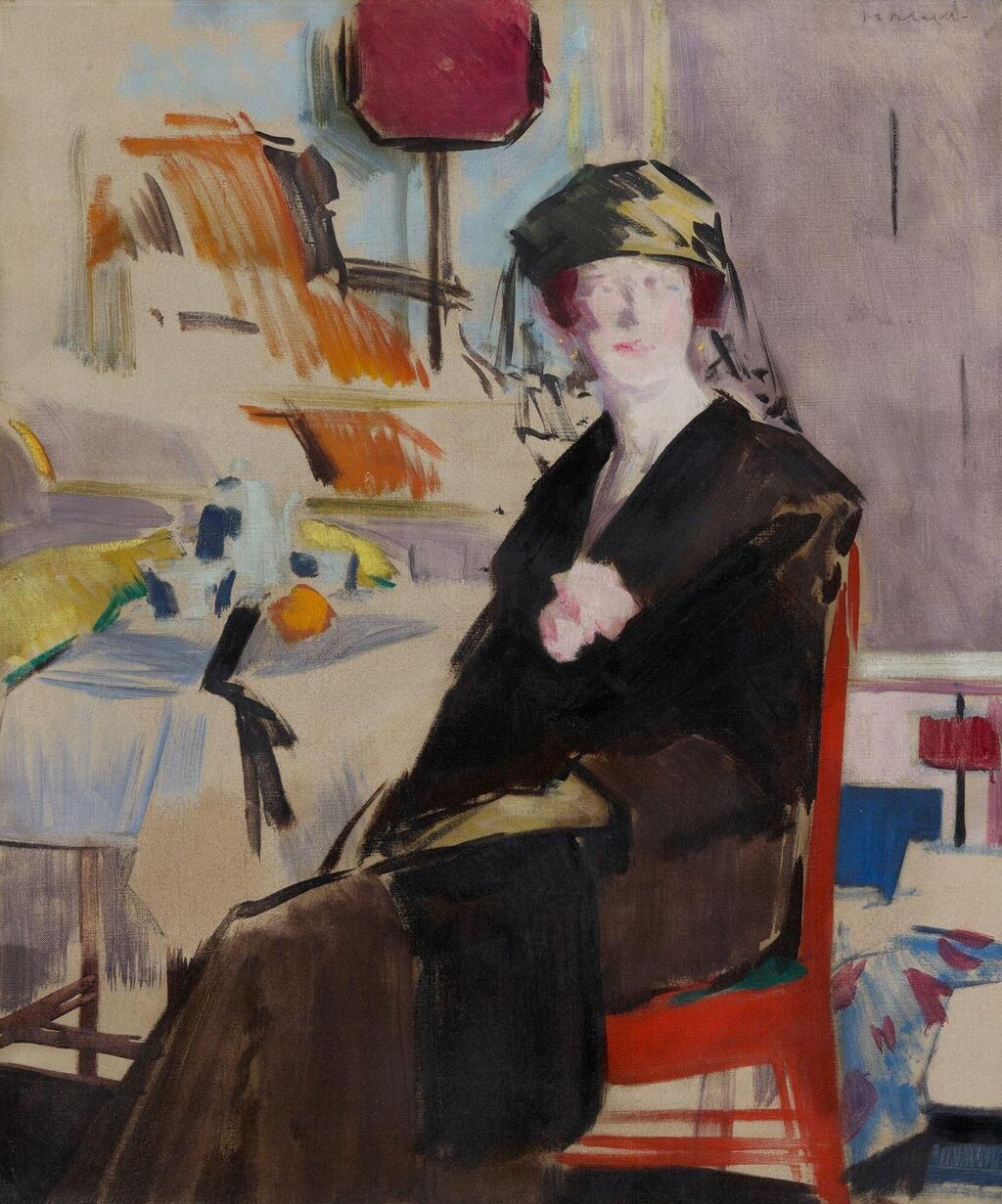
Interior: The Lady in Black
(Photo: From the Lyon & Turnbull auction house website)
The painting was later authenticated by art appraisers as an original work by Cadell, a member of the Scottish Colourists. Earlier this month, it was sold to a private buyer at auction for £189,200 (254,000 dollars).
The work, titled Interior: The Lady in Black, became the latest example of how artificial intelligence can help identify objects that once required the eye of a trained expert. Stories of family heirlooms turning out to be worth fortunes have long been a staple of American television, but Plotkin’s case highlights a new use for AI technology.
Plotkin said that although the painting immediately caught her attention, she never suspected its true value.
"I never, never thought about it at all, other than I loved the painting.”
Her son, Barry Plotkin, 60, recalled that over the years family members speculated about the painting’s origins, but no one ever sought a professional evaluation from an auction house.
Distinctive features of Cadell’s work
Several months ago, during a visit to his mother’s home in Florida, Barry had an idea: why not ask Gemini about the painting? He photographed it, uploaded the image and asked the chatbot what it could tell him.
“It was amazing how much information came out of that,” he said.
Gemini identified the painting’s orange brushstrokes, Art Deco aesthetic and distinctive background as hallmarks of Cadell’s work. It also noted the artist’s membership in the Scottish Colourists, a group of four artists — Cadell, John Duncan Fergusson, George Leslie Hunter and Samuel Peploe — who brought influences from Fauvism and French Impressionism into modern British art.
"Your mother didn’t just find a ‘Cadell,’” Gemini wrote, “she found a large-scale, 1920s studio portrait of his primary muse, painted in his most famous Edinburgh studio.”
Gemini also advised Barry to inspect the back of the painting. There, they found an auction marking, a canvas stamp and a processing date. They then contacted an auction house and a professional art appraiser. The chatbot suggested specialists Nick Curnow and Alice Strang of Lyon & Turnbull.
“As the story unraveled, we just got more and more excited,” Strang said in an interview, “because this is the stuff of auctioneers’ dreams.”
Strang and Curnow confirmed much of what the AI had concluded, with one significant difference. Gemini identified the subject as Bethia Hamilton Don Wauchope, one of Cadell’s regular models whose name appears on the back of the work. However, Lyon & Turnbull determined that the sitter was actually May Easter, another of the artist’s models. The turban Easter wears in Plotkin’s painting also appears in Cadell’s painting Pink and Gold. Further research and technical analysis, including examinations under three different types of light, supported most of Gemini’s findings.
Strang said she has no explanation for how the painting ended up in New York in 1966, only months after it had been sold by Christie's in London for £21 — roughly 600 dollars in today’s money. Strang and Curnow ultimately gave the work the title Interior: The Lady in Black.