

If someone close to you at work or at home seems emotionally and physically drained, shut down and chronically unmotivated, showing little engagement with what is going on and unable to find drive or enjoyment in almost any situation, and often firing off poisoned arrows of cynicism at workers, customers and colleagues, chances are they are suffering from severe professional burnout at work without realizing that is what they are experiencing. They may also complain of aches throughout the body, fatigue despite adequate sleep, headaches and difficulty concentrating.
Burnout at work has become a very common phenomenon. That worries researchers and psychologists as well as the World Health Organization, which for the first time in its history created a medical code for measuring workplace burnout and, unlike in the past, places responsibility for solutions first and foremost on employers.

In Israel the situation is, of course, tough - especially after two years of war following the coronavirus pandemic and a judicial overhaul. The results of a major study led by Dr. Irene Diamant at the Academic College of Tel Aviv-Yafo, with the National Insurance Institute taking part, are therefore not surprising. The study surveyed 5,504 workers across sectors including high tech, education and the public sector. It paints a clear and troubling picture: nearly every second employee in the country experiences high burnout.
According to the data, 48.6% of participants are at a high to extreme level of burnout. Of those, 32.9% report high burnout, 12.8% very high burnout and 2.8% extreme burnout. What is especially surprising are the findings on remote work. It turns out that working from home does not reduce burnout at all and in many cases increases it. Workers report a sense of “work that never ends” and difficulty setting clear boundaries at home.
Working from home: ‘The boundaries blur’
One of the most interesting findings is that hybrid workers or those working entirely from home do not experience lower burnout levels than employees who come to the office. That again puts the hybrid model under debate. In this study the picture is complex. Hybrid workers report getting more organizational resources such as flexibility, comfort and autonomy. At the same time, they face slightly higher demands, pressure and workload as well as more conflict between work and home. The result is that their burnout rates are identical to office workers.
In other words, flexibility can bring immediate benefits but does not protect against burnout and sometimes makes it harder to maintain boundaries between personal life and work.

(Illustration: Helga Khorimarko/ Shutterstock)
“People who work from home have more work-home conflict, which is the leading factor in burnout,” Diamant says. “When you work from home, it is harder to separate work boundaries from personal life. Sometimes only a door or a kitchen table separates the two, and that creates a different kind of burden.”
She says it is another hint that people do not always know what is good for them. “On the one hand, we all want to work from home in pajamas and save ourselves the traffic jams. But is that the right thing for our mental health? Maybe in the office, where we meet more people and sit together for coffee breaks and in the cafeteria, there is deep psychological value. The picture is complex. Workers see working from home as a resource the organization gives them, but it does not protect against burnout and increases work-home conflict.”
So what should be done. Should employers continue to allow working from home?
“It can suit some workers more than others, and you cannot apply this form of work across the board,” she says. “People have different preferences and needs, and there is also a geographic and spatial factor. Are you working from a two-room apartment or do you have a home office? Is it comfortable or cramped?”
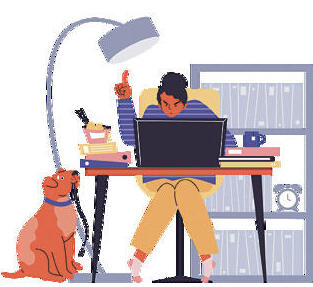
Other factors found to contribute significantly to burnout include heavy workload, multiple tasks and conflicting demands, and major conflict between time devoted to work and time devoted to private life, with a corrosive spillover between the two.
(Illustration: Rumka Vodki/ Shutterstock)
“It is not only long hours,” Diamant says. “In many cases workers describe a complete blurring of boundaries. Alongside near-constant availability, there is a real difficulty disconnecting mentally from work and creating time for family or rest.” She quotes respondents, mainly in high tech, who said, “Even when I go to sleep, I am thinking about work.”
“In high tech, for example, one of the significant factors in burnout is difficulty disconnecting,” she adds. “Workers feel they cannot unplug. The tasks never end. They are always on deadline and under pressure to achieve.”
You just described my job, minus the high tech salary
“Yes, that is typical in other fields as well, like media or medicine,” Diamant replies. “But you need to understand that each specific burnout pattern is created within an organization and stems from the nature and structure of the work. There is no one uniform burnout profile.”
She says difficulty disconnecting is often tied to a lack of personal boundaries, not only managerial demands. “People get home and cannot stop checking emails or thinking about work. When we asked, ‘To what extent, when you go to sleep, do you keep thinking about work,’ a high percentage in high tech answered ‘to a great extent.’ That is not only about the workplace. It is also about the worker’s existing lack of boundaries and not knowing how to cut off for rest, family or leisure.”
Maybe people who cannot set boundaries are drawn to a field like high tech that demands exactly that.
“Exactly,” Diamant says. “It is a closed loop. When I talk to a manager whose employees cannot disconnect from emails even before sleep, he will say, ‘But that is my outstanding employee. He is not burned out, he is excited, he takes on all the tasks.’”
And in practice?
“In practice that worker shows up at a clinic and we find that overdoing, workaholism and lack of boundaries create a kind of hidden burnout,” she says. “You do not see it from the outside, but then a burnout crisis erupts and the person collapses or an illness breaks out. People come to occupational psychologists with a sharp employment crisis accompanied by physical illness because something has cracked in an extreme way, in feeling, health and motivation. Suddenly they cannot work in their field.”
Younger workers more burned out: ‘Pressure is high from every direction’
On how this fits with the fact that young people today switch jobs frequently and do not develop long careers, Diamant says the labor market is no longer linear, but the dynamic pace also makes it easy to reach burnout quickly.
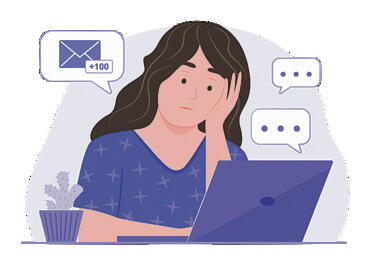
Here the study hits another striking point: younger workers are more burned out than older ones. Employees without children reported higher burnout than employees with children. And, unsurprisingly, women are more burned out than men, mainly on physical and cognitive dimensions.
“At a young age pressures converge,” she says. “You feel a need to advance and prove yourself, your skills are not fully developed yet, you are building a relationship, family and financial stability. Pressure is high from every direction. Older people develop coping and support mechanisms. Their psychological response is more moderate. They show more resilience under responsibility and workload, but less burnout.”
(Illustration: Wiro.Klyng/ Shutterstock)
For women, she says, multiple roles and tasks intensify the pressure. Women also feel more guilt and more fear of missing out when juggling everything but feeling they are not good enough in any arena, at home or at work. “In women’s view, if you work in a demanding job and succeed, you may feel more frustration because it seems your parenting is not fully realized,” she says. “On the other hand, if you are more at home with the children, you feel you are missing out at work. Women experience more work-home conflict, and that strongly drives burnout.”
Employer responsibility: ‘Mental health, not only achievements’
The WHO defines burnout as a health syndrome resulting from prolonged exposure to work stressors, tied to severe harm to individuals, organizations and the broader economy. Diamant says this underscores direct organizational responsibility for workers’ mental health.
“The fact that the WHO created an international standard, ISO 45003, for measuring workplace burnout shows how high this issue is on priority lists,” she says. “The standard has been adopted in Israel and directs organizations to take responsibility for their employees’ mental health. It guides how to promote mental health at work and prevent burnout.”
That is unprecedented.
“It is the first time in history,” she says. “There are standards for noise control or hazardous materials, but this is the first global standard saying an organization is responsible for workers’ mental health and must act to prevent burnout. It is a dramatic development, and the standard’s existence shows this is global, not only Israeli.”
Dr. Raz Dekel, an occupational medicine specialist and chief physician at the Labor Ministry, says the basic definition of burnout is a mismatch between tasks imposed on a person and the resources available to handle them. A wide range of burnout phenomena can stem from that mismatch and become chronic.
“Occupational medicine is built on a triangle: job demands, worker health and the worker’s personal characteristics,” he says. “Every burnout case is individual. Beyond job demands and health, it depends on the person’s interests, what is hard or easy for them, their resilience, personality structure and motivation. The relationship between those traits and job demands affects burnout levels, so it is hard to define burnout by medical measures alone.”
So how do you define it?
“By psychological measures,” Dekel says. “Occupational psychologists lead treatment, both in organizational functioning and employee well-being. One thing is clear: burnout causes stress, but its features differ from person to person. If someone feels control over space and time, even under high load, they will feel less stress and reach burnout less often.”
He says occupational psychologists succeed when they treat organizational pathologies in ways that reduce burnout drivers. As long as an organization exposes workers to a harmful environment that causes burnout, the worker cannot recover. “Take a baker who develops a flour-dust allergy that causes asthma,” he says. “No treatment will stabilize the asthma until the flour dust is removed. It is the same with burnout. If the occupational stressor is not removed, the worker remains burned out.”
The war period: A spike in reports of exhaustion
Another pattern in Diamant’s study is what researchers call a “subjective norm.” Workers who feel their environment is burned out, meaning “everyone around me in my organization is burned out,” tend to experience higher burnout themselves. The effect creates a culture that treats overload and pressure as normal, reducing sensitivity to burnout’s risks and preventing people from seeking help.
As in Europe, the United States and Japan, workplaces are paying more attention to burnout, but Israel has added pressures, especially the war of the past two years. The study found unusually high burnout during the war period. Workers measured during the fighting showed significantly higher burnout than in routine times. The highest levels were among spouses of reservists. Here too, women reported much higher burnout than men.
“During the war, we saw a sharp jump in burnout, a real peak in reports of exhaustion, loss of strength, lack of energy and difficulty investing at work,” Diamant says. What helped curb burnout was volunteering that workplaces allowed, giving employees a sense of contribution and meaning. She says that shows how meaning and value can matter more than conditions or pay.
She warns complaints about burnout are expected to rise further. “We are ahead of the big burnout boom because it often erupts after prolonged stress passes. Long-term stress produces burnout, and from extreme psychological experience come physical issues like digestive problems, neck and back pain, sleep disorders and cardiovascular problems. ”Researchers call this a “loss spiral.” As resources that should support people are depleted, more resources drain away, and the problem spills into life outside work.
“It is dangerous mentally and physically,” Diamant says. “If it continues untreated, the person pays heavy prices in illness, and the organization pays in lower productivity, accidents, turnover, resignations and more absences.”
She says organizations must first learn what not to do. “There is no single menu for coping with burnout. Each organization has its own story. It can be management style, staff shortages, wrong work methods or lack of training. Every organization must do a deep organizational assessment, in cooperation between employees and management, so each side understands the other.”
Burnout is not a personal flaw, she adds, as once assumed. It is mainly a product of systemic working conditions. She says organizations often invest in wellness days and workshops that are not always relevant to employees’ real psychological needs. Without precise measurement of workers’ experiences, intervention programs often fail.
Worker responsibility: Rest, breathing and exercise
Still, Diamant says workers also have responsibility for their mental well-being and managing burnout. “Burnout forms in response to working conditions and work structure, but individuals are responsible for their quality of life. We make choices to balance home and work, create islands of rest and breathing, and improve nutrition and exercise habits that help mentally as well. Personal responsibility is an important part of coping.”
Is there a difference between managers and employees in burnout?
“Yes,” she says. “In organizational interventions we create a proper view of manager on worker and worker on manager. Managers often do not see employees’ burnout, and employees do not see managers’ burnout. Managers are also highly burned out due to loneliness, heavy responsibility and constant crises, especially now. It is not higher or lower burnout, but different burnout. Organizations must talk about this mutual view. There must be no blindness either way, especially because burnout is hidden and not always visible.”
What about burnout in the military after two years of war?
Diamant hesitates but says: “There is great burnout in the military. There have been plenty of published data. The military is dealing with burnout among commanders and soldiers, but the processes and interventions there are different.”
The study also highlights factors that reduce burnout. At the top is a sense of meaning and fulfillment at work, not salary. Workers who felt their jobs matched their values, understood their organizational contribution and had social support reported lower burnout even under high demands. Clarity about tasks and responsibilities and a perception that the organization is committed to employee well-being also helped.
The research team from the occupational psychology program at the Academic College of Tel Aviv-Yafo conducted the study with funding and partnership from the National Insurance Institute’s Manof Fund.
The college itself is presented as an example of full implementation of ISO 45003. After identifying rising workloads and psychological effects on academic and administrative staff, CEO Elie Mersel decided to adopt the standard. After a three-year process that included open discussion spaces, adjusting role loads, embedding tools for managing work-home boundaries and expanding support systems, burnout levels dropped about 30%, satisfaction rose and a stronger sense of belonging was reported among the college’s 600 employees.
“When we set out, it was clear we were not only treating work processes but people,” Mersel says. “Implementing the standard had real impact. It fits our vision of social impact and helped us build a healthier, more attentive organizational culture that puts employee well-being as a top value. We see the results every day.”