

UBS says the Bank of Israel may be nearing renewed intervention in the foreign exchange market if the dollar continues weakening toward 2.80 shekels, according to a special report by the Swiss investment bank on Israel’s economy and currency.
UBS said that level could push inflation below the lower bound of the Bank of Israel’s 1% to 3% price stability target.
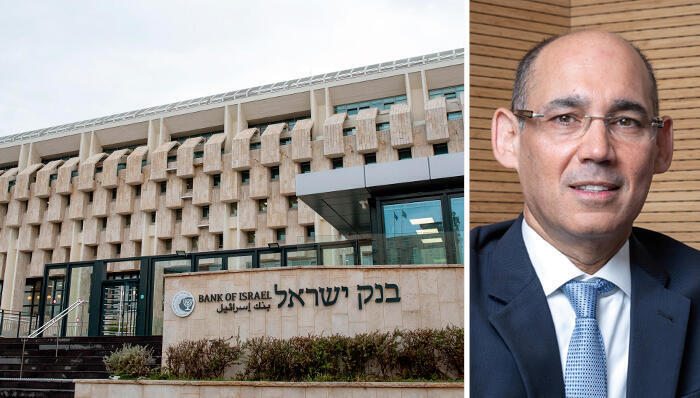
Bank of Israel Government Prof. Amir Yaron
(Photo: Shalev Shalom, Eyal Touag)
The report, written by emerging markets strategists Nimrod Mevorach and Manik Narain, draws in part on an interview Bank of Israel Deputy Gov. Andrew Abir gave ynet's sister publication Calcalist last week.
UBS said the central bank’s “tolerance level” appears to be around 2.80 shekels to the dollar. Under a relatively high pass-through scenario, in which 15% of the exchange rate move feeds into inflation, a decline to that level could push inflation below 1% this summer. The bank cited a sharp drop in core inflation to 1.4% last month, a multiyear low, from 3.6% a year earlier. Tradable goods inflation, which accounts for about 37% of the index, is already close to zero.
Under a lower pass-through scenario, in which only 10% of the shekel’s appreciation translates into lower inflation, the dollar would have to fall toward 2.70 shekels to produce a similar effect.
The UBS report points to a sharp shift in Israel’s macroeconomic story. Two years ago, the Bank of Israel was fighting high inflation and a steep depreciation of the shekel. Now, the main concern is increasingly that inflation could become too low because of the strengthening local currency.
UBS does not attribute the shekel’s rally mainly to Israel’s underlying macroeconomic data, but rather to unusual capital flows. It identified two major drivers: a sharp increase in foreign currency hedging by Israeli institutional investors and Google’s $32 billion acquisition of Wiz.
According to UBS, institutional investors have significantly increased their foreign currency hedges since the end of 2025, partly because of sharp gains on Wall Street. As the value of their dollar-denominated investments rises, they must sell dollars to maintain hedge ratios, strengthening the shekel.
UBS estimates that Israeli institutions’ “forward book” — the scale of their foreign exchange hedge positions — has jumped about 43.5% to roughly $99 billion. The bank said that if institutions return to their average hedge ratio of the past decade, it could generate additional dollar sales of about $25 billion, suggesting pressure for further shekel appreciation has not yet been exhausted.
However, UBS said that in the event of a sell-off in U.S. equities, the dollar could rise again to 3 to 3.1 shekels.
The report’s main message is that Israel’s exchange rate is becoming increasingly dependent on capital markets and the U.S. technology sector.
“A long position on the shekel has effectively become a U.S. technology position,” the analysts wrote.
UBS noted that 59% of foreign direct investment stock in Israel is tied to the high-tech sector. It also estimated that even after the latest wave of dollar sales, Israeli institutional investors remain below their historical average hedge levels, potentially leading to another $20 billion to $25 billion in dollar sales.
On Bank of Israel policy, UBS said it expects the central bank to first continue cutting interest rates before launching large-scale foreign currency intervention. It forecasts two consecutive rate cuts, next week and in July, bringing the rate down to 3.5%.
Still, UBS did not rule out the possibility that the Bank of Israel could use both tools at the same time: cutting rates to support economic activity while buying dollars to prevent inflation from falling too sharply.
The report also devoted a section to Israel’s upcoming elections and political system. Its central conclusion was that despite political uncertainty, markets are currently far more focused on Wall Street, high tech and capital flows than on domestic politics.
UBS said even early elections are not expected to materially change the macroeconomic picture in the short term, partly because the 2027 budget is expected to be drafted only after a new government is formed in early 2027.
The analysts described Israel’s political system as deadlocked. Prime Minister Benjamin Netanyahu’s coalition bloc is hovering slightly above 50 seats, well short of the threshold needed to form a government, while the opposition bloc is also struggling to produce a clear majority.
UBS said the most likely scenario for now is a political stalemate that could lead either to another election or to a unity government.