

The latest war with Iran and the northern front in Lebanon have brought rocket and missile threats back into Israeli life, but defense industries understand that, on the modern battlefield, explosive-laden FPV drones are becoming one of the most dangerous threats to military units and to civilians on the home front. Unlike missiles, which can be detected from afar, a drone can arrive and explode within 15 to 20 seconds — especially those operated by fiber optic cable, which makes them almost impossible to neutralize.
Rotem Rogovsky, CEO of SkyPro, and Ido Buchwalter, the company’s product manager, spoke Monday morning in the ynet studio about the drone threat and the solution they are developing to counter it.
So why is it so difficult to neutralize explosive drones?
Buchwalter: “The entire connection between the controller and the drone is through fiber optic cable and not frequencies — and that is what makes it hard to detect and neutralize.”
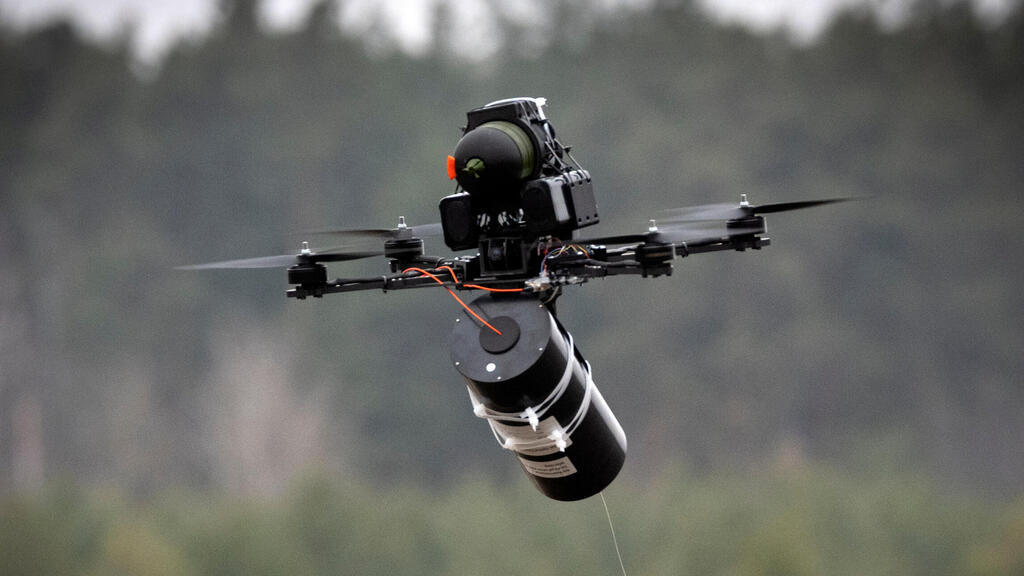
A fiber-optic FPV drone
(Photo: Efrem Lukatsky/AP)
So the more primitive the drone is, the deadlier it becomes?
Buchwalter: “Exactly. The fact that it is relatively primitive makes it hard to detect — and especially deadly.”
What solution are you developing?
Rogovsky: “Our venture was established to provide a response to these threats. We developed a technological solution that successfully passed a pilot stage and proved its capabilities. Because this is a sensitive defense field, we are keeping a low profile and cannot reveal technological details — but this is a solution that is going to change the rules of the game in protecting our soldiers.”
But what is the product, essentially? Is it drone against drone?
Rogovsky: “It is not a drone. It is a system that knows how to neutralize the fiber optic threat — something we have not yet seen.”
Can you completely eliminate the drone threat?
Buchwalter: “No one can say that with 100% certainty. All the existing solutions today — frequency jamming, image disruption — tens of millions of dollars have been invested in them, and the FPV drone simply penetrated them. The solutions need to be much more sophisticated.”
And will the future battlefield really look different, with fewer missiles and more drones?
Buchwalter: “That is already the reality on the ground. The next war will be fought with robots and swarms of sophisticated drones that are hard to catch. The biggest problem is that they are accessible — you can buy parts on AliExpress, assemble them at home and attach an explosive charge, all while the cost of neutralizing them is 20 times higher than the cost of the drone itself. That equation has to change.”
First published: 08:29, 05.05.26