

When Israelis talk about healthy nutrition, most think first of sugar, fat and sweetened drinks. Soft drink consumption has been declining over the past decade, and more Israelis are choosing water. Public awareness around snacks and sweets has also grown.
But one ingredient, no less dangerous, receives far less attention: sodium. And Israelis are falling into its trap. It hides in countless food products, including some perceived as healthy, and most people consume far more of it than recommended.
Gallery
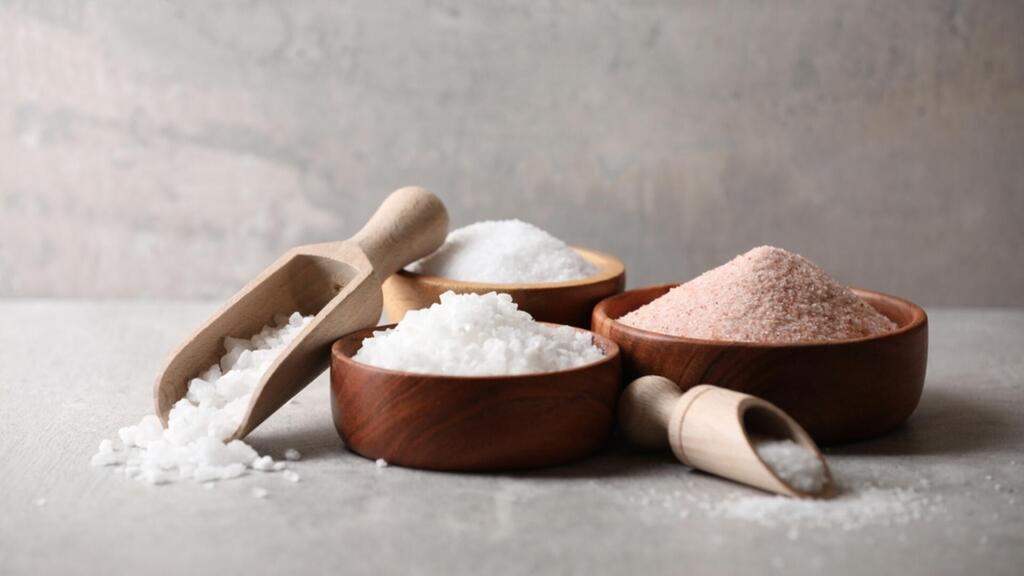
Sodium hides in everyday foods, raising serious health risks while drawing far less attention than sugar
(Photo: New Africa/Shutterstock)
Take specialty salts, for example, a category that has seen notable growth. Products such as Himalayan salt, marketed as more natural because it is mined from mountains, natural sea salt and similar varieties make up 21% of the salt sold annually, but account for 70% of the money Israelis spend on salt.
A kilogram of regular table salt under price control costs an average of 1.90 to 2.10 shekels ($0.52-$0.57), while Himalayan salt ranges from 9.50 to 25.90 shekels ($2.60-$7), depending on the type and where it is bought. The most expensive is black Himalayan salt.
“In all cases, this is sodium, and the harms of excessive consumption are known: high blood pressure, cardiovascular disease, stroke and kidney failure,” said clinical dietitian Mariana Orbach, director of the Dan-Petah Tikva clinical nutrition unit at Clalit Health Services. “The minerals promised by most specialty salts are negligible, and even the natural processing does not convince me.”
The same problem appears in gluten-free products, whose consumption has jumped 35% in recent years. The range of gluten-free products on shelves has expanded, and the market is booming globally, but as variety has grown, so has sodium content. Manufacturers are trying to improve flavor and texture and compete with regular products.
Gluten-free tortillas, for example, contain 500 to 900 milligrams of sodium per 100 grams, compared with 350 to 780 milligrams in tortillas containing gluten. Gluten-free crackers contain 600 to 900 milligrams of sodium per 100 grams, compared with 450 to 700 milligrams in regular crackers.
Pizza, hummus and cottage cheese
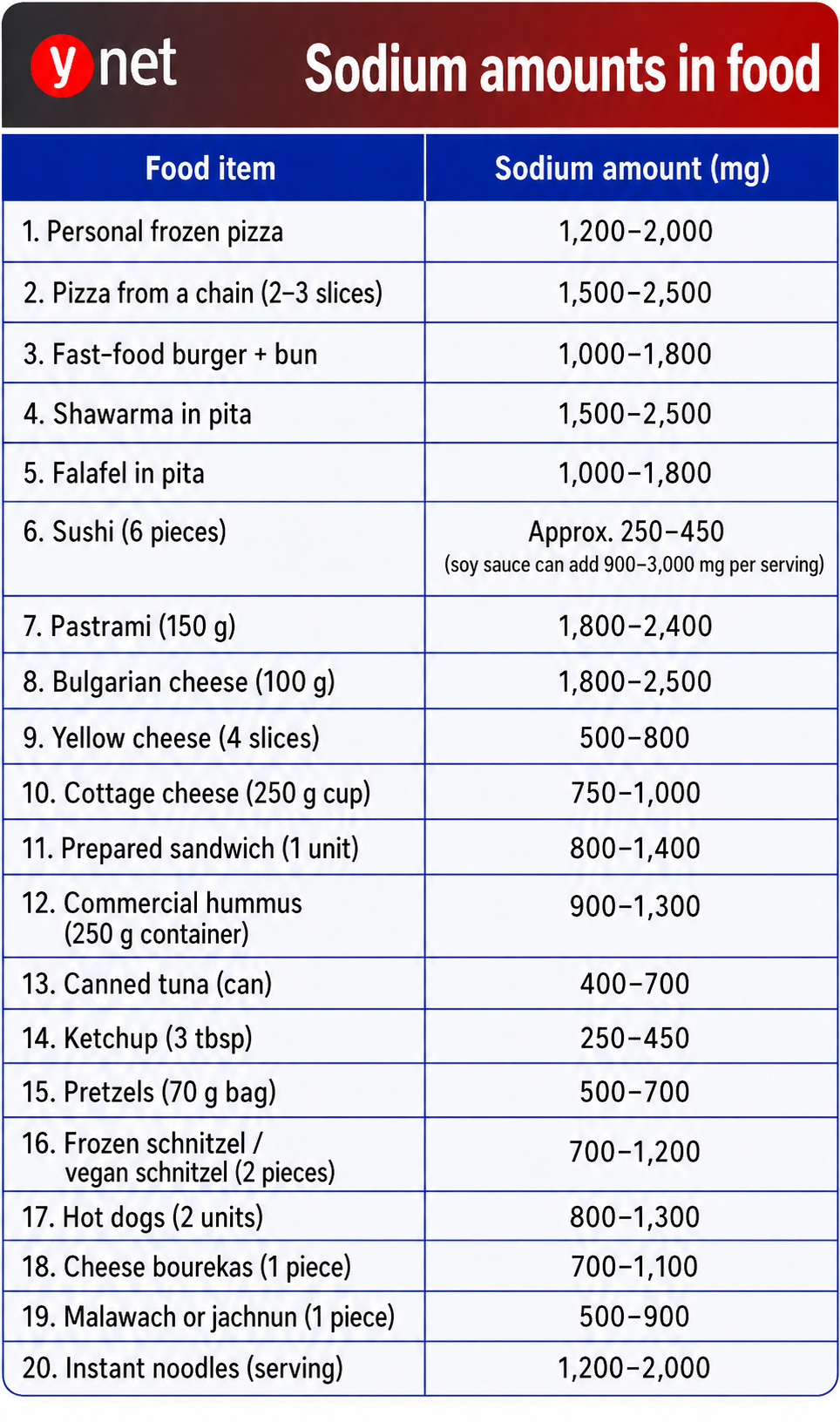
The Health Ministry recommends that adults consume no more than about 2,300 milligrams of sodium per day. But how many people notice that one serving of instant noodles, a generous portion of pastrami or sushi eaten with soy sauce can easily reach, or even exceed, the recommended daily intake?
Seasoning mixes used generously at home can also be sodium traps. Za’atar and ras el hanout, often added to meatballs, usually contain salt. Meat and poultry are another source of high sodium, partly because of koshering and partly because water and salt are injected into processed meats to increase weight and volume.
The Health Ministry recommends that adults consume no more than about 2,300 milligrams of sodium per day
(Photo: itor/Shutterstock)
“Salt absorbs water,” Orbach explained, adding that the final processed products can appear similar to fresh meat or poultry.
An attempt to map foods that many consumers do not suspect as major salt sources produced several surprises, including cottage cheese. A full container can reach one-third and sometimes nearly half of the recommended daily sodium intake. With the popularity of high-protein diets, many people eat at least one container a day.
Salted cheeses have also become more popular, with sales in the category rising 17% over the past eight years, driven by the same protein trend. The sodium price is steep: cheeses such as Bulgarian-style cheese, feta and halloumi contain 800 to 2,000 milligrams of sodium per 100 grams.
Packaged hummus is another example. A 250-gram container can contain 1,000 milligrams of sodium or more. Sauces such as soy, teriyaki and ketchup are also sodium boosters.
Pizza, one of the most popular foods among children, whether frozen or ordered from a chain, is often especially salty. Toppings such as pepperoni, olives and Bulgarian-style cheese add hundreds more milligrams of sodium. Even cereal is not innocent. A 40- to 50-gram bowl can contain 250 to 500 milligrams of sodium before milk is added.
A summer spike
Is it any wonder that a Health Ministry examination conducted in 2016, with findings published in 2021, placed Israel in the medium-high range globally for daily sodium consumption, with 9.6 grams among adults and 12 grams among teenagers? That is two to three times the recommended daily intake.
No serious survey has been conducted on the subject since then, and sodium consumption is assumed to have increased.
About 75% of the salt Israelis consume comes from processed food, while 15% comes from the salt shaker. Table salt sales have risen 8% in recent years, while consumption of high-sodium products climbs especially during the summer vacation months.
Wolt says its leading delivery categories, hamburgers, sushi, shawarma and pizza, all high in sodium, remain stable during July and August, but consumption patterns expand.
“During routine periods, most lunch orders are concentrated in earlier hours and in business areas,” the company said. “In the summer, there is a clear shift to later hours and a broader distribution of order locations. This stems from changes in the daily routine: summer vacation, children at home and more meals defined as family meals rather than office meals. In the evening, pizza consistently strengthens as part of a pattern of group and family consumption.”
For Hen Nissim, 36, a married mother of two from Ein HaEmek near Yokneam, healthy eating for her children, ages 3 and 5, is a major priority.
“I am health-conscious. My husband and I are fighting to maintain our weight, I exercise regularly and I also find myself battling the children over a healthy lifestyle,” she said. “But I fail more than once with high-sodium products, and when summer comes, it gets worse.”
One reason is the family pool.
“Friends and children come over, and like many children, they say: ‘Mom, pizza, Mom, hot dogs,’ and I cannot always say no,” she said. “When I try to avoid making schnitzel and fries at home or ordering hamburgers, the children react. My older daughter sometimes says, ‘But at Yagil’s house I ate fries, his mother ordered him a hamburger.’ And the younger one adds: ‘We want hot dogs.’ I admit it is hard for me to hear that, and I give in. Not to mention children’s meals at hotels, which are based on hot dogs, schnitzel and fries. When we come back from a weekend like that, I need to detox the children.
“At birthday parties, both sweet and salty foods go on the tables. In the summer, it can reach at least three or four times a day of high-sodium products, including August, when we need help from the grandparents. The whole environment is looking for what is easy, the salty food you can prepare quickly in the Ninja,” she said.
“Israelis love salty food,” said chef Gilad Dolev, a food research and development expert.
Orbach added: “We are drawn to salt because of the two minerals it contains, sodium and chlorine, which the body needs but cannot produce on its own.”
The Israeli food industry is drawn to large quantities of salt not only to satisfy Israeli taste, but also for other reasons.
“Salt helps with flavor and texture, and it serves as a cheap filler, alongside sugar and water, in place of more expensive ingredients the industry wants to use less of,” Dolev said. “In corn schnitzel, for example, using salt helps reduce the amount of corn kernels, which are twice as expensive. In gluten-free products, it helps build texture.”
The red label line
The sodium threshold that triggers a red warning label is 400 milligrams per 100 grams. The system worked. Food manufacturers made efforts to reduce sodium content in many products, including popular snacks, down to just below the red-label threshold.
That is what we found when checking sodium content in Bamba, Tapuchips and Doritos, which contain 350 to 397 milligrams of sodium. But why is sodium use still so high? Globally, the fight against sodium lags far behind the fight against sugar.
The World Health Organization recently published its “SHAKE the Salt Habit” document, which presents recommendations to regulators on how to help reduce salt consumption in the population. The organization treats sodium reduction similarly to sugar reduction and recommends several steps: reformulation, including maximum salt thresholds for high-sodium food categories; front-of-package warning labels and interpretive labels; oversight of salt-related claims; restrictions on high-salt food availability in schools and public institutions; menu labeling in restaurants and removal of salt shakers from tables; restrictions on advertising and marketing high-salt products to children under 18; taxation of high-salt products; public campaigns to encourage salt reduction; and promotion of reduced-sodium substitutes.
The first two recommendations have already been implemented in Israel. The Health Ministry launched important initiatives to reduce sodium in packaged foods, led by the red warning labels. They were followed in the past by an 11% reduction in sodium consumption among adults and a 19% reduction among teenagers. A voluntary agreement was also signed with food companies for a continued gradual reduction of sodium in food products.
But over the past three years, there has been a sense of stagnation in voluntary sodium reduction by food companies, which claim they have reached their technological and taste threshold. In other words, they have barely reduced sodium further in order not to harm flavor or shelf life.
The sodium threshold that triggers a red warning label is 400 milligrams per 100 grams
(Photo: Roselynne/Shutterstock)
Some countries are trying other methods. Thailand is promoting a sodium tax. Hungary has had a tax since 2013, known as the “chips tax,” on snacks and processed products high in sodium. Slovenia is considering raising VAT on sweet and salty foods.
Do such taxes help? Orbach supports taxation.
“Anything that costs the consumer more reduces consumption,” she said. “Raise prices on undesirable products and give subsidies for vegetables and fruit,” she recommended to regulators.
Can consumers truly rely on regulators and manufacturers to reduce sodium consumption, or must they become the gatekeepers? There is no doubt, Orbach said, that people must take responsibility for what they put in their mouths.
For consumers of kosher meat and poultry, she recommends soaking meat or chicken in water for at least an hour after purchase and then rinsing it again.
“The sodium content will decrease,” she said. “Salted cheeses that sit in brine should also be removed from the package and rinsed.”
Set limits for children
“The solution is more awareness,” Nissim said. “Understanding the meaning of the ingredients and how unhealthy they are. Once you understand it intellectually, awareness also increases, and as happened with cigarettes, people will begin to avoid them or at least reduce consumption.”
Orbach recommends that parents set boundaries.
“In my view, it is very important to decide how far you go with children’s demands,” she said. “There is no reason to surrender to children’s pressure. Every family can determine its own alternatives. Summer vacation is a major challenge for parents in many ways, so the recommendation is to cook once a week for the whole week, freeze the food, take it out as needed and leave nutritious, healthy food for the children every day.”
“Difficult but possible,” agreed Michal Ben Oved, 43, from Yavne, a married mother of two children ages 8 and 4½. A biologist by background who worked in research and industry, she knows the food industry’s tendencies well.
“My children like salty food, and I manage their desire for it in a balanced way,” she said. “Hamburgers are only fresh meat that the butcher cuts and grinds in front of me. I read ingredients and buy accordingly. I definitely try to limit the amounts of sugar and salt they consume because it is not healthy. I do bring snacks into the house, because today you cannot make everything disappear from children, but only small bags. I make popcorn the way we did in childhood, in a pot. We do not drink sweetened beverages at home.
“Unfortunately, when they are in after-school programs, I cannot control the amounts of sugar and salt, especially in lunches. That is a problem.
“At birthday parties, I ask that they not overdo it. I will not say it is not hard for them. My older son often comes home with the sentence, ‘But his mother gave him,’ about a friend. My explanation is: ‘I am not responsible for his mother, I am responsible for you and for your health.’ For now, he accepts it. I do not know what will happen in another two or three years, but I believe everything they experience in childhood sets a path for eating properly. Even if they rebel at some point against the abundance, as adults they will know what to return to.”
There is some good news. Dolev said the institutional food market, especially food services for children, is reducing salt use.
“That will also enter the private market,” he said.
Orbach would like Israel’s catering sector, especially in daycare settings and schools, to adopt the Finnish model.
“There, government representatives come to schools and take samples of the food products planned for children to test sodium and sugar quantities,” she said. “Can you see that happening in Israel?”
Not really. In the meantime, consumers will have to guard their own sodium intake, and their children’s.
The Health Ministry said in response: “We are working on multiple levels to reduce sodium consumption in the population. Every year, the sodium threshold in various foods is updated, and regulatory measures are being examined to reduce children’s exposure to advertising and marketing of harmful food. The ministry promotes public information activity on healthy nutrition and will continue to examine additional measures to reduce sodium.”